
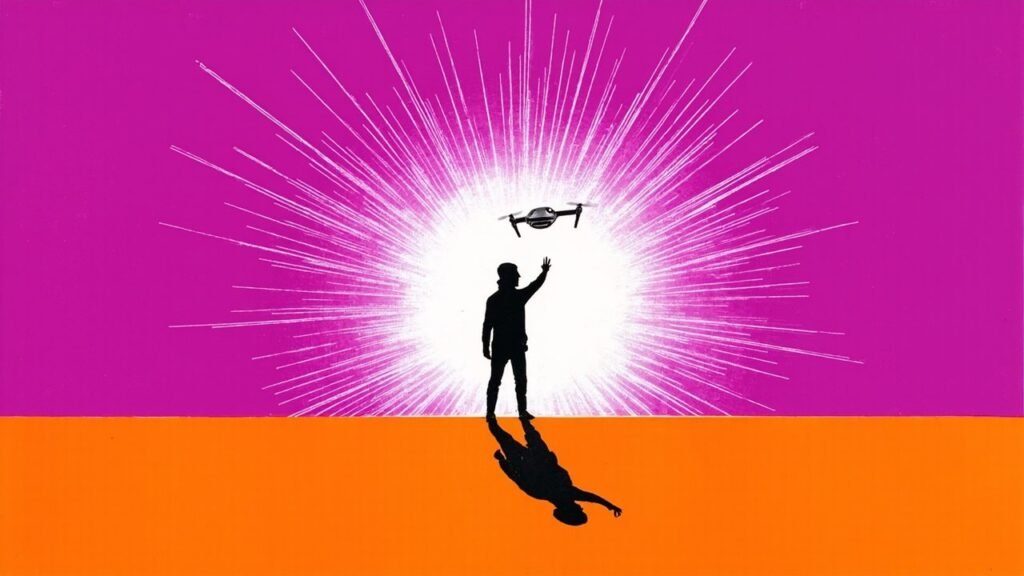
Amazon’s Ring announced Ring Robotics security robots on Tuesday, unveiling a flying indoor camera for homes and a roving security robot for businesses. The Ring Drone Cam is designed to move from room to room, investigate activity and alert users when something appears wrong. The Ring Rover Cam offers continuous 4K video, a retractable periscope camera and patrol automation for commercial spaces. Both systems use Ring’s AI Pilot software to map environments, choose patrol points and navigate around obstacles.
Ring Robotics security robots: A flying camera built for quick investigations
The Ring Drone Cam is a small quadcopter for indoor security. Ring says it weighs 165 grams and carries a 2K camera, two front LEDs and a 1080p underside camera. The device also has a 148-degree field of view, allowing its mobile position to cover 360 degrees around a room. Its LEDs are intended to support night monitoring, low-light recording and deterrence, with Ring comparing the moving lights to a security guard carrying a flashlight.
The drone can investigate triggers from Ring sensors, including motion, a door opening, a water leak or an alarm sounding. It can also fly on preconfigured schedules or be dispatched on demand through the Alexa Home Map. According to Engadget, users can select a destination on a 3D map, after which the drone charts its own course. The Verge reported that the Drone Cam is intended for indoor use and that its camera is shuttered while it is docked.
Battery life is the main constraint on the product’s usefulness as a continuous guard. Amazon said the battery will support about eight to 10 minutes of air time, depending partly on altitude and the effort required from the propellers. The Verge separately reported a claimed range of five to eight minutes. Eight minutes of charging will provide enough power for 1 minute of flight time. Without a Wi-Fi connection, the drone can only land, making cloud connectivity and dependable charging essential to its security role.
Ring will retail the Drone Cam for 249.99 dollars and begin shipping it on January 27, 2027. Engadget described the shipping device as roughly a quarter the size of the model demonstrated at CES in 2023. The Verge said it launches in the US, requires a Ring Protect plan for video storage and advanced features, and is still in the process of obtaining FCC certification.
Why the consumer price nearly derailed development
Ring founder Jamie Siminoff said the company has been working on the drone concept since 2016, before Amazon acquired Ring in 2018. The concept was first announced in 2021, but products were placed in boxes without shipping because earlier iterations did not work well enough, according to Engadget. Another false start followed in 2025, when the company needed more sensors and computing power, which in turn required greater power and larger batteries.
Those changes created a difficult engineering cycle. Siminoff said the added weight required the drone to fly harder, producing safety concerns that led to larger shrouds. The shrouds then reduced airflow and impaired flight performance. Fitting all of the required technology into a practical consumer device might have pushed the retail price past 5,000 dollars, which Siminoff said would make it wrong for consumers.
The eventual answer was cloud processing and AI Pilot. Ring said that moving more intelligence to the cloud allowed the company to reduce the drone’s weight and price. The trade-off is dependence on internet access. The Verge said this creates a potential failure point for a home security product, because an AI-piloted drone that depends on the cloud cannot continue autonomous navigation without a connection.
Rover Cam targets business patrols
The Ring Rover Cam is the commercial counterpart to the flying camera. Designed for businesses such as warehouses and small to medium-sized workplaces, it can patrol custom routes on a schedule, respond to disturbances and be sent to selected locations. It streams continuous 4K video through the Ring mobile app and can begin recording when it detects person motion, even while docked.
The robot’s camera sits on a periscope that can extend up to 4 feet, helping it see over obstacles. The body can also spin 360 degrees. Ring includes a siren, speaker and microphone for two-way communication, while the camera can stream and record while the Rover is travelling. Its light tower projects a blue ring onto the ceiling so users can locate it quickly and flashes red when the siren is active. Engadget said the devices are designed to deter unwanted people, not merely monitor them.
Ring Rover Cam will begin shipping on December 16 for 999.99 dollars. It is based on the Amazon Astro robot, which Amazon launched in 2021 as a domestic helper before repurposing it as an enterprise security product. The Astro business version cost 2,350 dollars and was discontinued in 2024. Ring founder Jamie Siminoff said the Rover Cam was originally inspired by feedback from Amazon Astro customers who valued roving security most.
AI Pilot turns exploration into patrol planning
Both Ring Robotics security robots use AI Pilot, a system combining device cameras, specialized vision models, on-device sensors and cloud processing. Ring says the software enables the devices to see, think and navigate autonomously. During setup, users can carry the Drone Cam through a space or allow the Rover Cam to explore independently, after which AI Pilot turns what the devices see into a floor plan.
The system identifies rooms and suggests patrol points such as side doors, windows, a register or a long corridor. It then calculates an efficient route to a selected point and responds in real time by navigating around furniture, shelving and other obstacles. This capability gives mobile cameras an advantage over fixed devices when an incident occurs in a location that ordinary sensors cover but a stationary camera cannot easily inspect.
The software also links both devices to Ring alarms and sensors. A trigger can send the selected robot to a patrol point, livestream the scene and record it in the Ring app. For users managing several fixed cameras, the practical benefit is mobile coverage without installing a camera at every doorway or corridor. For business operators, it offers a way to automate recurring checks, particularly after closing time.
Encryption and visible hardware shape the privacy case
Privacy is central to Ring’s pitch for the new category. Amazon said privacy is not just a feature of Ring Robotics, it is the default, and that the devices are designed to be seen and heard. The Drone Cam’s camera is physically shuttered when docked, while its noisy propellers make covert flight conspicuous. The Rover Cam has a bright light tower intended to remain easy to spot, and its siren provides another visible deterrent.
Videos from both devices are protected by TAKE, short for Throw Away the Key Encryption. Ring described it as the company’s strongest default encryption yet. The Verge reported that TAKE rotates encryption keys every five minutes and deletes Ring’s copies after 24 hours, limiting Amazon’s access while supporting cloud features such as smart alerts and AI-powered video search. It remains unclear whether buyers will have an option for local video storage.
These controls do not settle every question raised by cameras that can map interiors, move through rooms and depend on cloud processing. TechCrunch noted that Ring’s cameras have long faced criticism over unofficial surveillance networks and potential access by police departments. The Rover Cam is also more capable of roaming beyond a fixed camera’s position, while the Drone Cam can cover angles that stationary devices cannot. The visible deterrent hardware, shuttered dock camera and rotating encryption keys may reduce some concerns, but cloud dependence and possible local-storage limitations remain relevant to prospective buyers.
Two devices with different commercial roles
The Ring Robotics security robots announcement is significant less because the products establish a new category than because they turn several years of experimentation into purchasable devices. The Drone Cam offers a 249.99-dollar indoor option for scheduled checks, sensor-triggered investigations and on-demand viewing. Its short flight time and reliance on cloud processing make it better suited to rapid verification than uninterrupted surveillance.
The Rover Cam occupies a different market. Its 999.99-dollar price, continuous 4K stream, periscope camera, two-way audio, siren and scheduled route patrols target commercial operators that want mobile observation beyond ordinary wall-mounted coverage. The lower price of the revived Astro concept also makes the business product more approachable than the earlier 2,350-dollar version.
For Ring Robotics security robots, the immediate tests are practical rather than conceptual. Buyers will need to judge whether the Drone Cam’s limited battery life fits their routines, whether cloud navigation remains reliable and whether subscriptions make the services worthwhile. Businesses will need to compare autonomous patrols with the cost and consistency of conventional guards or fixed cameras. The devices may not replace every traditional security tool, but they show how camera networks, sensors, cloud models and mobile machines are beginning to operate as one coordinated system.