
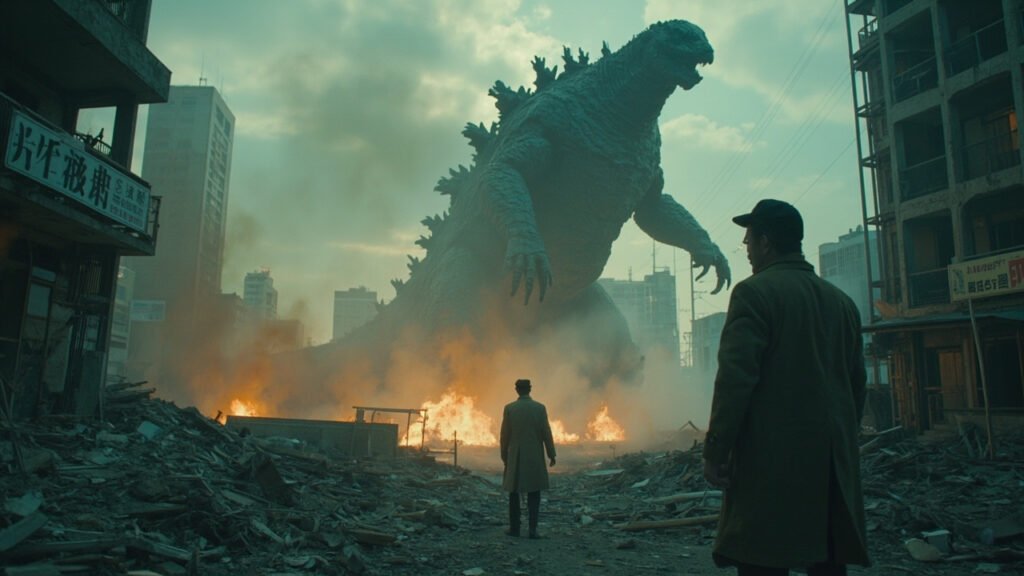
It is rare for a film sequel to match or even surpass its predecessor. The Godfather Part II and Terminator 2: Judgement Day are the best known examples on a pretty short list. Godzilla Minus Zero deserves to be added to it. Director Takashi Yamazaki’s sequel to his critically acclaimed Godzilla Minus One (2023) delivers everything one could want in a Godzilla movie: human pathos, great special effects and, ultimately, two giant kaiju duking it out over who gets to destroy Japan, and eventually the world, the most.
Yamazaki made a deliberate effort in Godzilla Minus One to return the monster to its filmic roots. He set the story in postwar Japan and used Godzilla as a symbol of the Japanese perspective on the 1940s nuclear holocaust, while also exploring deeply human themes of guilt and redemption. The first film centered on kamikaze pilot Kōichi Shikishima, played by Ryunosuke Kamiki, who struggled with survivor’s guilt after he failed to take action when Godzilla attacked the Japanese base on Odo Island in 1945.
That emotional foundation gives Godzilla Minus Zero a demanding standard. A successful sequel must preserve the qualities that made its predecessor work while finding new ground for its characters and conflict. Yamazaki faces an especially difficult creative challenge because the first film already combined a devastating historical setting with a personal story about guilt, sacrifice and redemption. The sequel therefore needs more than another impressive monster appearance. It needs to deepen the human drama without losing sight of the scale and spectacle that define the franchise.
Based on the supplied account, Godzilla Minus Zero succeeds on that central test. Human pathos remains central, the special effects meet the lofty expectations of a Godzilla movie and the climax provides the promised confrontation between two giant kaiju. The result is not simply a larger follow-up to Godzilla Minus One. It is a sequel that appears to match the qualities that made the original critically acclaimed.
The importance of Shikishima’s story should not be understated. Godzilla Minus One was not merely a disaster film built around destruction. Its use of the monster as a representation of Japan’s perspective on the 1940s nuclear holocaust linked the creature to collective trauma, while Shikishima’s failure to act on Odo Island grounded that history in individual remorse. The strongest Godzilla stories have often used the kaiju as a vehicle for questions about humanity, responsibility and the consequences of catastrophe.
Godzilla Minus Zero appears to carry forward that approach rather than abandoning it. The supplied review describes the film as everything one could want in a Godzilla movie, an assessment that places character emotion alongside visual spectacle instead of treating either as sufficient on its own. That balance matters because a sequel can easily lose credibility by making its human drama an excuse for more action, or by using action to avoid the emotional consequences established by the first film.
Yamazaki’s apparent achievement is also notable because Godzilla Minus One was critically acclaimed. Matching such a film would itself be difficult. Surpassing it, as the review argues the sequel has done, requires the new story to feel like a necessary extension of what came before rather than a separate attempt to reuse the same formula. The survival of themes such as guilt and redemption suggests that the sequel is connected to the moral and historical concerns at the heart of the original.
The stakes escalate in a way that fits the material. Godzilla Minus One draws on the trauma of the 1940s nuclear holocaust and a Japanese base attacked on Odo Island in 1945. Godzilla Minus Zero moves toward two giant kaiju competing over who can destroy Japan, and eventually the world, the most. The progression is a natural expansion of the first film’s premise, in which a single monster’s assault carried weight because it was tied to a specific history and a survivor’s conscience.
The review gives particular praise to the film’s special effects, although its verdict is broader than a technical assessment. Calling Godzilla Minus Zero everything one could want in a Godzilla movie implies that the film satisfies the genre’s central attractions while maintaining the dramatic substance of its predecessor. Human pathos, great special effects and a climactic battle among two giant kaiju form the review’s clearest reasons for placing the sequel alongside The Godfather Part II and Terminator 2: Judgement Day.
That short list contains one of cinema’s most acclaimed continuations. The comparison raises the standard for any sequel, since the new film must justify its existence through both quality and continuity. Godzilla Minus Zero appears to clear that standard by extending Yamazaki’s postwar vision, retaining the focus on difficult human choices and delivering the destructive spectacle expected by audiences.
There is another useful lesson in the sequel’s reception. A franchise film does not need to surrender the qualities that gave its original film meaning in order to become a crowd-pleasing continuation. Godzilla Minus Zero can offer two giant kaiju duking it out while still foregrounding pathos, and it can connect spectacular destruction to a story shaped by guilt and redemption rather than presenting spectacle as an end in itself.
The supplied account includes an advance warning that discussion of Godzilla Minus Zero contains spoilers, with no major reveals until after a gallery. Although the available material does not detail the sequel’s later plot, its central qualities are already clear: Yamazaki has expanded the scope of the conflict, preserved the emotional foundations of the first film and delivered effects and kaiju action capable of satisfying the most familiar expectations of the genre.
Whether Godzilla Minus Zero truly deserves permanent recognition beside The Godfather Part II and Terminator 2: Judgement Day will ultimately depend on how its complete story resolves. The early judgment is strongly favorable, based on human pathos, great special effects and a confrontation that turns two giant kaiju into competing agents of destruction. If those elements remain integrated, Yamazaki will have done something genuinely unusual: produced a sequel that does not merely follow a superior predecessor, but matches it on its own terms.
Does Godzilla Minus Zero deliver enough emotional weight alongside its kaiju spectacle to stand among the truly great film sequels?