
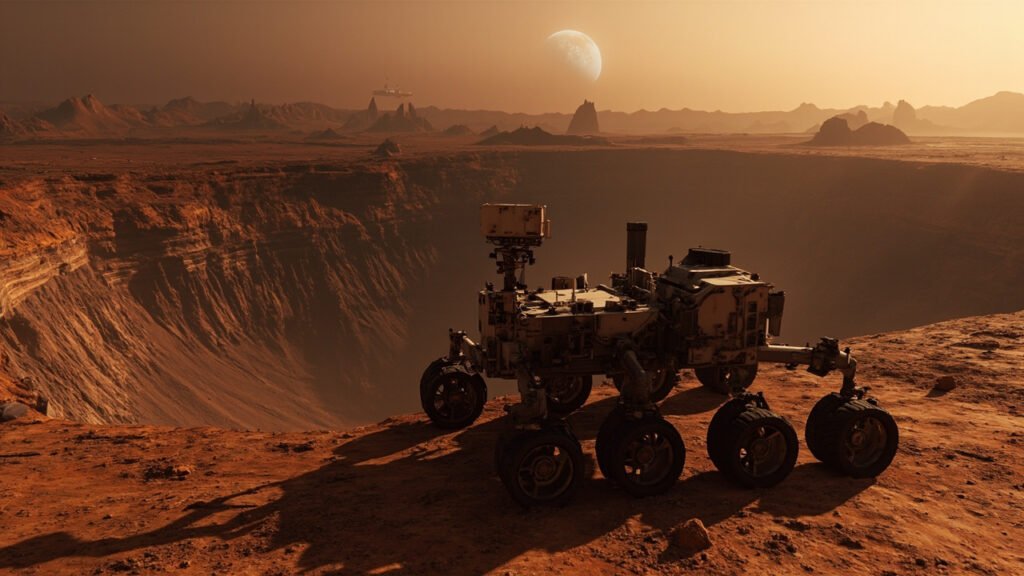
Two of NASA’s four active Mars missions have suspended science operations after separate technical issues emerged in recent weeks, leaving the aging planetary fleet operating at reduced capacity. The affected missions are NASA’s Perseverance rover and Odyssey orbiter, both of which remain beyond their original design lifetimes.
Perseverance is in its sixth year exploring the surface of Mars and has collected rock and soil samples intended for eventual return to Earth. Its current work is focused on the rim of a crater that once contained an ancient lake of liquid water, an environment that may hold important clues about the planet’s past.
The rover’s suspension of science operations stems from its communications system. Perseverance carries two redundant UHF radios for high-rate communication with a fleet of orbiters that relay data to Earth. It also has a separate X-band system capable of direct-to-Earth communications, although that link operates at a lower data rate.
The issue has therefore affected the rover’s ability to carry out its surface mission as planned, although experts does not describe the specific malfunction or provide a timetable for restoring normal science work. The two UHF radios and the separate X-band arrangement were designed to give Perseverance more than one route for moving data back to Earth, but the reported problem means its communications system has not performed as expected.
Odyssey, meanwhile, reached orbit around Mars in 2001 and is the longest-lived Mars mission in history. experts identifies the orbiter as one of the two missions that have suspended science operations, but does not detail the separate technical issue affecting it or explain whether that issue is connected to the rover’s communications problem.
Together, Perseverance and Odyssey represent half of NASA’s four missions operating at Mars. Their suspensions come as both spacecraft operate beyond their original design lifetimes. That makes the recent disruptions a test of aging hardware, backup communications paths and the ability to sustain exploration when individual systems encounter problems.
For Perseverance, the immediate stakes are both operational and scientific. The rover has already gathered rock and soil samples for eventual return to Earth, while its present investigation of the ancient lake crater could expand the evidence available about liquid water on Mars. Halting science operations can interrupt that work and delay the collection and transmission of information from the surface.
For Odyssey, the main significance lies in its role as the longest-running mission at Mars and another important member of the broader orbital fleet. experts notes that Perseverance relies on orbiters to relay high-rate data to Earth, but it does not state whether Odyssey is among the specific orbiters affected or whether its suspension has contributed to the rover’s communications difficulty.
The separate X-band system remains available for direct communication with Earth at a lower data rate, according to experts. That fallback offers a path for transferring some information even while the UHF system is experiencing trouble. Its lower capacity means it cannot fully replace the high-rate relay arrangement, leaving the extent of Perseverance’s operational constraints unclear.
NASA has not been described as abandoning either mission, and the outages are described as hopefully temporary. Even so, the simultaneous suspension of science work by Perseverance and Odyssey highlights the concentration of risk within a small group of spacecraft operating far from Earth. Repairs or software adjustments must also work across vast distances, with instructions sent to the vehicles and results returned through limited communications routes.
The wider fleet still includes NASA’s four missions operating at Mars, with Perseverance and Odyssey accounting for 2 of them. experts does not identify the other 2 missions, explain their status or provide further information about the technical faults. It also does not specify when either suspended science campaign might resume.
Perseverance’s sixth year on the surface of Mars is therefore marked by a temporary setback rather than the end of its sample-gathering mission. The rover continues to hold material gathered for eventual return to Earth, but its crater investigation depends on a communications system encountering difficulties. Odyssey’s pause adds a separate complication for a spacecraft that has operated around Mars since 2001.
Will Perseverance’s communications problem and Odyssey’s technical issue be resolved soon enough to restore normal science operations across half of NASA’s Mars fleet?