
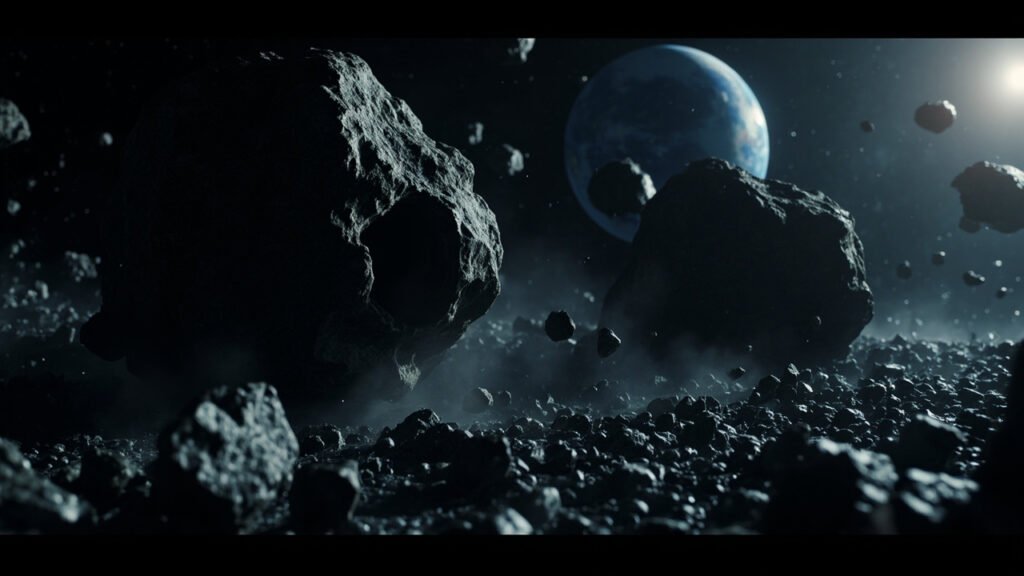
The European Space Agency’s Hera spacecraft has revealed a dramatically altered scene around asteroid Dimorphos, where NASA’s DART deflection experiment left a stadium-sized crater, a massive debris cloud and an orbit in increasingly wild motion. The findings could improve efforts to protect Earth from a future asteroid impact.
Hera reached the vicinity of Dimorphos and its larger companion, Didymos, after a two-year journey from Florida. The spacecraft’s first observations show that DART did more than carve a crater into the roughly 500-foot-wide Dimorphos. The car-sized impactor nearly reshaped the asteroid itself, challenging scientists who had expected the collision to produce either a conventional crater or a more limited change in its form.
NASA dispatched DART four years ago on what the space agency described as a suicide mission. The solar-powered probe struck Dimorphos in September 2022 at more than 13,700 mph, releasing some 10 billion joules of energy. The impact shortened Dimorphos’s 12-hour orbit around Didymos by about 33 minutes, or 25 times the most conservative expectation, according to the mission results.
Those orbital measurements, obtained with telescopes, established that the deflection experiment had worked. They did not reveal the physical consequences of the collision, however, because DART was destroyed and its final images stopped before the impact. Faraway telescopes and a small CubeSat briefly detected the impact flash, leaving scientists without a close view of the damage.
“We knew right away that the impact was successful, that DART made a really, really large mess,” said Sabina Raducan, a planetary scientist at the International Space reports Institute in Bern, Switzerland. “However, we didn’t really know what kind of mess. We were still missing pieces of the puzzle.”
Hera was designed to supply those missing pieces. ESA released the spacecraft’s first views of the scar left on Dimorphos, showing a crater nearly as large as the asteroid itself. Images captured by Hera’s Hyperscout-H instrument also exposed hundreds of boulders moving around the Didymos-Dimorphos system. Those observations were acquired on November 6 from an approximate distance of 29.9 kilometers, and the composite image used 11 long-exposure exposures.
The debris was more extensive than scientists anticipated. A Hubble Space Telescope image taken shortly after DART’s impact had already shown material streaming behind the two asteroids, but Hera’s initial reconnaissance revealed a far larger swarm of material.
“As we approached Didymos and Dimorphos, we quickly realized the asteroids were not alone,” said Naomi Murdoch, a planetary scientist at the Institut Supérieur de l’Aéronautique et de l’Espace in Toulouse, France. “In fact, they had a lot of company.”
Hera also found that Dimorphos is no longer stable in its orbit around Didymos. Didymos, the larger asteroid, was spinning on its axis as DART observed during its final approach in 2022. Dimorphos, though, was tumbling wildly, according to the first images returned by the spacecraft.
“As Hera returned more images, it became clear that the DART impact has left Dimorphos tumbling wildly in its orbit,” said Michael Kueppers, ESA’s Hera mission scientist.
Patrick Michel, Hera’s principal investigator from Côte d’Azur Observatory in Nice, France, said the team’s initial predictions offered two possible outcomes: a crater or a reshaping of the asteroid. The observations showed that both occurred because the crater’s scale changed the asteroid’s shape.
“In fact, we did both because the crater is so large that the shape has changed. Therefore, we are in a sort of a transition between just cratering and global transformation, and we are still not sure how this can happen,” Michel said.
Didymos and Dimorphos were selected because they resemble many near-Earth asteroids. Unlike asteroids on a collision course with Earth, however, they pose no risk to the planet. The double asteroid currently orbits the Sun about 120 million miles from Earth, giving scientists a safe place to examine the consequences of an impact that changed Dimorphos’s motion.
Over the next six months, Hera will fly closer to both asteroids and gather more detailed observations. The spacecraft will also release two small sub-satellites, Juventas and Milani, which will attempt landings on Dimorphos. Their work is intended to provide data on the asteroid’s composition, internal structure and mass.
Scientists will use those measurements to reconstruct the dynamics of the DART collision four years ago. The near-Earth asteroids that might threaten Earth differ in shape, size, density and makeup, so information about Dimorphos’s physical properties will help anchor computer models designed to determine the best deflection method for different kinds of asteroids.
Michel believes that understanding the full effect of the DART impact could represent a major advance for planetary defense. “Once we understand, we have a breakthrough, which really solves planetary defense,” he said.
Whether DART’s success can be translated into a dependable response to a genuinely hazardous asteroid will depend on what Hera learns during its extended survey and from the two proposed landings. Could those observations reveal exactly why such a relatively small impact caused Dimorphos’s orbit to become so chaotic?
Could Hera’s findings give planetary defenders a reliable way to alter a threatening asteroid’s course?