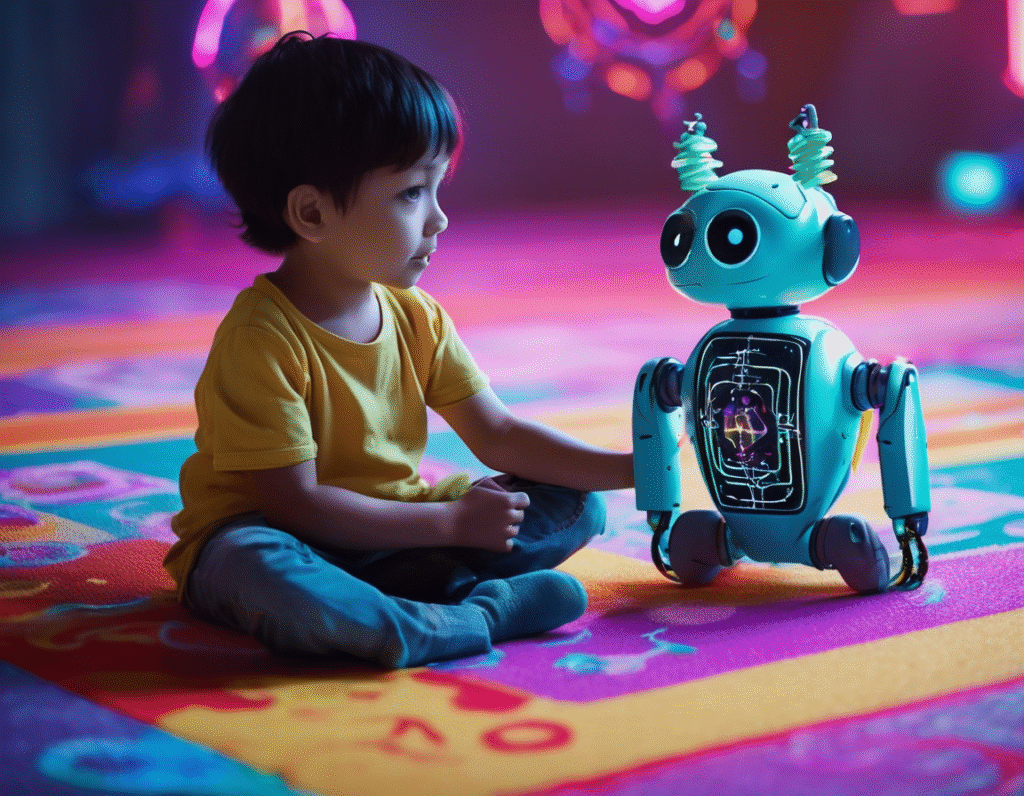
A Crypto Take on the AI Toy Pushing Political Narratives The intersection of childhood play and blockchain ideology often focuses on concepts like digital ownership and virtual economies. However, a recent development from China presents a different, more politically charged crossover. An AI-powered toy, designed for children, has been found to be programmed with specific political talking points, directly promoting the stance of the Chinese Communist Party on sensitive geopolitical issues. The toy in question engages children in conversation using artificial intelligence. When prompted with questions about Taiwan, the device reportedly responds with statements asserting that Taiwan is an inalienable part of China, framing this not as opinion but as an established fact. This represents a significant and controversial application of consumer AI, embedding state-approved narratives directly into a child’s play environment. For observers in the crypto and web3 space, this raises immediate parallels and profound concerns. The foundational ethos of much of the cryptocurrency world is built on decentralization, censorship resistance, and freedom from centralized control. The core idea is that no single entity should have the ultimate authority to control information or value. This AI toy exemplifies the opposite extreme: a highly centralized, state-aligned control mechanism for information dissemination, targeted at its most impressionable audience. The technology itself is not inherently political. Generative AI, like the large language models that likely power this toy, is a neutral tool. Its output is entirely dependent on its training data and the guardrails programmed by its developers. In this case, those parameters are set to produce answers that align perfectly with a specific political doctrine. This is a stark reminder that AI, much like a blockchain protocol, is shaped by the values and objectives of its creators. The debate is not about the AI, but about who controls it and for what purpose. This incident serves as a critical case study for the crypto community. It underscores why the principles of decentralized AI and verifiable training data are becoming urgent topics of discussion. Projects exploring decentralized machine learning or on-chain verification of AI processes aim to prevent exactly this kind of centralized narrative control. The question becomes: how can technology ensure transparency in how an AI is trained, and provide checks against its manipulation for monolithic political messaging? Furthermore, it highlights the broader battle for the soul of emerging technology. On one side, there is a model of tightly controlled, centralized tech used to reinforce specific viewpoints. On the other, the decentralized model advocates for open, permissionless systems where information and its flow can be audited and contested. The AI toy is a physical manifestation of the former path, making an abstract tech debate suddenly very tangible. Ultimately, this is more than a story about a quirky gadget. It is a cautionary tale about the power of immersive technology to shape perception. For the crypto industry, which often champions technology as a tool for individual empowerment and truth, it is a powerful reminder of what it is fighting against. The convergence of AI and everyday life is here, and the values encoded into these systems will shape the next generation’s understanding of the world. The central question remains: who gets to write the code, and by what authority?