
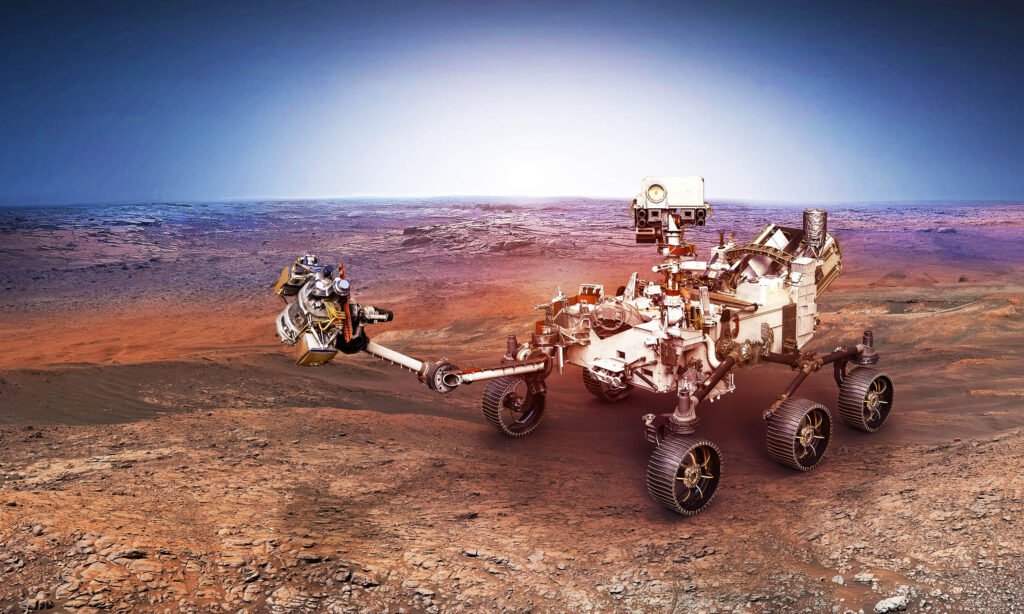
NASA’s Perseverance rover has made history by completing the first-ever drive across Mars using routes entirely planned by artificial intelligence. This milestone marks a significant leap forward in autonomous spacecraft navigation and opens new possibilities for future interplanetary missions.
Traditionally, every movement of Mars rovers has been carefully planned by mission controllers on Earth, with commands transmitted through the Deep Space Network with significant time delays. The new AI-driven system allows Perseverance to analyze its surroundings and chart optimal paths in real-time, dramatically reducing the time between decisions and actions.
## How the AI Navigation System Works
The autonomous navigation system, developed by NASA’s Jet Propulsion Laboratory, utilizes a combination of stereo cameras, lidar sensors, and machine learning algorithms to create detailed 3D maps of the Martian terrain. The AI processes this visual data to identify obstacles, assess terrain stability, and calculate the most efficient path forward.
Unlike Earth-based navigation, where GPS coordinates provide precise positioning, Mars rovers must rely entirely on visual odometry and inertial measurement units. The AI system enhances these traditional methods by learning from thousands of images of Martian terrain, enabling it to recognize safe and dangerous surfaces with remarkable accuracy.
## Implications for Future Mars Missions
This successful demonstration validates the viability of fully autonomous exploration vehicles for future missions to Mars and beyond. NASA scientists envision fleets of AI-navigated rovers that can explore vast regions of the Red Planet without constant human supervision, dramatically expanding scientific discovery potential.
The technology also has Earth applications, potentially improving autonomous vehicle navigation in challenging environments and advancing robotic systems used in disaster response and exploration.