
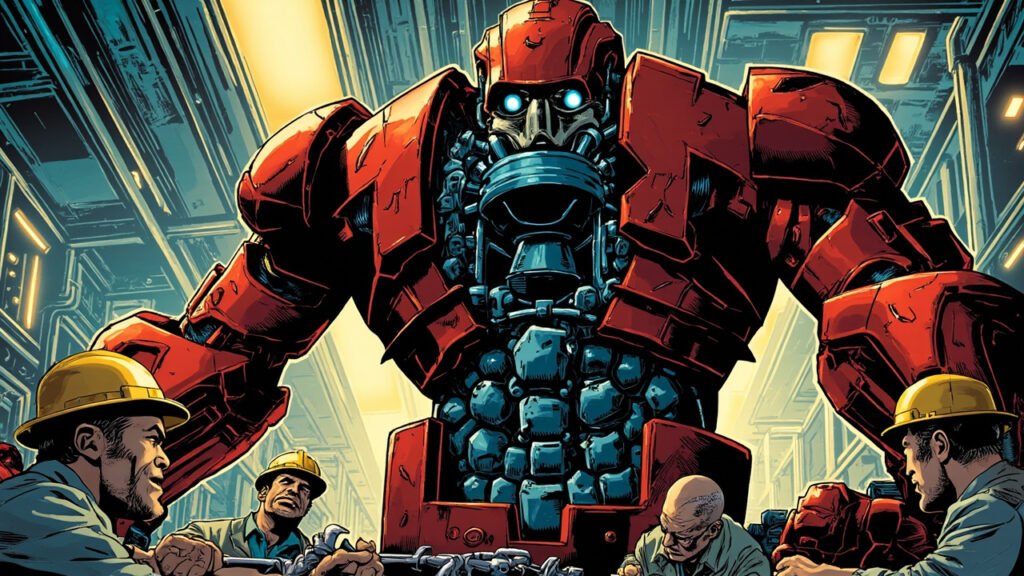
Ford Motor Company has quietly admitted that its bet on artificial intelligence to catch manufacturing defects ahead of time did not work, and the automaker is rehiring 350 veteran engineers to take the job back. Chief operating officer Kumar Galhotra told journalists that Ford had been relying more and more on automated quality systems and that the results fell short of expectations. The reversal is one of the most candid acknowledgements from a major manufacturer that today’s AI still needs the kind of human pattern recognition that decades of mechanical engineering experience produce.
The decision carries weight well beyond Ford’s assembly plants. The AI failure in quality control comes at the moment when every carmaker is racing to deploy machine learning across design, supply chain, and driver assistance, and Wall Street is valuing automotive AI as the next frontier of margin expansion. Ford’s pivot to people suggests the gap between AI promise and AI performance on the factory floor may be wider than vendor pitches admit.
What Went Wrong Inside Ford’s Plants
Charles Poon, Ford’s vice president of vehicle hardware engineering, was unusually direct about the cause. Mistakenly, the company thought that by just introducing artificial intelligence and ingesting the design requirements, the result would be a high-quality product. The automated systems ingested reams of design rules and historical defect data, but they did not reliably flag the kinds of subtle failures that a seasoned engineer would catch in seconds.
That is the gap Ford is now trying to close. The rehired specialists, some returning from retirement, others coming back from suppliers, are being asked to hunt for failure points before a part ever reaches the plant floor. Their job is to look at the kinds of design, tolerance, and supplier issues that the AI systems were missing, and feed that knowledge back into the training loop.
The ‘Gray Beard’ Strategy
Ford is calling the rehired group gray beard engineers, and the term captures both the experience and the skepticism they bring. The veterans are training younger staff, walking the assembly lines, and reprogramming the AI tools so the next round of automated checks actually works. The strategy is human in the loop at every critical decision, with AI as an accelerator rather than a replacement.
- 350 veteran engineers brought back, some from retirement and some from suppliers.
- Quality systems are now supervised by humans hunting for failure points before production.
- Veteran engineers are training junior staff and retraining the AI models on real defect patterns.
- Warranty and recall costs are falling, with CEO Jim Farley calling the savings a tailwind worth hundreds of millions of dollars.
The Payoff Is Already Showing
The numbers from Ford’s quality dashboard support the strategy. CEO Jim Farley said the rehired engineers have already contributed hundreds of millions of dollars in cost tailwinds by lowering warranty claims and recall campaigns. The company also took the top spot among mainstream brands in the J.D. Power Initial Quality Survey released this past week, an external validation that the operational reset is working.
For a carmaker whose margins have been squeezed by EV investments and a costly supplier network, that kind of quality dividend is significant. A single avoided recall can save a manufacturer hundreds of millions in parts, labor, and reputational damage, and a sustained improvement in initial quality is one of the most reliable predictors of long-term profitability in the auto industry.
AI in the factory is not plug and play. The vendors sell pattern recognition, but the patterns that matter most are the ones only a 30-year engineer can name.
What It Means For The AI Industry
Ford’s admission is a reality check for the entire industrial AI sector. Machine learning systems are excellent at crunching volumes of sensor data, but the failure modes that hurt a manufacturer most are often rare, context dependent, and physically subtle, the kind of knowledge that lives in the heads of veteran engineers rather than in a training corpus. A model trained on last year’s defect logs will not catch tomorrow’s novel supplier issue unless a human labels it first.
The lesson extends well beyond carmaking. Aerospace, semiconductor fabrication, pharmaceutical manufacturing, and heavy industry all face the same gap between AI capability and AI reliability. Companies that have built a workforce of expert operators and engineers will be the ones that can actually deploy AI safely, because the human in the loop is not a fallback, it is a requirement for the foreseeable future.
For the broader AI market, the Ford story is also a reminder that enterprise AI revenue is not a straight line. Hyperscaler model providers and industrial AI startups have spent two years selling the dream of lights-out automation, and a high-profile reversal from a Fortune 50 manufacturer will give procurement teams a reason to ask harder questions about ROI timelines. The AI race is not over, but the field just got a lot more realistic about what kind of AI actually works on a factory floor.
Ford’s gray beard strategy is likely to be studied and copied. Expect other manufacturers to revisit the balance between automation and expertise, and expect enterprise AI buyers to demand more concrete evidence that a model is ready to be trusted with the failures that cost real money. The era of AI everywhere is not slowing down, but the era of AI without adults in the room may finally be ending at Ford and, with it, a more sober phase of industrial machine learning is taking shape inside the American factory.