
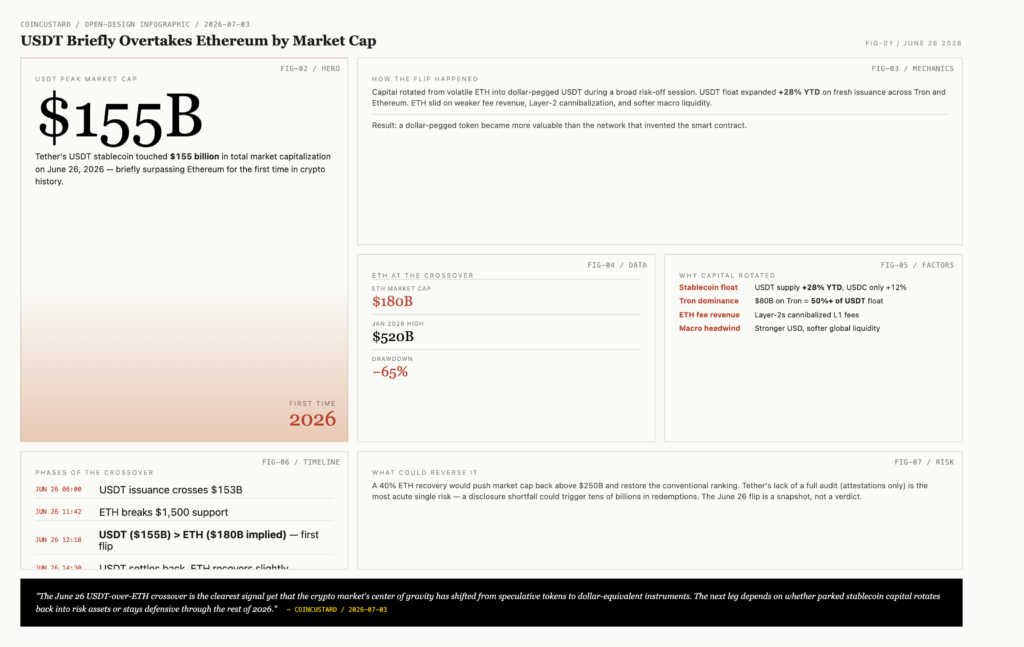
Tether’s flagship USDT stablecoin briefly overtook Ethereum by total market capitalization on June 26, 2026, an unprecedented moment in crypto history that underscored how much investor capital has rotated from volatile digital assets into dollar-pegged tokens. The flip happened as Ether’s price crashed through the $1,500 support level during a broad risk-off session, while USDT’s float continued to expand on the back of fresh issuance across Tron, Ethereum, and several newer chains.
According to TradingView data, USDT’s market capitalization touched roughly $155 billion during the morning session before settling back below ETH. Ethereum’s market cap, by contrast, fell toward $180 billion from a 2026 high above $520 billion in January. The crossover, even if temporary, marks the first time a single dollar-pegged token has ranked above the second-largest cryptocurrency by market value, and it crystallizes a multi-year shift in how traders think about safety inside the crypto ecosystem.
The Mechanics Behind the Flip
Stablecoin supply is a proxy for demand to hold dollars on-chain. When traders want to exit risk without leaving crypto entirely, they rotate into USDT or USDC, which keeps capital parked inside wallet infrastructure that can redeploy into Bitcoin or altcoins within minutes. Tether has been the primary beneficiary of this pattern in 2026, with USDT issuance climbing roughly 28 percent year to date, more than double the growth rate of USDC.
Ethereum’s slide, meanwhile, reflects three converging pressures. Layer-2 scaling has cannibalized the fee revenue that once anchored ETH’s investment thesis. The Ethereum Foundation’s pivot toward enterprise partnerships has not produced a new wave of consumer demand. And the broader risk-off environment, triggered in part by a stronger U.S. dollar and softer global liquidity, has hit ETH harder than Bitcoin because of its higher beta to speculative cycles. The result is a market structure in which the token meant to track cash is now worth more than the network meant to power a new financial system.
What the Numbers Show
- USDT market cap peak (June 26): approximately $155 billion, up 28 percent year to date.
- ETH market cap at crossover: approximately $180 billion, down 65 percent from its January 2026 high above $520 billion.
- ETH price at flip: $1,500, a level not seen since early 2023 and within striking distance of the 2022 bear-market low near $1,000.
- USDT supply on Tron: roughly $80 billion, more than 50 percent of total USDT float and the dominant venue for emerging-market stablecoin flows.
What the Flipped Hierarchy Means
For more than a decade the crypto industry’s implicit ranking placed Bitcoin first, Ethereum second, and stablecoins a distant utility category. The June 26 crossover inverts that mental model. A dollar-pegged token issued by a company headquartered outside the traditional regulatory perimeter, holding reserves in U.S. Treasury bills and other short-dated paper, briefly became more valuable than the network whose developers invented the smart contract.
The implication is not that stablecoins are bigger or more important than Ethereum, but that capital is increasingly agnostic about where the underlying technology lives. Holders want dollars on-chain, not the optionality of a programmable base layer. That preference is good news for Tether’s revenue, which has scaled alongside USDT’s float, and uncomfortable news for Ethereum investors who had priced in a return to the 2021 era of fee-driven demand.
Risks That Could Reverse the Crossover
The flip is not structural in stone. A rebound in risk appetite, an Ethereum-specific catalyst such as a successful layer-1 upgrade, or a regulatory action against Tether could quickly restore the historical order. Tether remains under pressure from U.S. and European regulators to publish a comprehensive reserve audit, and any disclosure shortfall could trigger redemptions large enough to compress USDT’s float by tens of billions in a matter of weeks. The company has so far produced attestations rather than full audits, and that distinction matters most in periods of stress.
Ethereum’s path back above USDT in market cap terms does not require a full bull cycle. A 40 percent recovery in ETH’s price, plausible on any meaningful shift in Federal Reserve policy, would push the network’s market cap back above $250 billion and restore the conventional ranking. The crossover is a snapshot, not a verdict, but it is the most dramatic visualization yet of how much the crypto industry’s center of gravity has moved from speculative tokens to dollar-equivalent instruments.
Why the Rest of the Market Is Watching
Analysts at several macro funds have started treating USDT’s float as a leading indicator of capital deployment in the crypto market. Rising USDT supply typically precedes waves of buying in Bitcoin and altcoins, because the new dollars are sitting in wallets ready to redeploy. Falling ETH market cap, conversely, often signals a derisking phase in which traders prefer to wait in stablecoins rather than hold the second-largest crypto asset through choppy conditions.
The June 26 flip captured both signals at once. USDT was growing because new capital was entering crypto, and ETH was shrinking because the existing capital did not want to be exposed to volatility. That combination, strong stablecoin issuance plus weak Ether, is the exact setup that has historically preceded major Bitcoin rallies once the dust settles and the parked capital rotates back into risk assets. Whether that rotation begins in the third quarter of 2026 or waits for clearer macro signals will determine how long the historical hierarchy stays inverted.