
SEC’s Peirce Expects Clarity Act to Pass This Summer as US Crypto Rules Take Shape
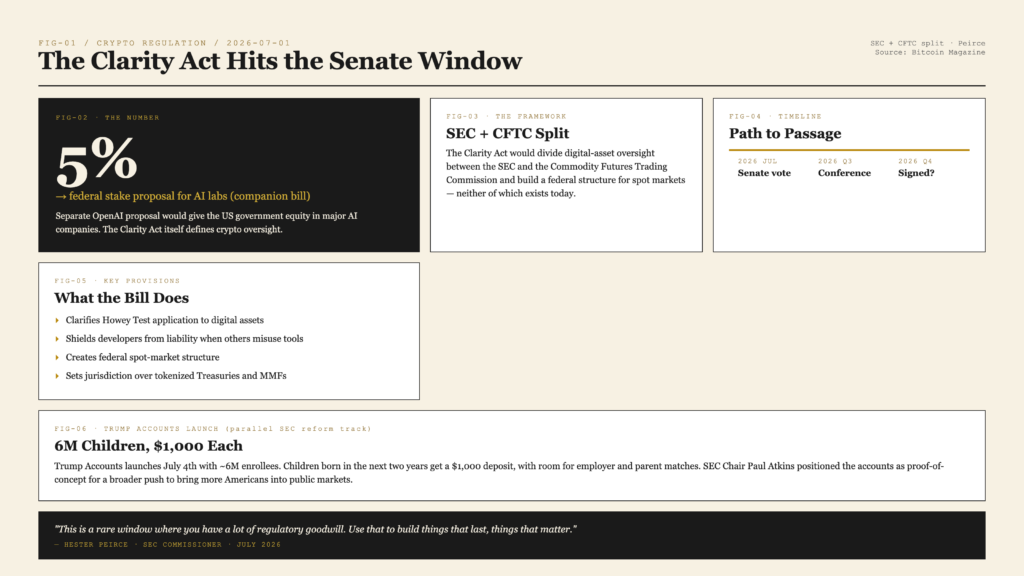
US Securities and Exchange Commissioner Hester Peirce said she expects the long-pending Clarity Act to pass Congress this summer, framing the bill as the most consequential piece of crypto legislation to move through Washington in a decade. In an interview on the Searching for Mana podcast carried by Bitcoin Magazine, Peirce said the bill has cleared the House and now awaits Senate action, and that she sees a rare window of bipartisan goodwill for digital-asset reform.
The Clarity Act would divide oversight of the crypto industry between the Securities and Exchange Commission and the Commodity Futures Trading Commission, a split that the industry has lobbied for since the early days of token sales in 2017. The bill would also build a federal structure for spot markets that does not currently exist, giving exchanges, brokers, and custodians a single rulebook to operate under. For an industry that has spent the last several years navigating enforcement actions and rule-by-rule guidance, the prospect of a comprehensive framework has become the central political ask.
Howey Test, Developer Liability, and the Path Forward
Beyond the SEC-CFTC split, the Clarity Act would clarify how the Howey Test, the standard courts have used since 1946 to determine when a transaction counts as an investment contract, applies to digital assets. That question has hung over every token sale since the DAO report of 2017, and Peirce argued the current ambiguity has rewarded builders of throwaway projects while making honest actors hard to tell apart from fraudsters. The bill would also shield developers from liability when others misuse their tools, a carve-out the industry has lobbied for hard after years of prosecutors reaching up the stack to sue wallet authors and protocol maintainers.
“This is a rare window where you have a lot of regulatory goodwill. Use that to build things that last, things that matter.” — Hester Peirce, SEC Commissioner
Peirce’s term at the SEC is nearing its end, and she will leave the agency for a law school teaching post. In her final months, she has used every available platform to push for a permissive framework: allow experimentation, address harms as they surface, and avoid baking today’s assumptions into statute. She tied the technology’s promise to the transfer of value across networks, the removal of costly intermediaries, and the use of smart contracts to automate back-office work, and predicted that AI agents will increasingly transact with crypto assets as onchain settlement becomes the default.
Tokenized Securities and the Trump Accounts Launch
SEC Chair Paul Atkins struck similar notes in a Fox News interview with Larry Kudlow after an address to the Economic Club of New York, casting himself as an advocate of free-market capitalism and pointing to a series of reforms aimed at drawing more Americans into public markets and easing the path to an IPO. Atkins highlighted the Trump Accounts, set to launch on July 4th, as an expression of American capitalism and long-term saving. He said about 6 million children have enrolled, and that children born in the next two years will receive a $1,000 deposit, with room for matches from employers, parents, and other sources.
Tokenized securities, Peirce said, could improve collateral mobility, ease securities lending, and let issuers reach shareholders through their wallets, an acknowledgement that the line between traditional finance and onchain infrastructure is collapsing. She also linked the regulatory moment to artificial intelligence, predicting that AI agents will transact with crypto assets as machine-to-machine payments become routine. On AI regulation itself, Peirce favored a hands-off stance: allow experimentation, and address harms as they surface rather than shape the technology from the start. She noted that a firm’s use of AI does not excuse the firm from responsibility for the outcome, a careful line that preserves room for enforcement without prejudging the technology.
What Investors Should Watch This Summer
For crypto investors, the practical implications of the Clarity Act hinge on a handful of Senate votes that will play out over the next two months. If the bill passes as Peirce expects, exchanges and custodians will get a single rulebook, token issuers will get clarity on when their offerings count as securities, and developers will get explicit protection from liability for downstream misuse. The risk is that the bill gets bogged down in the Senate, where crypto has historically had fewer champions than the House, or that it passes with amendments that water down the developer-liability shield.
Spot ETF products, which were finally approved for Bitcoin and Ethereum in 2024 and 2025 after years of rejection, would benefit disproportionately from a clear federal market structure. Today, issuers operate under a patchwork of SEC no-action letters and CFTC guidance; under Clarity, a single regulator would have jurisdiction over each product from listing through settlement. The bill’s spot-market provisions are also expected to address the long-standing question of whether tokenized Treasuries and money-market funds settle as securities or commodities, a question that has grown more urgent as BlackRock and Franklin Templeton have scaled their tokenized offerings past nine figures in assets.
Stablecoin issuers, including Tether and Circle, are watching the parallel GENIUS Act more closely than Clarity itself, but the two bills are expected to move together through the Senate. For builders, the message from Peirce is direct. Use this window to build things that last, because the regulatory goodwill that has opened up is unlikely to stay open forever.