
Apple Plans Five New iPhones Through 2027 in Biggest Product Expansion in Years
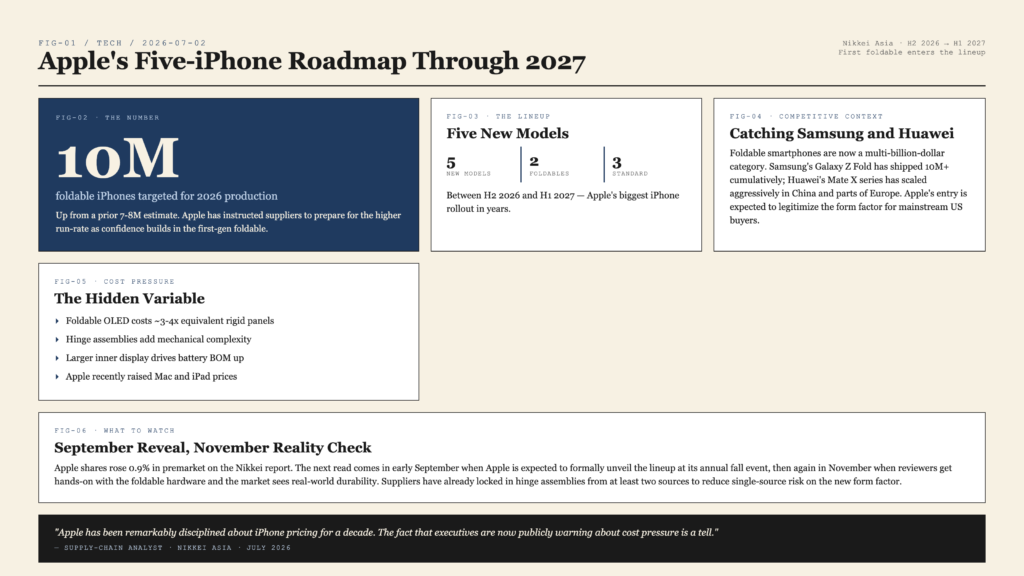
Apple is preparing one of its most ambitious iPhone rollouts in years, with plans to introduce at least five new models between the second half of 2026 and the first half of 2027, according to a report from Nikkei Asia carried by Yahoo Finance. The lineup will include Apple’s long-awaited first foldable smartphone, a category the company has avoided while Samsung and Huawei have built multi-billion-dollar businesses. Apple shares rose 0.9% in premarket trading on Thursday following the report.
According to Nikkei, citing people familiar with the matter, Apple has instructed suppliers to prepare for the production of around 10 million foldable iPhones this year. The revised target is higher than the company’s previous estimate of between 7 million and 8 million units, signalling increased confidence in demand for its first foldable smartphone. The expanded production schedule suggests that Apple is no longer treating the foldable as a niche experiment but as a mainstream addition to the iPhone family, with volumes that would put it among the top-selling foldables in the industry on day one.
The Foldable Lineup and a Five-Model Roadmap
The five-model roadmap covers more than just the foldable. Apple is expected to refresh its standard iPhone 18 family in the fall of 2026, add a higher-end Pro variant, and introduce at least one new model aimed at emerging markets or the mid-premium segment, the same playbook that worked with the iPhone 16e earlier this year. The first half of 2027 will bring the second-generation foldable, which industry sources say Apple is targeting at a price point closer to $2,500 than the $3,000-plus that early rumors suggested.
The expanded launch schedule highlights Apple’s efforts to strengthen its position in the premium smartphone market as competition intensifies. Foldable devices have become an increasingly important segment of the industry, with rivals including Samsung Electronics and Huawei Technologies already offering multiple foldable smartphone models. Samsung’s Galaxy Z Fold series has shipped more than 10 million units cumulatively since launch, and Huawei’s Mate X line has grown rapidly in mainland China and parts of Europe. Apple’s entry into the category is expected to legitimize foldables in the eyes of mainstream US buyers who have so far been skeptical of the form factor.
Component Costs Are the Hidden Variable
The reported production expansion comes as Apple continues to navigate higher component costs and ongoing supply-chain pressures. The company recently increased prices for several Mac and iPad models, citing rising costs for memory and storage chips. Apple executives have also cautioned that sustained increases in component prices could eventually influence future iPhone pricing, an unusual admission for a company that has historically absorbed cost increases to protect the iPhone’s positioning.
“Apple has been remarkably disciplined about iPhone pricing for a decade. The fact that executives are now publicly warning about cost pressure is a tell.” — supply-chain analyst cited in Nikkei’s broader coverage
The foldable iPhone is particularly exposed to cost pressure. Foldable displays, which require ultra-thin glass and a flexible OLED stack, cost roughly three to four times as much as equivalent-size rigid OLED panels. Hinge assemblies add another layer of mechanical complexity, and the battery capacity required to power a larger inner display drives up the bill of materials further. Apple’s reported 10-million-unit target suggests the company believes it can drive enough volume to amortize tooling costs and bring the per-unit bill of materials down, but that math depends on yields at the display supplier, which sources have not yet confirmed.
What the Five-Model Push Means for Apple’s Year
For Apple, the five-model push is a strategic bet on three things at once. First, that the foldable category will grow fast enough to justify a flagship-class product. Second, that the premium smartphone market can absorb another round of price increases without crimping demand. Third, that competitors who have been willing to launch six or seven models a year, like Samsung and Xiaomi, are leaving share on the table by spreading themselves too thin.
The supply-chain signal in the Nikkei report is unusually clear. Apple’s order books at display suppliers have been revised upward twice in the past quarter, and the company’s procurement team has reportedly locked in hinge assemblies from at least two suppliers to reduce single-source risk. Component buyers have also accelerated orders for the LTPO OLED panels that allow variable refresh rates on the inner display, a feature that has been standard on Samsung’s foldables since the Z Fold 4 but that Apple reportedly wanted to perfect before shipping.
If Apple executes, the company’s iPhone revenue in calendar 2027 could set a new annual record even with relatively flat unit growth, as the foldable carries an ASP of more than double the standard iPhone. The foldable’s gross margin profile, however, depends entirely on the supplier cost curve, and analysts at multiple Wall Street firms have flagged that the first-generation foldable is unlikely to match the gross margins of the standard iPhone Pro until at least the second-generation refresh. That dynamic is consistent with Apple’s normal playbook for new categories, beginning with lower margins to establish the product, then driving profitability as volumes scale and yields improve.
If Apple stumbles on display yields or component costs, the five-model roadmap will look like overreach, and the company will be forced into a round of price cuts that would compress iPhone margins at the worst possible moment, just as the broader smartphone market is showing early signs of recovery. For now, suppliers are preparing for the bigger number, and Wall Street is pricing in the upside. The next test will come in early September, when Apple is expected to formally unveil the lineup at its annual fall event, and again in November, when reviewers get their hands on the foldable hardware and the market gets its first read on real-world durability.