
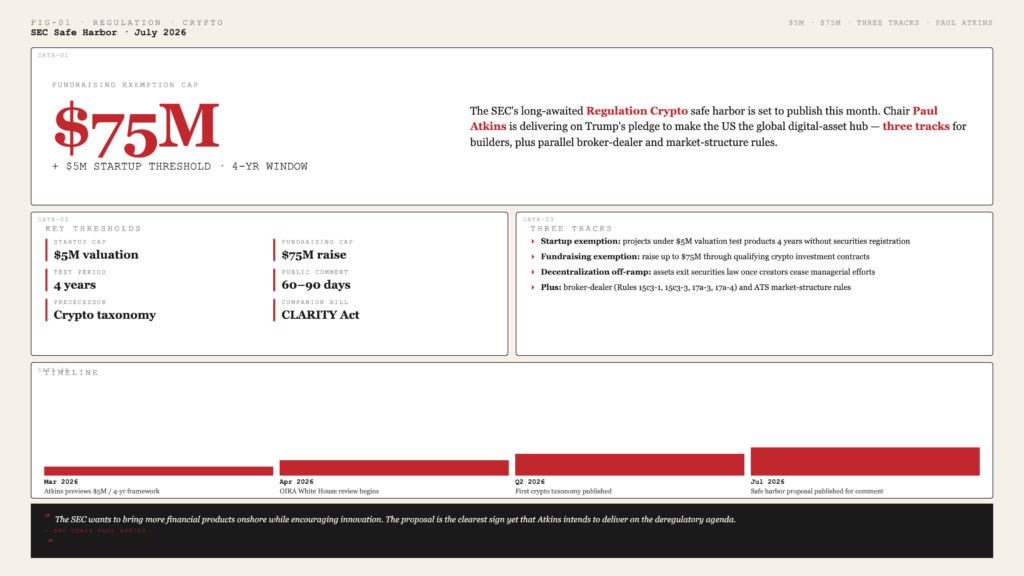
The U.S. Securities and Exchange Commission is preparing to publish its long-awaited crypto safe harbor rules later this month under the umbrella Regulation Crypto proposal, the agency confirmed in an updated 2026 rulemaking agenda, ending a multi-year wait that has left startups, decentralized finance builders, and token issuers operating in legal limbo. The White House Office of Information and Regulatory Affairs is currently reviewing the proposal before the SEC releases it for public comment, a procedural step that signals the formal rule is moving toward publication as the Trump administration pushes to make the United States the global center for digital asset innovation.
Chair Paul Atkins has tied the proposal directly to that strategic objective, telling industry audiences that the SEC wants to bring more financial products onshore while encouraging innovation. The safe harbor framework, which Atkins has been previewing in various forms since March, is designed to create temporary exemptions for qualifying token sales, decentralized finance activities, and tokenized securities, shielding eligible projects from SEC enforcement action while they develop under defined regulatory conditions. Unlike the staff guidance the agency has issued in past years, formal rules carry greater legal weight and are far more difficult for future administrations to reverse.
Three Tracks for Builders
At the heart of the proposed framework is a three-track structure that the SEC has signaled it intends to formalize. The first track, a startup exemption, would allow early-stage companies with valuations up to $5 million to test crypto products during their first four years without triggering the full weight of federal securities registration. The second track, a fundraising exemption, would let qualifying projects raise up to $75 million through investment contracts that meet specific SEC criteria, an order-of-magnitude increase over the typical ceiling for private placements and a major unlock for builders who have struggled to access U.S. capital under the existing framework.
The third track, an investment contract exemption, focuses on the path an asset takes once it is sufficiently decentralized. Under the proposal, a digital asset could exit the perimeter of federal securities regulation once its creators no longer perform essential managerial efforts, a codification of the so-called decentralization test that the agency has hinted at for years but never written into binding rules. Atkins has said this provision is critical because it gives entrepreneurs a clear off-ramp from the regulatory regime, removing one of the largest sources of legal uncertainty that has driven crypto companies offshore.
Beyond the Safe Harbor
The updated agenda adds three separate crypto rulemaking projects to the SEC’s 2026 calendar. The crypto asset proposal is the most visible, but a parallel broker-dealer rule will amend Rules 15c3-1, 15c3-3, 17a-3, and 17a-4 to explain how existing financial responsibility and record-keeping rules apply to digital assets, including how broker-dealers should safeguard customer crypto holdings. A third proposal would update market structure rules for digital assets traded on alternative trading systems and national securities exchanges, addressing the patchwork of listings rules that has confounded exchanges and token issuers alike.
The package lands against a backdrop of other crypto policy momentum. Earlier this year, the SEC outlined conditions allowing certain qualifying decentralized finance platforms to operate without registering as broker-dealers, a major concession to the DeFi sector that has been at the center of jurisdictional fights between the SEC and the Commodity Futures Trading Commission. Congress is also considering the CLARITY Act, which would permanently sort digital assets into three legal categories, digital commodity, investment contract asset, or payment stablecoin, and end the turf war between the two federal regulators.
What’s at Stake
For founders and developers, the practical effect of the safe harbor proposal would be the ability to build, test, and ship products on U.S. soil without the legal exposure that has pushed many projects to incorporate in Switzerland, Singapore, or the Cayman Islands. For investors, the formalization of the $5 million startup threshold and the $75 million fundraising cap creates a clear pathway for capital allocation, including the prospect that institutional allocators, which have been slow to enter the space, will find the regulatory clarity they have demanded. For the SEC itself, the rule represents a philosophical pivot from enforcement-led policy to rule-making, the clearest sign yet that Atkins intends to deliver on the deregulatory agenda he inherited.
Public comment periods on SEC proposals typically run 60 to 90 days, with the final rule often taking a year or more to publish. Industry lawyers will be watching the exact language of the decentralization test, the limits on eligible fundraising, and the duration of the safe harbor windows, all of which are likely to be heavily litigated. The agency’s first crypto taxonomy, published earlier this year, will serve as a foundation for the rule, but the safe harbor itself will be the first binding test of the new regulatory philosophy.