
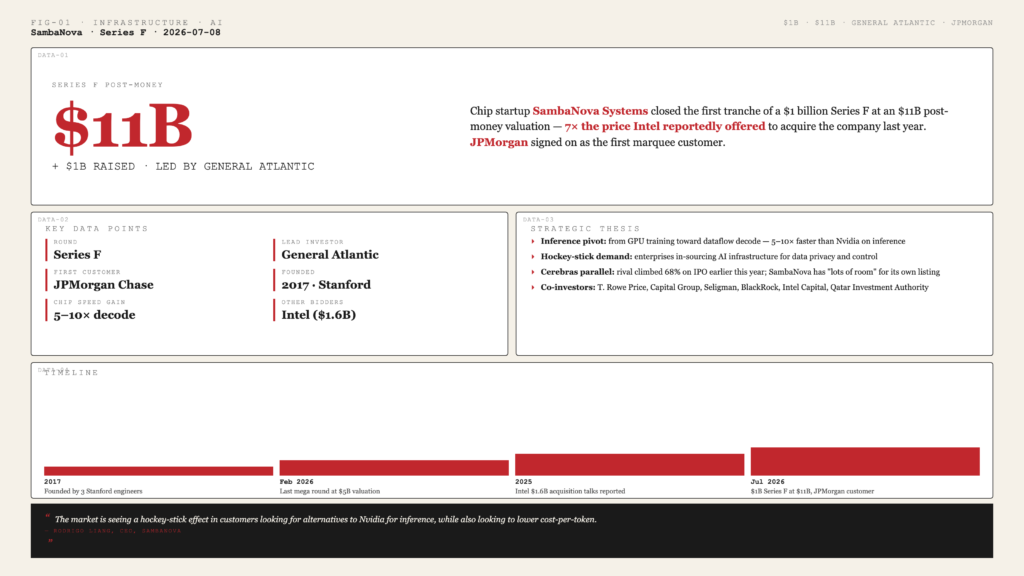
SambaNova Systems has closed the first tranche of a $1 billion Series F funding round at an $11 billion post-money valuation, the company confirmed Wednesday, marking one of the largest private capital raises by an AI chip designer this year and the clearest signal yet that investors are placing real bets on Nvidia challengers as the AI infrastructure market pivots from training to inference. The round was led by General Atlantic, with significant participation from T. Rowe Price, Capital Group, and Seligman Ventures, and it pushes SambaNova into rare territory: a private AI chip startup now valued at more than triple the price Intel was rumored to have offered to acquire the company roughly a year ago.
The funding arrives just five months after SambaNova’s previous mega-round and underscores how quickly the competitive landscape for AI silicon is consolidating. General Atlantic’s co-president and head of global growth equity, Martín Escobari, framed the investment in stark terms, telling Bloomberg that the industry already recognizes the need for fast inference for large AI models, but that the next major shift is now beginning in earnest: enterprises and financial institutions moving to in-source their AI infrastructure for data privacy and control. JPMorgan Chase, which has been named as SambaNova’s first marquee customer alongside the raise, will deploy the company’s chips to power in-house AI workloads, a major endorsement of the inference-first thesis at the heart of SambaNova’s pitch.
From Training to Inference: A Shifting Map
SambaNova was founded in 2017 by three Stanford-trained engineers and is part of a small but well-capitalized group of startups trying to pry open a market Nvidia has dominated almost entirely since the launch of the H100. While Nvidia’s graphics processing units have been the workhorses of the training era, the economics of running trained models in production are now driving a different buying pattern. Data center operators are increasingly turning to chipmakers like SambaNova that can deliver comparable or better performance on inference using existing software stacks and at a lower cost-per-token, the unit by which AI services are typically measured and billed.
Rodrigo Liang, SambaNova’s chief executive, told Bloomberg the market is now seeing what he described as a hockey-stick effect in customer demand for alternatives to Nvidia, particularly for inference, and especially from buyers looking to drive down cost-per-token. SambaNova’s chips, Liang said, are designed to complement Nvidia products rather than replace them, freeing up Nvidia hardware for training workloads by handling the decode portion of inference between five and ten times faster. The company is on track to release its fifth chip, the SN50, which will extend the line of dataflow accelerators that includes the current SN40 generation.
Strategic Optionality
One of the most interesting disclosures accompanying the round is the existence of acquisition talks between SambaNova and Intel. Intel reportedly explored a deal to acquire the company for roughly $1.6 billion last year, a sum that, measured against the new $11 billion valuation, would have valued the chip designer at a fraction of its current private market worth. Liang declined to comment directly on the discussions but said SambaNova is always open to conversations around strategic combinations or alliances, a signal that the company intends to remain in control of its own destiny but is not philosophically opposed to a deal at the right price.
The new round also brings in a wide spread of institutional and strategic capital. Beyond the lead investors, the Series F includes A&E Investment, Assam Ventures, Battery Ventures, BlackRock, Cambium Capital, Intel Capital, Kabila Capital, QFO Capital, Qatar Investment Authority, Vista Equity Partners, and Volantis. The Qatar Investment Authority participation is notable, as Gulf sovereign capital has been an increasingly visible source of funding for AI infrastructure plays, including a recently announced $49 billion vehicle from Abu Dhabi’s MGX.
The Public-Market Question
SambaNova’s closest public-market comparable, Cerebras Systems, climbed 68 percent on its initial public offering earlier this year before giving back much of those gains, an experience that may inform how SambaNova eventually approaches its own listing. Liang told Bloomberg the company is in no rush to go public, but with the additional capital raised, he said, the balance sheet gives them significant flexibility to choose the right moment. Cerebras is among the inference-focused chip designers that have also been gaining ground on Nvidia in the same market segment, although the two companies have taken different paths to the public markets.
For now, SambaNova is leaning into a thesis that turns on a simple arithmetic: as AI moves from research labs into everyday enterprise workflows, the bulk of the compute spend will be on inference, not training, and the company believes its dataflow architecture is best positioned to capture that shift. With JPMorgan as a flagship customer, $1 billion in fresh capital, and an $11 billion private valuation, SambaNova now has the runway to test that thesis at scale.