
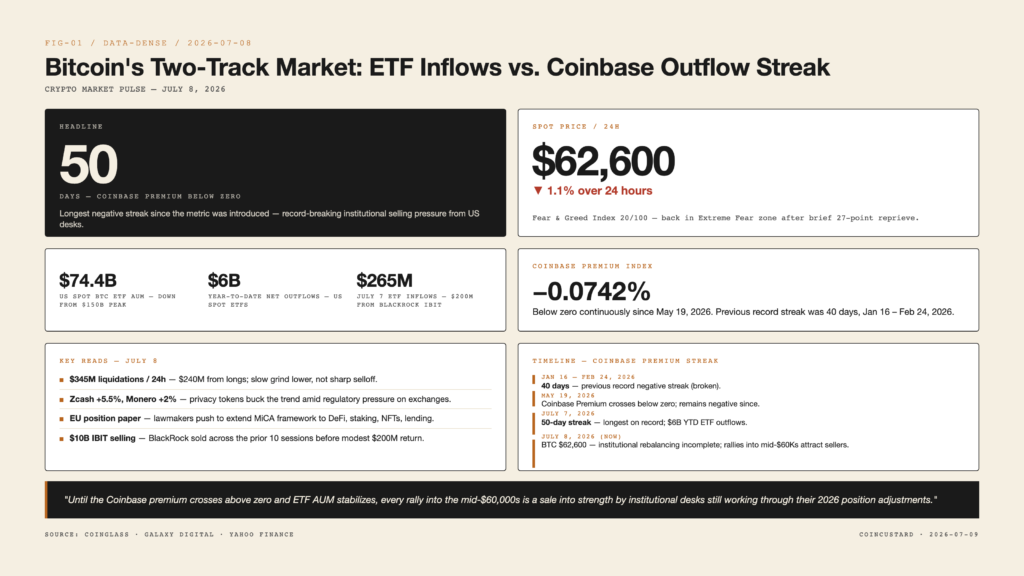
Bitcoin has retreated from its midweek peak, trading near $62,600 with a 1.1% 24-hour pullback as leveraged long positions continue to take damage. The retracement comes even as spot Bitcoin ETFs logged a second consecutive day of positive flows on July 7, with more than $265 million in net inflows — over $200 million of which came from BlackRock’s IBIT after the fund sold nearly $10 billion across the prior ten sessions. The split between price action and institutional flow tells a story about who is selling into every rally and why the recovery is struggling to hold.
The Coinbase Premium Signal
The most striking data point is the Coinbase Bitcoin Premium Index, which has now remained below zero for 50 consecutive days — the longest negative streak since the metric was introduced. The index measures the difference between Bitcoin’s price on Coinbase and its average across global markets, and because Coinbase is widely regarded as a primary trading venue for US institutional investors, a sustained negative reading typically indicates stronger selling pressure in the United States than elsewhere. The previous record was a 40-day negative streak from January 16 through February 24, 2026.
According to CoinGlass, the index has been in negative territory since May 19, 2026, with the latest reading at minus 0.0742%. Since early May, the index has crossed above zero only once. Galaxy Digital Head of Research Alex Thorn noted that net outflows from US spot Bitcoin ETFs have reached approximately $6 billion year to date. Total assets held by US spot Bitcoin ETFs have fallen to about $74.4 billion, down from more than $150 billion at their peak. June was one of the weakest months on record for ETF flows, and the negative premium streak suggests institutional desks have not finished rebalancing.
Liquidations, Fear, and the $65,000 Line
Liquidations have cooled from the prior session but remain elevated. Total liquidations dropped from $532 million to $345 million over 24 hours, with more than $240 million of that figure coming from long positions — a reminder that overly optimistic bulls are being punished by every shallow pullback. The Fear and Greed Index briefly exited “Extreme Fear” on July 7, climbing to 27 out of 100 before slipping back to 20 as prices softened. Until Bitcoin breaks cleanly above $65,000, the index is likely to continue oscillating around these depressed levels.
- Bitcoin price: $62,600, down 1.1% over 24 hours.
- ETF inflows (July 7): $265 million, $200 million from BlackRock IBIT.
- Liquidations (24h): $345 million, $240 million from longs.
- Year-to-date US spot Bitcoin ETF outflows: $6 billion.
- US spot Bitcoin ETF AUM: $74.4 billion, down from $150 billion at peak.
- Coinbase Premium Index streak: 50 consecutive days negative.
- Fear and Greed Index: 20 of 100, back in “Extreme Fear.”
What the Flow Data Reveals
The split between ETF flow direction and spot price is the cleanest read on positioning. Net inflows of $265 million on July 7 suggest real demand is present at current levels, but the prior ten sessions saw roughly $10 billion in IBIT outflows. That distribution leaves a heavy supply overhang, which is why shallow pullbacks attract fresh selling rather than dip buyers. The pattern is consistent with a market that has cleared most of its weak hands but still carries residual inventory from the early-year peak above $150 billion in ETF assets.
The Liquidation Tell
The fact that $240 million of $345 million in 24-hour liquidations came from long positions is a structural signal. Long liquidations dominate when the market grinds lower rather than selling off sharply, because leveraged bulls scale into positions that get trimmed on every minor recovery. A persistent skew toward long liquidations indicates the market is bleeding speculative positioning one slow drip at a time — painful for active traders, but the kind of base-building that clears the way for the next sustained move once the macro setup improves.
The Privacy Token Outlier
While the broad market retraced, privacy-focused projects defied the trend. Zcash gained 5.5% and Monero rose 2% over the same 24-hour window — a notable divergence at a moment when the majors are coiling for a directional move. The pattern is familiar: when Bitcoin dominance softens and risk appetite compresses, capital rotates into tokens with distinct narrative angles. Privacy coins have benefited from a steady drumbeat of regulatory pressure on centralized exchanges and renewed debate over on-chain surveillance, both of which are playing into the same demand thesis.
The EU Tightens the Regulatory Frame
European Union lawmakers have adopted a position paper on digital assets that outlines how the EU should develop regulations for the cryptocurrency market following the implementation of the Markets in Crypto-Assets framework. The European Commission is being asked to evaluate whether decentralized finance, crypto lending and borrowing, staking, and non-fungible tokens should be more explicitly included within the EU’s regulatory perimeter. Lawmakers emphasized the need for consistent application of the framework across all member states, warning that separate national regulations could fragment the EU’s single digital asset market.
The Coinbase Premium Index negative streak and the year-to-date ETF outflows together suggest institutional rebalancing is not yet complete — which is why every shallow rally attracts sellers and why the $65,000 line has become the macro dividing point.
The combination of a record-long negative Coinbase premium, persistent ETF outflows, and a fresh round of European regulatory tightening leaves Bitcoin’s near-term path dependent on whether spot flows can turn sustainably positive before the regulatory headwinds compound. The next two weeks of ETF flow data, combined with the EU position paper, will set the tone for the rest of the summer. For traders, the message from the data is unambiguous: until the Coinbase premium crosses above zero and ETF AUM stabilizes, every rally into the mid-$60,000s is a sale into strength by institutional desks still working through their 2026 position adjustments.