
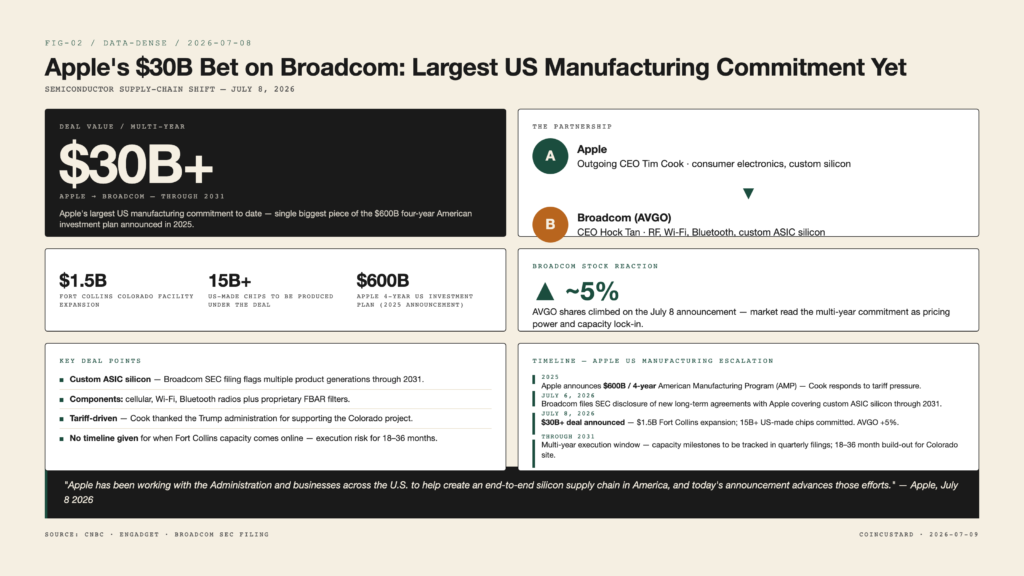
Apple has signed a multi-year agreement with Broadcom valued at more than $30 billion to produce wireless components in the United States, the iPhone maker’s largest domestic manufacturing commitment to date. The deal, announced July 8, includes a $1.5 billion expansion of Broadcom’s Fort Collins, Colorado facility and is expected to yield more than 15 billion US-made chips. Shares of Broadcom climbed nearly 5% on the news, and for outgoing Apple CEO Tim Cook, the agreement represents the most significant single piece of the company’s $600 billion four-year American investment plan announced in 2025.
The Anatomy of the Deal
The agreement runs through 2031 and deepens a relationship that already supplies Apple with connectivity components across its entire device lineup. Broadcom disclosed in an SEC filing on Monday that it had entered new long-term agreements with Apple to develop and supply “custom ASIC silicon products” for multiple generations of Apple products. ASICs, or application-specific integrated circuits, are increasingly used for artificial intelligence workloads, which positions the deal to extend well beyond traditional wireless components. Apple said Broadcom will make wireless components used to help devices connect to cellular, Wi-Fi, and Bluetooth networks.
Of the $1.5 billion earmarked for the Colorado site, Broadcom will use the funds to produce advanced radio frequency components, including FBAR filters — a proprietary Bulk Acoustic Wave filtering technology used by smartphones to filter specific wireless bands. The companies were not specific about what additional Broadcom will produce beyond the claim that the deal will lead to the production of 15 billion US-made chips. Broadcom does not operate its own vast manufacturing resources and outsources production to third-party suppliers, including TSMC. The release frames Apple’s commitment as the largest piece of its American Manufacturing Program, or AMP, launched to expand domestic production across its supply chain.
Why the $30 Billion Matters
The dollar figure is significant for three reasons. First, it is large enough to materially shift the geographic concentration of Apple’s silicon supply chain. Second, it commits Apple to a multi-year production schedule that locks in pricing and capacity in a way that single-year contracts cannot. Third, it lands at a moment when the Trump administration has been applying pressure on consumer electronics companies to onshore production, and Cook has chosen to lean into that narrative rather than resist it.
- Deal value: more than $30 billion, multi-year, runs through 2031.
- Fort Collins, Colorado facility expansion: $1.5 billion.
- Total US-made chips expected: more than 15 billion units.
- Components: cellular, Wi-Fi, Bluetooth, FBAR filters, custom ASIC silicon.
- Stock reaction: Broadcom shares climbed approximately 5% on the announcement.
- Apple American Manufacturing Program total commitment: $600 billion over four years.
The Trump Administration Connection
Last year Apple faced the threat of tariffs unless it did more to invest in the domestic tech supply chain. To address that pressure, the company pledged to invest up to $600 billion over the four years of the current administration. The $30 billion Broadcom contract is the single largest commitment announced so far under that umbrella, and Cook thanked President Donald Trump and his administration for supporting the project. The political framing is intentional: the deal is both a manufacturing announcement and a tariff-management move, and the choice of a US-based facility in Colorado over a foreign site doubles as a domestic jobs story the administration can point to.
The ASIC Silicon Angle
The mention of custom ASIC silicon in Broadcom’s SEC filing is the underappreciated piece of the announcement. Apple has been steadily building out a portfolio of custom silicon across its product line, from the M-series chips in Macs to the A-series chips in iPhones to the S-series chips in Apple Watch and the H-series chips in AirPods. Extending that custom-silicon strategy into the wireless component layer, via Broadcom, signals a deeper architectural integration than the off-the-shelf connectivity parts Apple has historically used. The ASIC angle also opens the door to AI-specific workloads running closer to the radio layer, which is a meaningful capability shift for future device generations.
“Apple has been working with the Administration and businesses across the U.S. to help create an end-to-end silicon supply chain in America, and today’s announcement advances those efforts,” Apple said in its release.
What Investors Are Watching
Broadcom did not provide a specific timeline for when the new Fort Collins capacity will come online, which leaves room for execution risk. The Colorado expansion requires permitting, construction, and equipment installation timelines that can stretch 18 to 36 months in the semiconductor sector. Investors will want to see capacity milestones in future quarterly filings to validate that the 15 billion chip production target is achievable on schedule. Hock Tan, Broadcom’s CEO, framed Apple’s commitment as enabling the chipmaker to expand its manufacturing footprint in Fort Collins, but the operational details remain to be spelled out.
The Apple-Broadcom deal sets a new benchmark for what large US consumer electronics companies are willing to commit to onshore production when the political and tariff environment demands it. For competitors in the smartphone, PC, and consumer device markets, the deal resets the expectation for what counts as a meaningful American manufacturing investment. The next 18 months will show whether $30 billion is the floor or the ceiling — and whether other device makers will be forced to follow Apple’s lead to avoid being labeled as laggards on domestic production.