
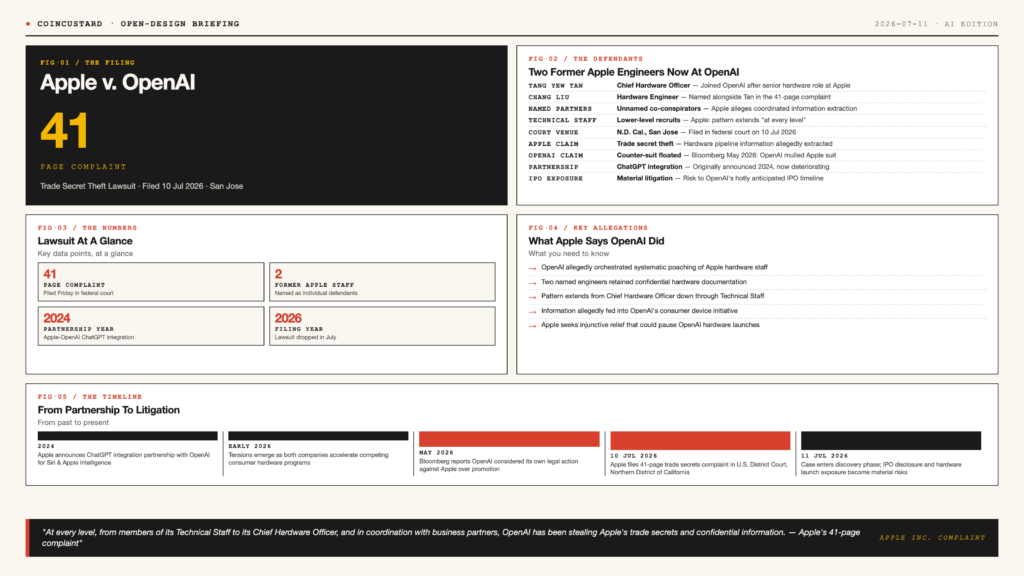
Apple has filed a sweeping federal lawsuit against OpenAI, accusing the artificial intelligence company of orchestrating a deliberate campaign to steal the iPhone maker’s hardware trade secrets as it races to build its first consumer device. The 41-page complaint, lodged Friday in the U.S. District Court for the Northern District of California in San Jose, paints a portrait of systematic poaching and coordinated information extraction that Apple says reached every level of the ChatGPT maker’s organisation.
The suit names two former Apple engineers now working at OpenAI: Tang Yew Tan, OpenAI’s chief hardware officer, and Chang Liu, a hardware engineer. Apple alleges that the pair, along with unnamed business partners, funnelled confidential information about Apple’s hardware development programs directly into OpenAI’s consumer device initiative, an effort that has until now been largely hidden from public view. The lawsuit frames the alleged conduct not as the work of a few rogue employees, but as a corporate-level strategy with structural backing from OpenAI’s leadership.
“At every level, from members of its Technical Staff to its Chief Hardware Officer, and in coordination with business partners, OpenAI has been stealing Apple’s trade secrets and confidential information,” the complaint states, according to excerpts reviewed by multiple outlets.
From Partnership to Litigation
The lawsuit lands roughly two years after Apple and OpenAI announced a high-profile partnership to integrate ChatGPT into Apple’s products, including Siri and the company’s broader Apple Intelligence suite. That relationship has visibly deteriorated over the past year as both companies have accelerated competing consumer hardware and AI initiatives.
According to a May 2026 Bloomberg report, OpenAI had itself been preparing legal action against Apple, alleging that the iPhone maker had failed to adequately promote the ChatGPT integration, a complaint that now reads differently against the backdrop of Friday’s trade secrets suit. The two filings, if both pursued, would create an extraordinary cross-litigation scenario between two companies that publicly framed themselves as partners less than 24 months ago.
The Two Named Defendants
The named defendants in the case are central to Apple’s hardware roadmap. Tang Yew Tan joined OpenAI as chief hardware officer after a lengthy career overseeing Apple’s hardware engineering, a role in which he would have had visibility into confidential chip, sensor, and device-architecture work. Chang Liu, the second named engineer, held a similar position inside Apple’s hardware organisation before moving to OpenAI.
Apple’s complaint argues that the defendants, in violation of their employment agreements and California trade secret law, retained internal documentation and engineering notebooks that contain information directly relevant to Apple’s consumer device pipeline. OpenAI is accused of using that information to accelerate its own hardware program and to recruit additional Apple staff.
“At every level, from members of its Technical Staff to its Chief Hardware Officer, and in coordination with business partners, OpenAI has been stealing Apple’s trade secrets and confidential information.” — Apple’s 41-page complaint
A Direct Hit on OpenAI’s IPO Path
The timing of the lawsuit is particularly damaging for OpenAI. The company has been widely expected to pursue a public listing in 2026 or 2027, with private-market valuations that would rank it among the most valuable technology IPOs in history. A high-profile trade secrets dispute with Apple, the most valuable consumer hardware company on earth, introduces material risk into any prospectus, particularly around disclosure of ongoing litigation, intellectual property exposure, and the integrity of OpenAI’s hardware roadmap.
Underwriters typically require that pending material litigation be disclosed in S-1 filings, and plaintiffs in trade secret cases routinely seek injunctive relief that can pause product launches. If Apple’s complaint survives early motions, OpenAI’s consumer device program, still largely under wraps, could face delays that would affect both revenue projections and the company’s pre-IPO narrative.
Hardware, AI, and the Talent Wars
The lawsuit also illuminates a structural shift in the technology industry: the boundary between AI software and consumer hardware has dissolved, and with it the boundaries between the talent pools that build each. OpenAI’s hiring of senior Apple hardware veterans, and Apple’s aggressive response, signal that the next phase of AI competition will be waged as much on factory floors and silicon roadmaps as in model benchmarks.
For Apple, the suit is also a defensive move. The company has spent years positioning itself as the privacy-first alternative to data-hungry AI services, and any perception that its hardware pipeline has been compromised would undercut that brand positioning at a moment when investors are closely watching Apple’s AI monetisation timeline.
OpenAI has not yet filed a formal response in court, but the company is expected to deny the allegations and to argue that any information brought to OpenAI by former Apple employees was either not confidential or had been independently developed. The case will now proceed through discovery, a process likely to last well into 2027 and one that will almost certainly surface internal communications between OpenAI executives and former Apple staff.
For an industry already on edge about AI safety, IP ownership, and the concentration of talent at a handful of well-funded labs, Apple’s lawsuit is more than a corporate dispute. It is the first major test of whether the legal system can keep pace with the speed at which AI companies are now hiring, building, and shipping in hardware-adjacent markets once dominated by a handful of incumbents.