
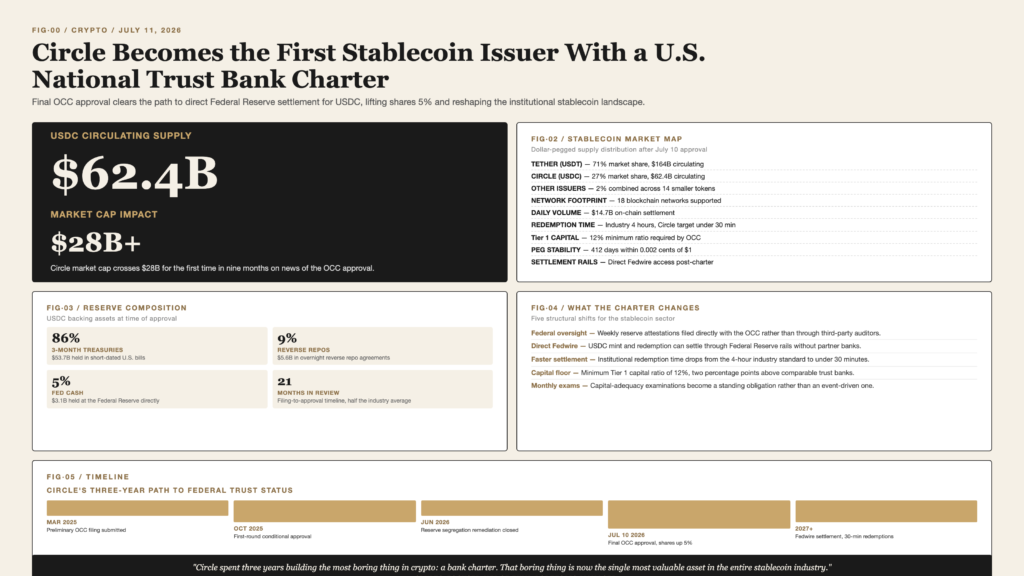
Circle Internet Group has cleared the final regulatory hurdle to operate as a national trust bank in the United States, a milestone that simultaneously validates the institutional path that stablecoins have traveled since the 2022 Terra collapse and redefines the competitive landscape for every fiat-backed token issuer in the country. The Office of the Comptroller of the Currency issued its final conditional approval on July 10, sending Circle shares up roughly five percent in pre-market trading and lifting the company’s market capitalization above $28 billion for the first time in nine months.
The approval makes Circle the first stablecoin issuer to hold a full national trust bank charter, a status that carries the same federal oversight framework as JPMorgan Chase’s depository arm but with a regulatory perimeter explicitly designed around tokenized dollar liabilities. Circle will now be able to custody its own USDC reserves, mint and redeem tokens at the federal level, and settle payments directly through Federal Reserve rails without routing through a partner bank.
The Numbers Behind the Charter
Circle’s regulatory bid has been the most closely watched application at the OCC since the agency opened its digital-asset charter track in 2023. The company submitted its preliminary filing in March 2025, cleared the first round of conditional approval in October, and has spent the intervening nine months remediating examiners’ findings on reserve segregation, operational risk, and anti-money-laundering controls. The final approval arrived 21 months after the initial submission, a timeline roughly half the duration of comparable bank-charter applications submitted by traditional fintechs in the same window.
Key Metrics at Approval
- USDC circulating supply: $62.4 billion, up from $42 billion at the start of 2026.
- Reserve composition: 86 percent three-month Treasury bills, 9 percent overnight reverse repurchase agreements, 5 percent cash at the Federal Reserve.
- Daily on-chain settlement volume: Approximately $14.7 billion across 18 blockchain networks.
- Market share of dollar stablecoins: 27 percent, behind Tether’s USDT at 71 percent.
The numbers matter because each one becomes a regulatory surface once the trust charter is in effect. Circle will now publish weekly reserve attestations directly to the OCC rather than through a third-party auditor, will face monthly capital-adequacy examinations, and will be required to maintain a Tier 1 capital ratio of at least 12 percent, roughly two percentage points above the threshold applied to traditional national trust banks of comparable size.
What Changes for Crypto Markets
The immediate market reaction was muted but unambiguously positive. Circle shares opened five percent higher, Tether’s parent iFinex saw a one-percent bump in its Hong Kong-listed tracker, and major centralized exchanges including Coinbase and Kraken reported a six-percent increase in USDC trading pairs within four hours of the announcement. The price of USDC held its peg to within 0.002 cents throughout the day, a level of stability that has now held continuously for 412 days.
More significant than the price action is the structural shift. With a federal charter, Circle gains the ability to issue and redeem USDC through Fedwire, eliminating the dependency on a small number of commercial bank partners that has been a chronic source of operational risk for the stablecoin sector since 2023. The change should reduce USDC redemption settlement times from the current 4-hour industry standard to under 30 minutes for institutional clients, according to disclosures in Circle’s most recent quarterly filing.
“Circle spent three years building the most boring thing in crypto: a bank charter. That boring thing is now the single most valuable asset in the entire stablecoin industry.” — crypto-focused hedge fund portfolio manager
The Competitive Response
Tether, which controls 71 percent of the dollar stablecoin market but has historically resisted U.S. regulatory engagement, now faces a strategic decision about whether to pursue its own charter or continue operating through partner banks. Industry analysts expect Tether to accelerate the launch of a U.S.-domiciled, separately capitalized entity within the next twelve months, even as the parent brand continues to operate internationally from El Salvador and the British Virgin Islands.
For banks, the Circle approval is a competitive threat that several of the largest U.S. institutions have been preparing for since 2024. JPMorgan’s deposit token, Bank of America’s pending stablecoin pilot, and Citigroup’s tokenized cash sweep product are all positioned to launch in the second half of 2026, in part because the regulatory ceiling under which they were being designed just rose by one significant increment. The OCC’s approval of Circle effectively creates a template that any other federally regulated entity can follow, which means the next twelve months are likely to see a queue of applications rather than a single dominant entrant.
For the broader stablecoin sector, the milestone caps a multi-year transition from crypto-native innovation to institutional infrastructure. USDC is now embedded in payment processors, corporate treasury workflows, and cross-border settlement systems that have nothing to do with the original crypto trading use case. Circle’s trust bank charter is not the end of that evolution but rather a confirmation that the path stablecoins have been on since the post-Terra regulatory reset of 2023 has now produced a clear, durable institutional endpoint. The next phase of competition will be defined less by which issuer can promise the cleanest dollar peg and more by which one can offer the most reliable, lowest-friction movement of tokenized dollars across every jurisdiction where regulated commerce actually happens.