
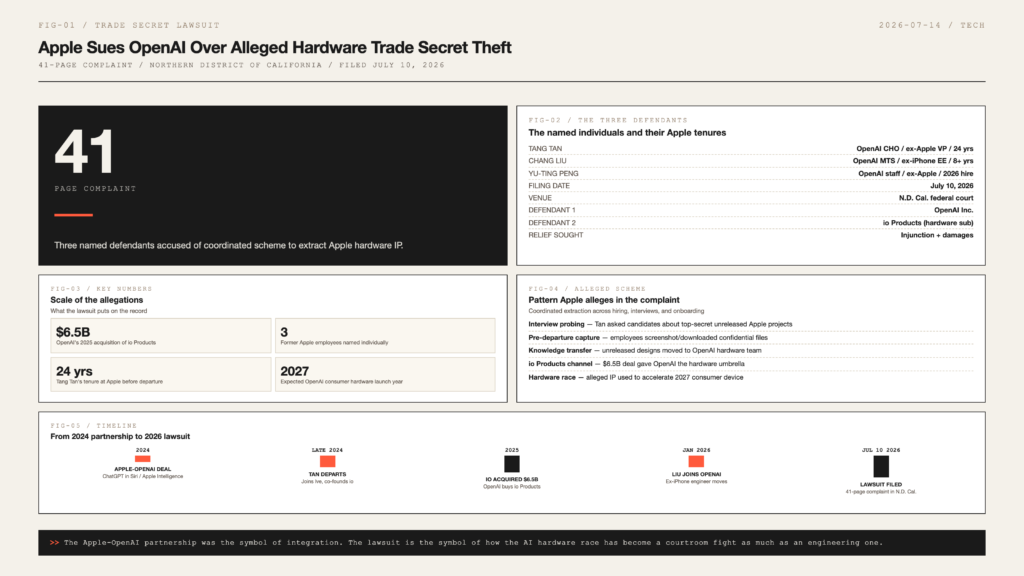
Apple has sued OpenAI in U.S. federal court, accusing the ChatGPT maker of orchestrating a coordinated scheme to steal Apple trade secrets through current and former employees. The 41-page complaint, filed on July 10, 2026, in the Northern District of California, names OpenAI, its hardware subsidiary io Products, and three individuals who previously worked at Apple. The lawsuit marks a dramatic collapse of a partnership that, just two years ago, saw Apple announcing ChatGPT integration into Siri and Apple Intelligence.
At the center of the case is Tang Tan, OpenAI’s Chief Hardware Officer, who spent 24 years at Apple, most recently as Vice President of Product Design for the iPhone and Apple Watch. The complaint alleges that Tan used his position at OpenAI to extract confidential information from Apple employees interviewing for positions at the AI company, and to harvest screenshots and downloads of proprietary project files from colleagues he recruited.
The Three Named Defendants
The lawsuit identifies three individuals who allegedly moved trade secrets from Apple to OpenAI. Tang Tan is the most prominent. He left Apple in 2024 to co-found io Products with Jony Ive, the former Apple design chief. OpenAI acquired io in 2025 for approximately $6.5 billion, and Tan moved into his current role overseeing OpenAI’s consumer hardware efforts.
Chang Liu worked at Apple for more than eight years as a systems electrical engineer on the iPhone. He departed Apple in January 2026 to join OpenAI as a Member of Technical Staff. The complaint alleges that Liu transferred knowledge of unreleased Apple product designs and components directly relevant to OpenAI’s hardware ambitions.
The Third Defendant and Scheme Details
The third named individual is Yu-Ting Peng, also identified in some filings as Alyssa Peng, who joined OpenAI in April 2026 after working at Apple. According to the complaint, all three defendants took confidential information including unreleased product designs and component specifications to OpenAI, which is actively building its own AI hardware device expected to launch next year.
The scheme allegations are detailed and specific. In one instance, the complaint describes Tan asking a job candidate about a “top-secret project for an unreleased new Apple product.” In another, a former Apple employee allegedly “began screenshotting and downloading files related to a highly confidential Apple project” immediately before interviewing at OpenAI. Tan allegedly asked follow-up questions about the same project during the interview.
The io Products Connection
The OpenAI acquisition of io Products in 2025 for $6.5 billion is central to the lawsuit. io was formed to develop consumer AI hardware products, bringing together Jony Ive’s design sensibility with OpenAI’s AI capabilities. The deal was widely seen as a response to Apple’s struggles with on-device AI features and signaled OpenAI’s intent to compete directly with Apple in consumer devices.
Apple’s complaint frames the acquisition as a vehicle for absorbing Apple talent and, allegedly, Apple intellectual property. The lawsuit notes that Tan allegedly admitted to receiving confidential information about AI hardware startup Iyo from a former Apple employee. The pattern, Apple argues, is systematic rather than incidental.
What Apple Is Seeking
The complaint seeks injunctive relief, monetary damages, and a court order preventing the use or further dissemination of the allegedly stolen trade secrets. Apple has not specified a dollar amount but has signaled that the harm includes both direct competitive injury and reputational damage to its product development pipeline.
Beyond damages, the strategic value of the case is precedent. Apple is drawing a line around its hardware innovation pipeline at precisely the moment when AI-native consumer devices are emerging as the next major product category. The lawsuit signals to competitors that Apple will litigate aggressively to protect its position.
Implications for the AI Hardware Race
The case lands at a pivotal moment. OpenAI’s consumer hardware push is widely expected to produce its first device in 2027. Apple’s own AI hardware efforts have been slower to materialize, with Siri and Apple Intelligence facing criticism for falling behind competitors. The lawsuit effectively argues that OpenAI’s hardware momentum is built on stolen Apple foundations.
The litigation could slow OpenAI’s hardware program if it results in design freezes, hiring restrictions, or asset forfeitures. It could also accelerate Apple’s parallel AI hardware investments as the company works to ensure that its next-generation products do not depend on the same talent pool now entangled in the lawsuit.
The Apple-OpenAI partnership was once the symbol of how the world’s most valuable hardware company could integrate frontier AI without building it. The lawsuit is the symbol of how that integration collapsed — and how the AI hardware race has become a courtroom fight as much as an engineering one.
The broader industry will be watching closely. Trade secret cases in Silicon Valley historically take years to resolve, and injunctions are rarely granted at the outset. But the discovery process alone can force disclosure of internal communications, hiring records, and project timelines that companies would prefer to keep private. Even if Apple ultimately secures a modest settlement, the public record could reshape how the entire consumer electronics industry approaches talent mobility in the AI era.
For now, both companies have reason to keep the dispute contained. Apple wants its innovation pipeline protected without signaling that its hardware roadmap is vulnerable. OpenAI wants its first consumer device to launch on schedule without the overhang of an active trade secrets lawsuit. The legal fight will likely settle quietly — but the strategic message, that proprietary hardware knowledge is treated as a crown jewel worth litigating over, will linger long after the case closes.