
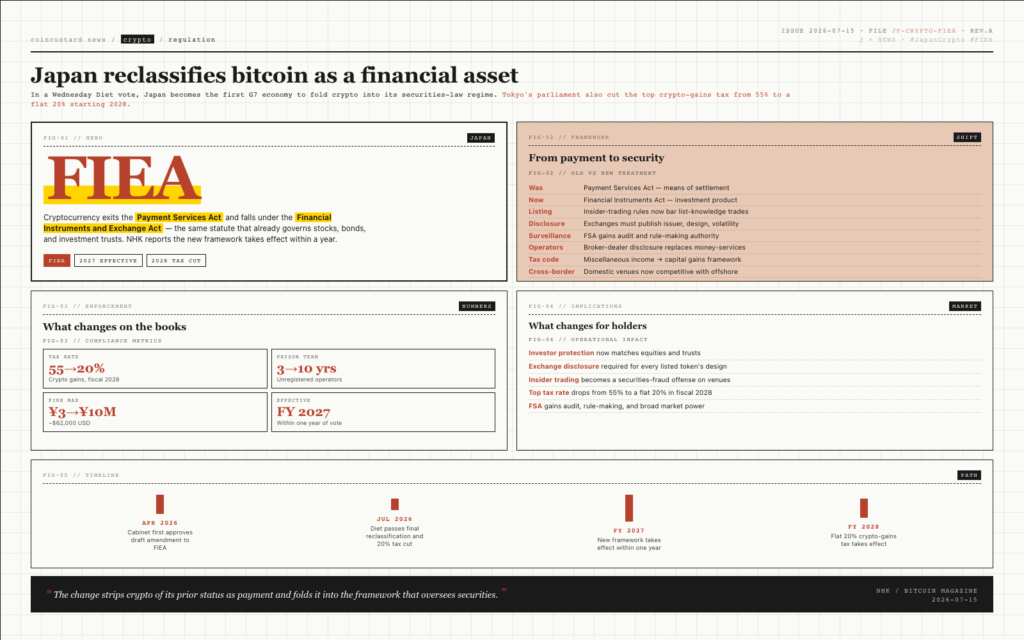
Japan’s parliament passed a landmark amendment on Wednesday that reclassifies bitcoin and other cryptocurrencies as financial assets, pulling digital assets out of the country’s payment-services regime and into the same statutory framework that governs stocks, bonds, and investment trusts. The vote, reported by public broadcaster NHK, marks the first time a G7 economy has formally moved crypto into securities-law territory, and sets the stage for a 20 percent flat tax on crypto gains starting in 2028.
The legislation took years to negotiate and survived a cabinet draft, a Diet debate, and a parallel tax bill before final passage. Its practical effect is to treat bitcoin as an investment product rather than as a payment instrument, a category shift that rewires disclosure, insider-trading rules, market surveillance, and criminal penalties across the entire Japanese crypto market.
How the new law rewires crypto supervision
Under the amendment, crypto assets leave the Payment Services Act and fall under the Financial Instruments and Exchange Act (FIEA), the statute Japanese regulators use to police securities markets. The same exchange operators that previously disclosed as money-services businesses now disclose as broker-dealers. The same tokens that previously cleared as digital payment instruments now clear as investment products.
The most consequential operational change is the disclosure regime. Exchanges must publish data on each token’s issuer, blockchain design, and volatility profile, a reporting standard that mirrors the disclosure demands placed on listed securities. Insider-trading rules now apply to crypto listings, delistings, and major technical incidents, meaning the same gating that prevents a broker from front-running a corporate earnings release now prevents a Japanese exchange from trading on knowledge of an imminent listing.
Enforcement gets sharper
Criminal penalties for unregistered crypto operations climb sharply under the new framework. The maximum prison term for unregistered operators rises from three years to 10 years. The maximum fine climbs from 3 million yen to 10 million yen, near 62,000 U.S. dollars. Both numbers were set in the early days of Japanese crypto regulation; both now reflect the severity that securities regulators have applied to traditional market misconduct for decades.
Regulators also gain broader market-surveillance authority over the sector. The Financial Services Agency can now pull trading data, audit exchange operators, and order rule changes across the industry in ways that were previously reserved for brokerage and asset-management firms. The institutional posture toward digital assets has shifted from tolerance to active supervision, with the full enforcement toolkit of a securities regulator.
“The change strips crypto of its prior status under the Payment Services Act, where regulators treated it as a means of settlement, and folds it into the Financial Instruments and Exchange Act (FIEA), the same statute that oversees traditional securities.”
The 20 percent tax cut that comes with it
The reclassification also clears the way for the country’s second major crypto reform, a flat 20 percent tax rate on crypto gains starting in 2028. Japan’s existing framework taxes crypto gains as miscellaneous income at rates as high as 55 percent, a level widely blamed for pushing traders offshore and suppressing professional market-making on regulated venues. The new flat rate brings crypto tax treatment in line with capital gains on listed securities.
By aligning tax treatment with securities treatment, the Diet is signaling that the next phase of Japanese crypto policy will look more like Tokyo’s equities policy than its payments policy. That means deeper liquidity on regulated venues, broader institutional participation, and a stronger incentive for retail traders to keep assets on domestic exchanges rather than moving them to offshore platforms.
What changes for Japanese crypto holders
- Crypto holdings gain the same investor-protection standards that currently apply to equities and investment trusts.
- Exchange operators face mandatory disclosure around each token’s issuer, blockchain design, and volatility profile.
- Insider trading is now a securities-fraud offense on Japanese crypto venues, with prison sentences up to 10 years.
- The top tax rate on crypto gains drops from 55 percent to a flat 20 percent starting in fiscal 2028.
- FSA gains full market-surveillance authority, including audit and rule-making power over the sector.
Why the timing matters
The reclassification lands while Japan is also moving on a yen-pegged stablecoin framework, an exchange-traded fund pipeline, and a regional Web3 hub strategy in Osaka and Fukuoka. Combined, those initiatives point toward a coherent industrial policy: treat crypto as financial market infrastructure, supervise it as such, and tax it as such. Markets that move first on this trifecta tend to absorb a disproportionate share of regional liquidity, and Japan’s regulators know it.
The implementation timeline is fast by Japanese legislative standards. NHK reports the change takes effect within a year of passage, with a target of fiscal 2027. That puts the legal framework in place well before the tax cut takes effect in 2028, giving exchanges and regulators a year to align their operations with securities-law disclosure standards before retail-facing tax incentives land. Japan’s parliament has now made the first move in what looks like a coordinated, multi-year integration of crypto into the country’s mainstream financial market architecture.