
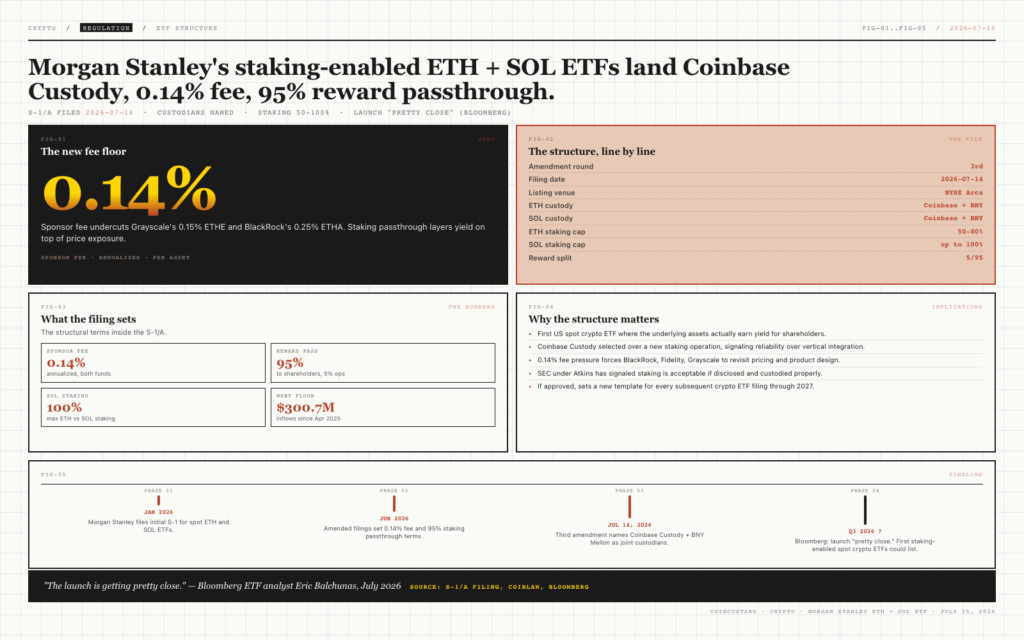
Morgan Stanley filed its third round of amended S-1/A registration statements for spot Ethereum and Solana exchange-traded funds on July 14, 2026, naming Coinbase Custody Trust Company alongside the Bank of New York Mellon as custodians and staking facilitators, according to the amended filings reviewed by analysts this week. The move brings the long-anticipated Morgan Stanley ETH and SOL ETFs closer to launch and crystallizes the operational infrastructure that has been the missing piece since the bank’s January 2026 debut filing.
The amended filings set the terms of the most aggressive institutional crypto ETF pricing structure yet proposed. Both funds carry a 0.14% annualized sponsor fee, undercutting Grayscale’s 0.15% ether product and well below BlackRock’s iShares Ethereum Trust at 0.25%. The Ethereum trust is permitted to stake between 50% and 80% of its holdings, while the Solana trust can stake up to 100% of its SOL. Staking rewards split 5/95, with 5% going to custodians and staking providers and 95% accruing to the trust for distribution to shareholders, a structural innovation that distinguishes Morgan Stanley’s products from every other spot crypto ETF currently trading.
Why the Staking Passthrough Matters
Spot Bitcoin and spot Ethereum ETFs that have launched to date hold their underlying assets in cold storage and earn nothing on them. That structure was a regulatory necessity under the prior SEC framework, which treated staking as an unregistered investment contract. Under Paul Atkins’ leadership, the SEC has signaled that staking activity can be permitted within an ETF wrapper if the structure is clearly disclosed, the custodians are appropriately registered, and the rewards flow through to shareholders. Morgan Stanley’s filings are the first major institutional test of that framework.
The math is significant. Ethereum staking currently yields roughly 3.2% annually, and Solana staking yields between 6% and 7% under normal network conditions. A Morgan Stanley Solana ETF that stakes 100% of its holdings and passes through 95% of rewards would deliver a staking yield of roughly 5.7% to 6.7% on top of any price appreciation, less the 0.14% sponsor fee. The combined return profile is materially better than holding SOL directly through most retail platforms, where staking yields are partially absorbed by platform fees, and meaningfully better than the 0% yield on existing spot Solana products still waiting on approval.
Fee War Benchmarks
- Morgan Stanley proposed: 0.14% sponsor fee with staking passthrough.
- Grayscale Ethereum Trust (ETHE): 0.15% sponsor fee, no staking.
- BlackRock iShares Ethereum Trust (ETHA): 0.25% sponsor fee, no staking.
- Fidelity Wise Origin Bitcoin Fund (FBTC): 0.25% sponsor fee, no staking.
- VanEck Ethereum Strategy ETF: 0.20% sponsor fee, futures-based.
Coinbase Custody and BNY Mellon Split Custodial Duties
The amended filings name Coinbase Custody Trust Company as the primary custodian for both the ether and Solana assets, with the Bank of New York Mellon acting as custodian for cash and traditional settlement functions. The dual-custodian structure mirrors what other large institutional crypto ETFs have adopted, but Morgan Stanley’s choice is notable because Coinbase is the only major crypto-native custodian with the regulatory standing and operational scale to handle a multi-billion-dollar staking position.
Coinbase Custody already serves as custodian for the majority of US-listed spot Bitcoin and Ethereum ETFs. The fact that Morgan Stanley selected Coinbase rather than building or contracting a new staking operation signals that the bank is choosing operational reliability over vertical integration, a sensible posture for a first-time crypto ETF issuer.
Market Positioning and What Comes Next
Morgan Stanley’s Bitcoin Trust, ticker MSBT, drew $300.7 million in inflows after its April 2025 debut. That fund trades at 0.18% and does not offer staking. The new ether and Solana products sit alongside MSBT in Morgan Stanley’s crypto lineup but target a different investor: advisors and institutional clients who want yield, not just price exposure. The combination of near-zero fees and staking passthrough is a direct response to two years of advisor feedback that spot crypto ETFs are too expensive for the yield profile they actually offer.
“The launch is getting pretty close.” (Bloomberg ETF analyst Eric Balchunas, July 2026)
The critical question is whether the SEC will approve the staking structure as filed. The Commission under Atkins has been more permissive on staking than its predecessor, but no spot ETF has yet received approval to stake any portion of its holdings. Morgan Stanley’s third amendment is the closest the market has come to that threshold. Bloomberg’s Eric Balchunas and other ETF analysts have indicated that approval could come within weeks if the SEC does not object to the staking disclosures. If approved, Morgan Stanley would launch the first US spot crypto ETFs where the underlying assets actually work for the shareholders, a structural shift that could reset advisor expectations for the entire crypto ETF category.
For investors, the practical effect of the Morgan Stanley ETH ETF filing is that a new generation of crypto ETFs may soon combine near-zero fees, multi-asset diversification, and staking yield in a single brokerage-line product, the closest the institutional market has come to matching the economics of holding the assets directly.