
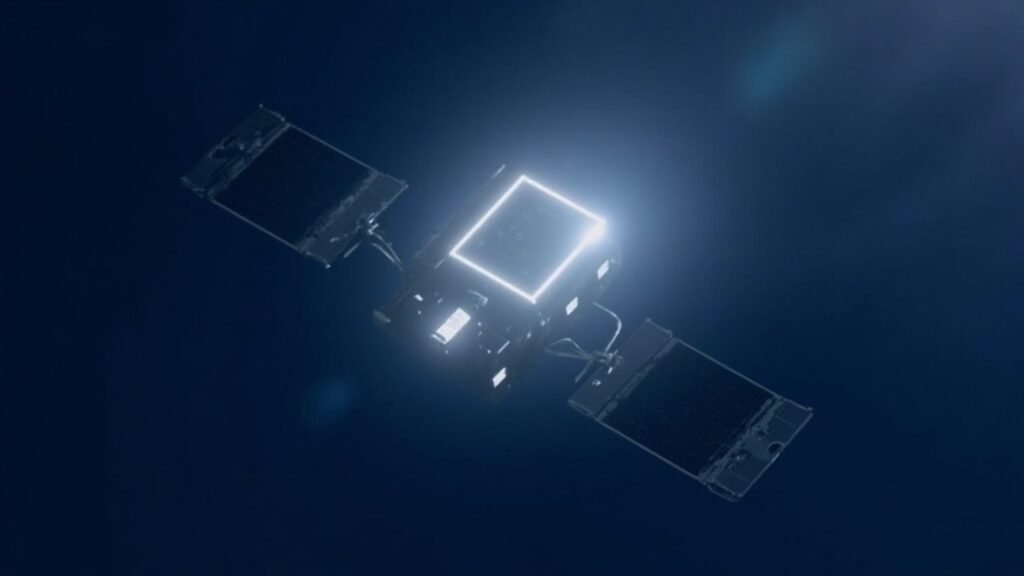
Google Project Suncatcher is heading to orbit. The company announced that its first prototype satellite, carrying four Trillium-generation Tensor Processing Units, is scheduled to launch on October 1 aboard SpaceX’s Transporter-18 rideshare mission. The mission is an early test of whether AI hardware can survive the radiation, thermal swings, and vibration of low Earth orbit.
What Google Project Suncatcher Is Trying to Prove
The long-term research program, called Google Project Suncatcher, asks a deceptively simple question: can space host scalable machine learning infrastructure? Satellites in low Earth orbit get near-constant sunlight, generating up to eight times more solar power than ground installations. If constellations of satellites could be linked together, they might one day manage large AI workloads without depending on terrestrial power grids.
Announced roughly a year earlier, the moonshot is following the same playbook Google used for autonomous driving and quantum computing — years of experimentation before any practical system. The October launch is the first deliberate step toward that end goal.
The Prototype Satellite and Its Hardware
The vehicle was developed in partnership with Planet and carries a minimal viable payload of four TPUs. Those chips are the same Trillium silicon Google uses in its data centers, adapted for a flight environment. Future satellites in the program are expected to carry dozens of TPU chips each, flying in coordinated clusters.
Before the chips were bolted to the satellite, Google’s engineers ran them through ground testing meant to simulate launch and orbit. A 10-minute rocket ride subjects a spacecraft to intense vibration and sustained acceleration up to 10 times Earth’s gravity. Individual TPU components can experience forces between 50 and 100 g during that window.
Vibration, Radiation, and Bitflips
To replicate launch stresses, the team shook the satellite along all three axes at the frequencies a rocket produces. The hardware held up, an outcome Google described as a pleasant surprise. Engineers then moved on to radiation testing at UC Davis’s Crocker Nuclear Laboratory, running live AI workloads on TPUs inside a proton beam.
The team monitored for bitflips and other errors caused by solar events and cosmic rays. Early results indicate that Trillium TPUs can tolerate a total ionizing dose greater than what a five-year space mission would deliver. Final confirmation, however, will only come from putting the chips in actual orbit.
Cooling Without Air
Heat dissipation is a different kind of problem in space. TPUs generate large amounts of heat in a compact footprint, and there is no convective airflow in a vacuum to carry it away. Google’s engineers are experimenting with heat pipes combined with radiator panels, a thermal architecture tested in a thermal vacuum chamber that simulates both the vacuum and the temperature swings of low Earth orbit.
The orbital test will reveal whether the cooling design works as modeled. Designs will be refined based on telemetry from the first mission, with the team planning more ambitious tests in 2027.
Laser Links Between Satellites
Future Project Suncatcher constellations will need to move enormous volumes of data between satellites in close formation. The team is developing free-space optical links, essentially laser crosslinks, capable of very high bandwidth over extremely short distances. Each satellite must know its own position and the position of its neighbors to keep the beams aligned.
Maintaining that connection requires extraordinary precision. Google compared the alignment challenge to hitting a coin-sized target from miles away while both endpoints are in motion. A two-satellite test of the laser system is scheduled for 2027, the program’s next major milestone.
Why a Moonshot Instead of a Data Center
The economic logic is straightforward: sunlight in orbit is nearly continuous, which sidesteps one of the biggest constraints on terrestrial AI infrastructure. If even a fraction of the projected solar gain translates into usable compute, orbital clusters could become a competitive alternative to building more ground-based data centers.
That promise is still years away from reality. The October 1 launch is explicitly framed as a learning mission — a chance to identify failure modes, gather in-orbit data, and feed those lessons into the next generation of hardware and thermal designs.
The Road Ahead for Google Project Suncatcher
Google’s team has been transparent that none of this will happen overnight. The first launch is about discovering what breaks, what survives, and what needs to be redesigned. Results from the prototype will shape the 2027 dual-satellite mission, which in turn will inform the eventual multi-satellite clusters the program envisions. As Google Project Suncatcher heads to the launchpad, the company is treating orbital AI compute the same way it treated self-driving cars and quantum chips — as a long research arc that begins with one careful, deliberate test.
Google Project Suncatcher draws on collaborations with Planet Labs and other partners experienced in operating satellite constellations, lending operational expertise to a research-driven effort that began in 2024. Published studies, including arXiv papers from 2025, outline radiation effects on Trillium TPUs and the mechanical stresses of tight orbital formations. Those early findings have already shaped the upcoming prototype mission, ensuring that each subsequent iteration benefits from a growing body of empirical space-hardware data.