
# AI Spending Set to Hit $2.5 Trillion in 2026 as World Leaders Debate Governance
## Historic Investment Wave Rivals History’s Greatest Projects
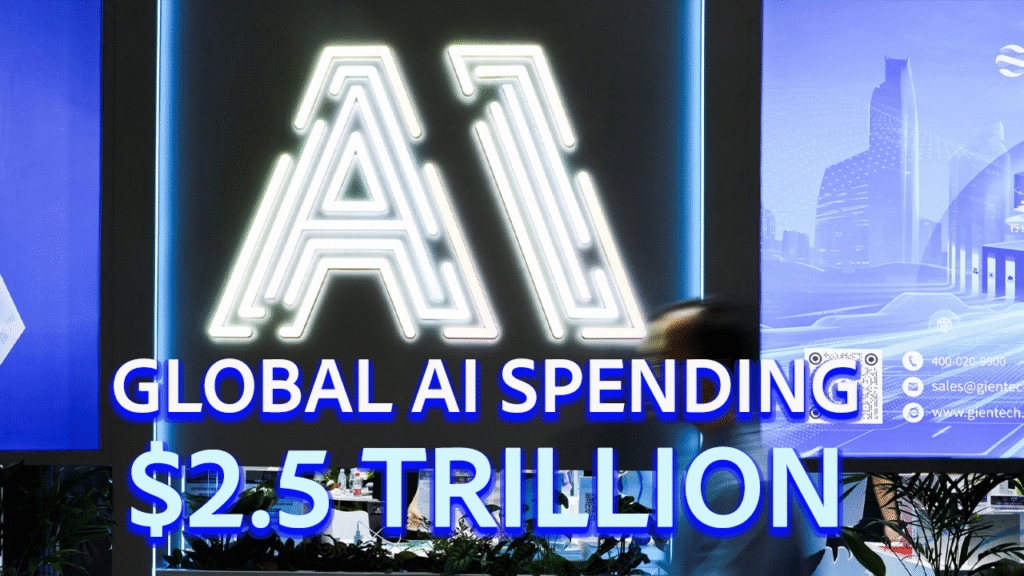
Global spending on artificial intelligence is forecast to reach an astonishing $2.5 trillion in 2026, representing a 44 percent increase over 2025, according to new research from Gartner. This unprecedented investment surge has drawn comparisons to some of history’s most ambitious scientific and infrastructure undertakings, including the Manhattan Project, Apollo Program, and the U.S. Interstate Highway System.
The scale of AI investment is difficult to comprehend without perspective. Between 2013 and 2024, total global corporate investment in AI reached $1.6 trillion—surpassing the combined costs of developing the atomic bomb, landing humans on the moon, and building 75,000 kilometers of American highways. Unlike those government-led initiatives, AI funding has flowed primarily through private markets, venture capital, corporate research, and global investors, making it one of the largest privately financed technological waves in human history.
## Where the Money Is Going
The breakdown of projected 2026 AI spending reveals the technology sector’s priorities. AI infrastructure will consume the lion’s share at $1.37 trillion, followed by AI services at $589 billion and AI software at $452 billion. Cybersecurity investments will total $51 billion, while data science and machine learning platforms will receive $31 billion. By 2027, Gartner forecasts AI spending will surpass $3.3 trillion globally.
Geographic distribution remains heavily concentrated. The United States accounts for roughly 62 percent of total private AI funding since 2013, with American companies investing $471 billion across nearly 7,000 newly funded AI companies. China ranks second at $119 billion, followed by the United Kingdom at $28 billion. India, despite its ambitions highlighted at this week’s global summit, has attracted only $11 billion in private AI investment.
## World Leaders Convene for AI Governance Discussions
The financial magnitude of AI investment frames the stakes as world leaders gather in New Delhi for the India AI Impact Summit 2026. United Nations Secretary-General Antonio Guterres delivered a stark warning, urging that AI’s future cannot be left to “the whims of a few billionaires.” He called on tech tycoons to support a $3 billion global fund ensuring open access to artificial intelligence for all nations.
French President Emmanuel Macron emphasized Europe’s determination to shape AI regulations. “Europe is not blindly focused on regulation,” Macron stated. “Europe is a space for innovation and investment, but it is a safe space.” The French leader highlighted collaboration with India as key to establishing global AI governance frameworks.
India’s Prime Minister Narendra Modi unveiled the “MANAV Vision” for artificial intelligence, emphasizing his country’s commitment to open-source development. “The AI model which succeeds in India can be deployed all over the world,” Modi said. “India believes that AI technology will only be beneficial when it is shared and its core systems are open.”
## Bill Gates Withdraws from Summit
A notable absence at the summit was Microsoft founder Bill Gates, who withdrew just hours before his scheduled appearance amid scrutiny over his past relationships with the late Jeffrey Epstein. The Gates Foundation stated the withdrawal was to “ensure the focus remains on the AI Summit’s key priorities.” Gates had previously stated he regrets “every minute” spent with Epstein.
As the first global AI meeting held in a developing country, the five-day summit has provided India an opportunity to boost its position in the rapidly evolving sector. The country rose to third place in Stanford University’s annual AI competitiveness ranking last year, though experts caution it remains far behind the United States and China in critical infrastructure and talent concentration.
## The Human Stakes of AI Disruption
Beyond the financial figures and diplomatic discussions, the Guardian has launched “Reworked,” a year-long reporting series examining how AI disrupts workplaces in ways both thrilling and alarming. The series arrives as anxiety over job displacement fuels what some analysts describe as a nascent workers’ movement challenging how AI adoption should proceed.
The convergence of unprecedented capital flows, global governance debates, and labor disruption concerns underscores the pivotal moment artificial intelligence represents. With $2.5 trillion poised to flow into AI systems this year alone, the decisions made in conference rooms and capitols will shape technological development for generations.