
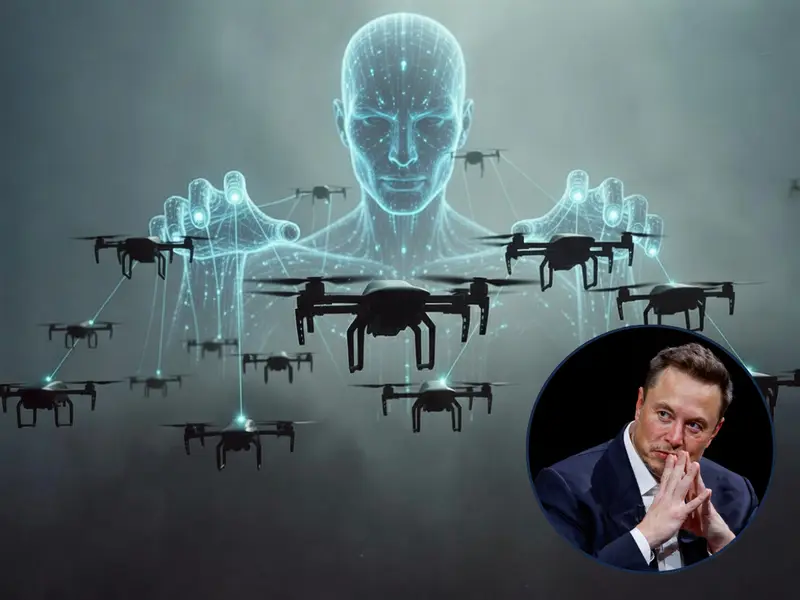
In a striking development at the intersection of artificial intelligence and national defense, SpaceX and its AI arm xAI have entered the Pentagon’s classified drone swarm competition. The program, officially unnamed and shrouded in secrecy, challenges leading technology companies to develop autonomous drone swarm systems capable of complex military operations.
The Pentagon launched the competition in late 2025 as part of its initiative to modernize US military capabilities through advanced AI systems. The competition focuses on developing swarms of aerial drones that can operate collaboratively, making real-time decisions without human intervention. These systems could revolutionize reconnaissance, search and rescue, and combat operations by providing unmatched situational awareness and operational flexibility.
SpaceX’s entry into the competition marks a significant expansion of the company’s defense work. While SpaceX has long provided launch services and satellite internet to the military through its Starlink division, this represents the company’s first major foray into autonomous weapons systems. The involvement of xAI, founded by Elon Musk in 2023, brings cutting-edge AI capabilities to the project.
“We’re excited to apply our AI expertise to national defense challenges,” said an xAI spokesperson in a rare public statement. “The drone swarm problem represents some of the most complex multi-agent coordination challenges in existence, and solving them could have profound implications beyond military applications.”
The competition has attracted significant attention from both technology companies and civil liberties groups. Proponents argue that AI-controlled drone swarms could save lives by reducing the need for human soldiers in dangerous situations and improving targeting accuracy. Critics, however, warn about the implications of autonomous weapons systems that could make life-and-death decisions without human oversight.
The involvement of Musk, who has previously expressed concerns about AI safety, has raised particular interest. At various points, Musk has called for regulatory oversight of AI development and warned about potential risks from advanced artificial intelligence. His participation in a defense-related AI program has led some observers to question whether his views have evolved or whether military applications represent an exception to his concerns.
SpaceX and xAI face formidable competition in the program. Reports indicate that Google DeepMind, Microsoft, Amazon, and several defense contractors have also entered the competition. Each team is developing different approaches to the drone swarm challenge, ranging from fully centralized systems where all drones are controlled by a single AI to decentralized architectures where drones make independent decisions while coordinating with teammates.
The technical challenges involved are substantial. Drone swarms must maintain communication in contested environments, avoid collisions in three-dimensional space, adapt to changing conditions in real-time, and accomplish complex missions despite potential losses of individual drones. Additionally, the systems must be robust against electronic warfare attacks and capable of operating in GPS-denied environments.
Security experts note that the competition could accelerate the development of AI systems with significant civilian applications. Technologies developed for military drone swarms could find uses in disaster response, environmental monitoring, and infrastructure inspection. The high reliability and autonomy required for military applications could raise standards for commercial autonomous systems as well.
The Pentagon has emphasized that all competing systems will include meaningful human oversight, addressing concerns about fully autonomous weapons. However, the definition of “meaningful oversight” remains contested, with different interpretations of how much autonomy is acceptable in various scenarios.
The competition is expected to culminate in live demonstrations in late 2026, where competing systems will be tested in realistic scenarios. The Pentagon has not indicated which technologies it will ultimately adopt or how many competing teams will receive contracts for further development.