
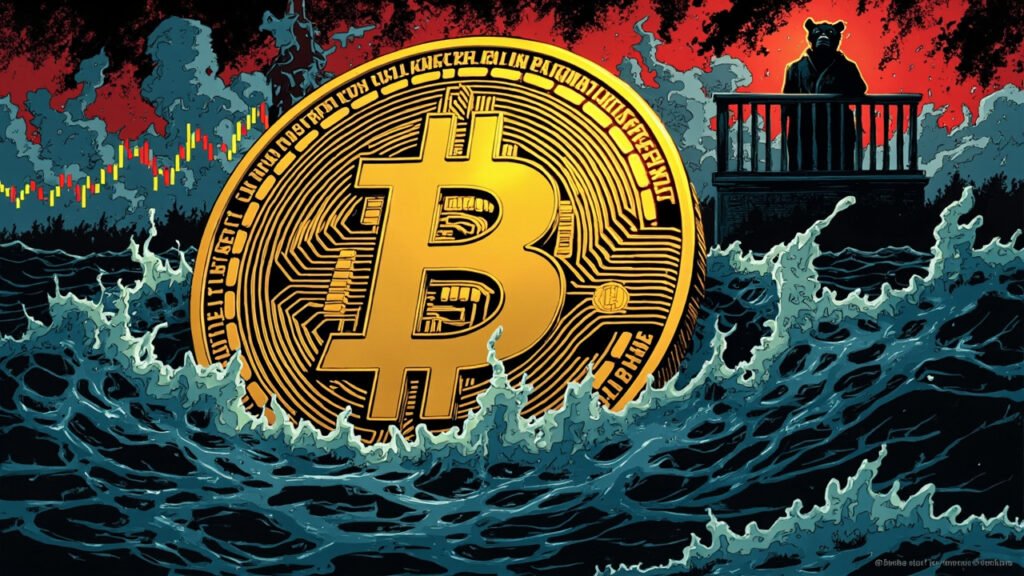
Billionaire investor Jeremy Grantham, the co-founder of Boston-based asset manager GMO and one of Wall Street’s most prominent bubble-watchers, has predicted that bitcoin will “dwindle away with a whimper” rather than collapse in a dramatic crash, warning that the cryptocurrency’s role as a store of value is being steadily eroded by competition, regulation, and the absence of a real yield floor. The remarks, delivered at a financial outlook conference in Boston on Friday, are the latest in a string of high-profile skeptics who have turned more bearish on digital assets after a brutal second quarter.
Grantham, who built his reputation identifying the Japanese asset bubble of 1989, the dot-com peak of 2000, and the 2008 housing crisis, argued that bitcoin’s lack of cash flow, dividends, or industrial utility makes it uniquely vulnerable to a slow erosion of demand. “It is not going to vanish overnight,” he said. “It is going to lose relevance, then liquidity, then participants, until one day you wake up and it is a curiosity rather than an asset class.”
Why a “whimper” is more dangerous than a crash
The warning carries particular weight because Grantham is not predicting the kind of sudden flash crash that crypto markets have endured before. His thesis is that bitcoin enters a multi-year period of range-bound decline, punctuated by short speculative rallies, in which institutional interest quietly fades and retail capital migrates to newer vehicles. That trajectory is far harder for traders to hedge against than a single sharp drawdown, because the losses are psychological as much as financial, and they unfold across enough time that most participants adjust rather than capitulate.
Granham pointed to a series of structural pressures he believes are already weighing on the market. Spot bitcoin ETF flows have flattened after the initial surge of 2024 and 2025, exchange-traded product balances have plateaued, and corporate treasuries that hoarded bitcoin in 2024 are now net sellers in many cases. At the same time, the rise of tokenized money market funds, central bank pilot programs, and stablecoin-based payment rails is giving institutions yield-bearing alternatives that did not exist two years ago.
Three forces Grantham says are quietly draining demand
- Tokenized money market funds now offer a regulated yield, undercutting bitcoin’s appeal as a “digital gold” for income-oriented allocators.
- Stablecoin payment rails are absorbing a growing share of cross-border remittance and B2B settlement volumes that might once have moved through BTC rails.
- Regulatory clarity in major economies is bringing the next generation of institutional money into yield-bearing products rather than non-yielding cryptocurrencies.
“Bitcoin’s worst enemy was never the skeptics. It was the simple fact that the financial system caught up to it.” — A senior strategist at one of the largest U.S. registered investment advisors, who asked not to be named
How bitcoin bulls are pushing back
Bitcoin advocates have not been idle. Michael Saylor, whose company Strategy remains the largest corporate holder of the asset, has continued to argue that the digital scarcity thesis is intact and that any drawdown in price is a buying opportunity for institutions with multi-decade horizons. Saylor’s defenders note that even with bitcoin off its all-time high, the dollar value of corporate and ETF holdings remains multiple times larger than at any point before 2024, and that on-chain settlement volume continues to grow year over year.
Industry data backs up parts of that argument. Active bitcoin addresses are near record highs, the Lightning Network’s payment capacity has roughly doubled since the start of 2026, and several sovereign wealth funds in the Middle East and Asia have added to their positions during recent weakness. Still, the same data shows that the marginal buyer in 2026 is no longer the speculative retail trader who defined the 2020-2022 cycle, and Grantham’s argument is precisely that this more sober, more institutional crowd will eventually move on.
The outlook for the rest of 2026
Grantham’s broader call is that U.S. equities are also richly valued and due for a multi-year period of low real returns, with bitcoin caught in the same gravitational pull. He has urged allocators to overweight commodities, deep value international equities, and inflation-protected bonds, a stance that has made him a fixture on bearish outlook lists for more than a year. Critics counter that his long-term track record, while impressive on bubbles, has been mixed on the timing of his calls, and that the structural changes he describes have been “six months away” for at least three years.
What is not in dispute is that bitcoin enters the second half of 2026 with a thinner narrative, a more crowded short side, and a much larger institutional footprint than at any previous cycle top. Whether the asset’s next chapter is the slow erosion Grantham forecasts, the renewed bull run its advocates expect, or something messier in between, will be one of the defining questions of the next twelve months. For now, the most influential bear on Wall Street is betting that bitcoin’s story will end not with a bang, but with the quiet disappearance of the buyers who once made it matter.