
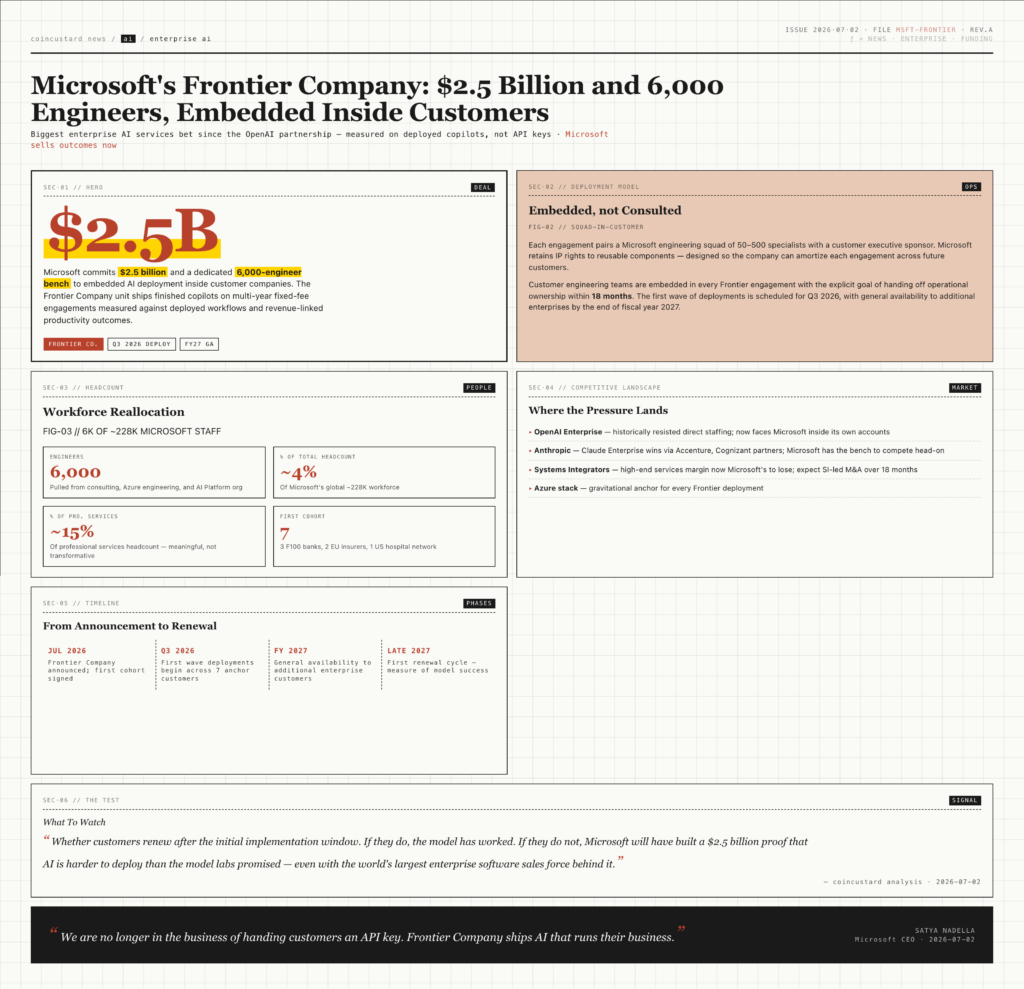
Microsoft unveiled a $2.5 billion initiative on Thursday that will place 6,000 of its own engineers, architects, and project managers inside customer companies to help them ship generative AI products. The new unit, branded the Frontier Company, marks the software giant’s most ambitious enterprise services bet since the launch of its OpenAI partnership and signals a hard pivot from selling access to AI models to selling outcomes — finished, deployed AI systems delivered on a customer’s own timeline.
The program, announced simultaneously by Microsoft CEO Satya Nadella, the company’s Frontier Company corporate blog, and reported in detail by CNBC, Bloomberg, and GeekWire on July 2, 2026, will be staffed by a dedicated cohort pulled from Microsoft Consulting Services, Azure engineering, and the company’s recently consolidated AI Platform organization. Internal memos viewed by Bloomberg describe the unit as “an implementation force that lives inside the customer,” with multi-year engagements priced as integrated services contracts rather than per-seat or per-token subscriptions.
What Frontier Company Actually Sells
Frontier Company is not a managed service in the traditional Microsoft sense. It is closer to the consulting bench that Accenture or McKinsey would deploy on a digital transformation, except that the bench ships production AI. Each engagement pairs a Microsoft engineering squad of between 50 and 500 specialists with a customer executive sponsor, and is measured against concrete deliverables: deployed copilots, integrated agent workflows, and revenue-linked productivity targets. Microsoft will retain IP rights to the reusable components and frameworks, a clause designed to let the company amortize each engagement across future customers.
The first cohort of customers, drawn from financial services, healthcare, and manufacturing, includes three Fortune 100 banks, two European insurers, and a U.S. hospital network, according to people familiar with the rollout. Microsoft declined to name the customers but confirmed that the program is structured as a multi-year, fixed-fee engagement with performance milestones tied to measurable AI adoption metrics. The first wave of deployments is scheduled to begin in Q3 2026, with general availability to additional enterprise customers by the end of fiscal year 2027.
Strategic Calculus
- The move formalizes a stance Microsoft has been signaling for a year: that selling raw model access is a commodity business, and durable margin lives in implementation.
- By embedding staff inside customers, Microsoft deepens switching costs and locks out OpenAI’s own enterprise sales motion from accounts where Microsoft is already the systems integrator.
- The 6,000-person bench represents about 4% of Microsoft’s total global workforce and roughly 15% of its professional services headcount, a meaningful but not transformative reallocation.
“We are no longer in the business of handing customers an API key. Frontier Company ships AI that runs their business.” — Satya Nadella, Microsoft CEO, July 2, 2026
The Competitive Picture
Frontier Company lands directly on two competitors. The first is OpenAI’s own enterprise motion, which has been hiring implementation partners but has historically resisted staffing customer engagements directly. The second is Anthropic, whose Claude Enterprise offering has won marquee accounts in legal and financial services by leaning on partner integrators like Accenture and Cognizant. Microsoft now has the bench to compete head-on, and crucially, the Azure stack to anchor each deployment on its own infrastructure.
For systems integrators, Frontier Company is a mixed signal. Partners remain essential for the long tail of mid-market customers that Microsoft does not want to staff directly. But the high-end accounts — the ones that drive most of the services margin — are now Microsoft’s to lose. Industry analysts expect a wave of SI-led M&A over the next 18 months as mid-tier consultancies reposition to defend the segments Microsoft is leaving behind.
What It Means For AI Adoption
The deeper question is whether the Frontier Company model accelerates or merely front-loads AI deployment. Microsoft’s argument is that large enterprises fail at AI not because they lack models but because they lack the organizational capacity to integrate those models into existing workflows, data estates, and regulatory frameworks. A dedicated Microsoft squad that ships a working copilot in 90 days, the company claims, compresses the timeline from pilot purgatory to production by an order of magnitude.
Critics counter that embedding vendor staff inside customer organizations creates the same dependency problem that doomed many early cloud migrations: enterprises that outsource the actual integration work do not build the internal muscle to maintain and extend those systems once the vendor leaves. Microsoft addresses this concern in its standard contracts by requiring that customer engineering teams be embedded in every Frontier engagement, with the explicit goal of handing off operational ownership within 18 months.
Whether Frontier Company succeeds will be measured not in press releases but in renewal rates. If customers renew after the initial implementation window, the model has worked. If they do not, Microsoft will have built a $2.5 billion proof that AI is harder to deploy than the model labs promised, even with the world’s largest enterprise software sales force behind it. The first renewal cycle arrives in late 2027, and the entire enterprise AI services industry will be watching.