
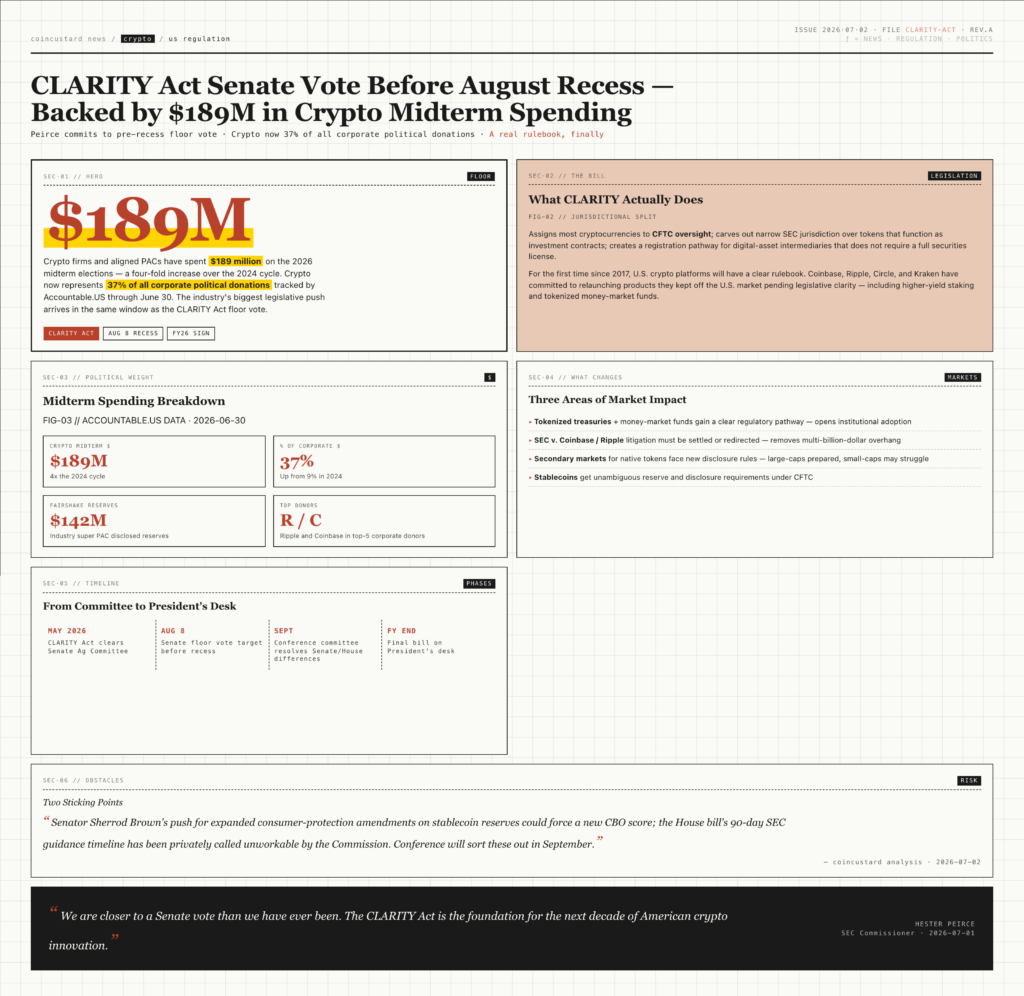
SEC Commissioner Hester Peirce declared on Wednesday that the long-stalled CLARITY Act, the bill that would draw a definitive line between SEC and CFTC jurisdiction over digital assets, will reach the Senate floor before the August recess. Her remarks, delivered at the Blockchain Association’s Policy Summit and confirmed in conversations with The Block, Bitcoin Magazine, and Yahoo Finance, mark the most concrete timeline the bill has had since its introduction in 2024 and come as the crypto industry has already poured $189 million into the 2026 midterm elections, accounting for 37% of all corporate political donations tracked by watchdog group Accountable.US through June 30.
The CLARITY Act, formally the “Clarity for Digital Assets and Real-world Tokenization Yields Act,” assigns most cryptocurrencies to CFTC oversight, carves out a narrow SEC jurisdiction over tokens that function as investment contracts, and creates a registration pathway for digital asset intermediaries that does not require a full securities license. The bill cleared the Senate Agriculture Committee in May and is now waiting on a floor vote that Peirce says she expects before lawmakers leave Washington on August 8 for the summer district work period.
Why The Timeline Matters Now
Until this week, the bill’s path forward was uncertain. Senate Banking Committee leadership had expressed reservations about preempting SEC enforcement authority, and the House Financial Services Committee’s companion legislation had not been formally conferenced. Peirce’s public commitment to a pre-recess vote suggests the SEC has been given assurances that its jurisdictional primacy over securities-classified tokens will be preserved in conference, an outcome that several industry lawyers had called a precondition for the Commission dropping its opposition.
For the industry, the practical implication is that for the first time since 2017, U.S. crypto platforms will have a clear rulebook. Coinbase, which has been lobbying actively for the bill through its Stand With Crypto initiative, has indicated it would relaunch several products it has kept off the U.S. market pending legislative clarity, including a higher-yield staking service and a tokenized money market fund. Ripple, Circle, and Kraken have made similar commitments in Senate Banking testimony over the past month.
The $189 Million Election Variable
- Crypto firms and aligned PACs have spent $189 million on 2026 midterm races, a 4x increase over the 2024 cycle.
- Crypto now represents 37% of all corporate political donations in 2026, up from 9% in 2024, per Accountable.US data released July 1.
- Ripple and Coinbase rank among the top five corporate donors across all industries, not just financial services.
- Fairshake, the industry super PAC, has $142 million in disclosed reserves heading into the final pre-primary spending window.
“We are closer to a Senate vote than we have ever been. The CLARITY Act is the foundation for the next decade of American crypto innovation.” — Commissioner Hester Peirce, July 1, 2026
What Stands In The Way
Two obstacles remain material. First, Senator Sherrod Brown, the ranking Democrat on Banking, has signaled he will demand amendments to expand consumer protection provisions, particularly around stablecoin reserves and disclosure of algorithmic token mechanics. Those amendments could push the timeline past August if the Senate parliamentarian determines they require a new score from the Congressional Budget Office. Second, the House companion bill includes a provision, championed by House Financial Services Chair French Hill, that would require the SEC to issue formal guidance on which tokens it considers securities within 90 days of enactment — a faster pace than the SEC’s traditional rulemaking timeline and one the Commission has privately called unworkable.
Industry lobbyists say they expect a conference committee to resolve these differences in September, with a final bill on the President’s desk by the end of the fiscal year. That timeline lines up with the post-primary campaign spending surge, when Fairshake’s reserves are likely to flow to candidates who supported CLARITY in the primaries.
What Changes For Markets
The market impact, if CLARITY becomes law, will be concentrated in three areas. First, tokenized treasury products and money market funds will gain a clear regulatory pathway, opening the door to institutional adoption at a scale the current SEC enforcement overhang has blocked. Second, the long-running SEC litigation against Coinbase, Ripple, and other major platforms will need to be either settled or redirected, removing a multi-billion-dollar legal liability overhang. Third, the secondary market for native tokens will face new disclosure rules, which most large-cap projects have been preparing for but which smaller-cap tokens may struggle to comply with.
For investors, the most immediate signal to watch is the Senate floor schedule. A vote before August 8 would put the bill on track to become law this year. A slip past the recess, combined with continued Senate Banking opposition, would push the timeline into 2027 and reset the industry’s legislative clock — a delay that the $189 million spent on this cycle suggests the industry is no longer willing to absorb quietly.