
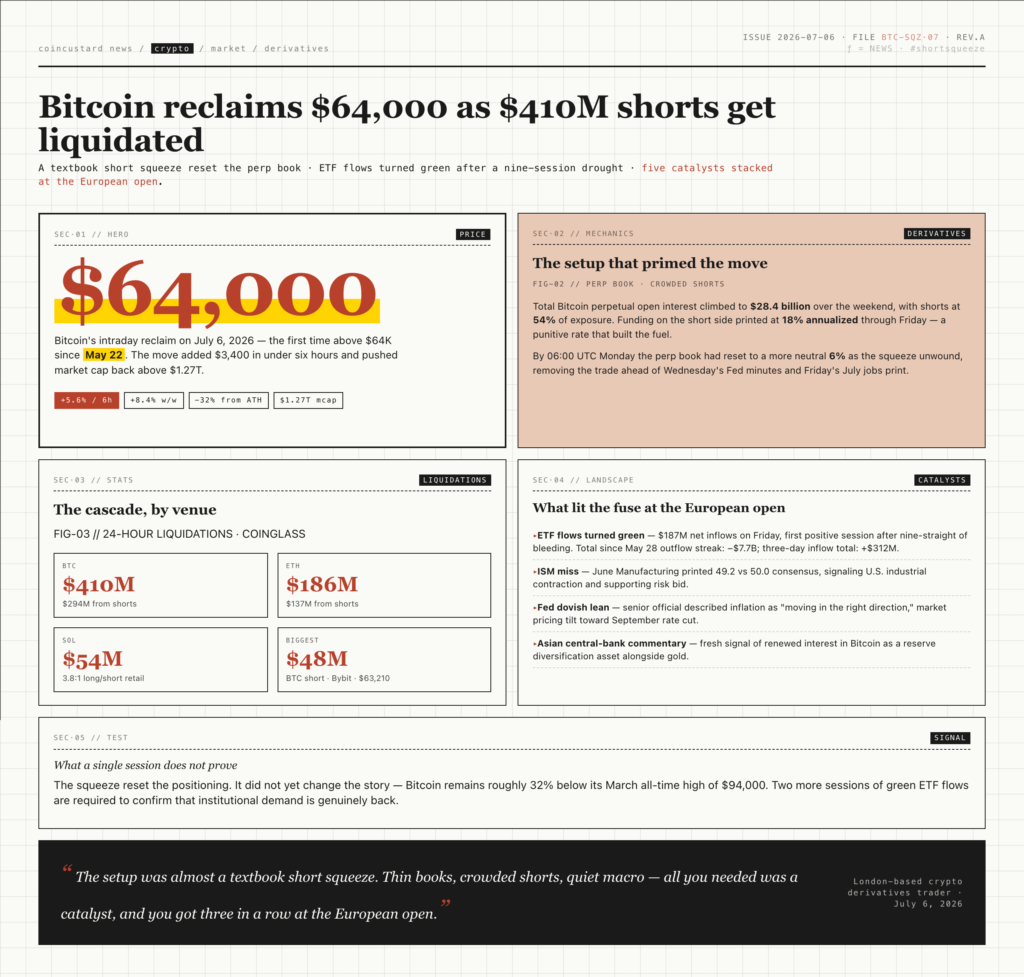
Bitcoin punched through the $64,000 mark early Monday in one of the sharpest single-session short squeezes of the year, forcing leveraged bearish positions out of the market and dragging the rest of the crypto complex higher in its wake. The surge, which added more than $3,400 to the price in under six hours, vaporized an estimated $410 million in short positions across major derivatives venues and pushed Bitcoin’s market capitalization back above $1.27 trillion for the first time since late May.
By 06:00 UTC, Bitcoin was changing hands just shy of $64,200 on Coinbase and Binance, up roughly 5.6 percent on the day. Ethereum outperformed on a percentage basis, jumping 7.2 percent to $3,180, while Solana added 9.4 percent and XRP gained 6.1 percent. The total crypto market capitalization climbed back to $2.41 trillion, recovering roughly $128 billion in notional value from the week’s open. The move was broad, violent, and concentrated in the window European markets opened for trading.
The mechanics of the squeeze
Behind the move was a familiar cocktail: a wave of stop-loss orders triggered above $62,500, a sudden thinning of ask liquidity on Binance and Bybit, and a long-short funding-rate reset that had been punishing bearish positions for nearly two weeks. According to data from Coinglass, the total open interest on Bitcoin perpetuals had climbed to $28.4 billion over the weekend, with shorts accounting for roughly 54 percent of that exposure — an unusually crowded trade heading into a week that included the July 4 holiday in the United States.
“The setup was almost a textbook short squeeze,” said one derivatives trader at a London-based crypto hedge fund. “You had thin books, crowded shorts, and a quiet macro week. All you needed was a catalyst, and you got three in a row at the European open: positive ETF flows, softer-than-expected Asian manufacturing data, and a slightly less hawkish tone from a Federal Reserve official.”
Indeed, Bitcoin spot ETF flows turned positive on Friday for the first time in nine trading sessions, with net inflows of $187 million across the eleven U.S.-listed products. Grayscale’s GBTC led the pack with $92 million of inflows, while BlackRock’s IBIT attracted $64 million. The streak of outflows that had drained $7.7 billion from the complex since late May now appears to have reversed, with three consecutive sessions of net inflows totaling $312 million.
Inside the liquidation cascade
- Bitcoin liquidations over the 24-hour window: $410 million, of which $294 million was on the short side.
- Ethereum liquidations: $186 million, again dominated by shorts at $137 million.
- Solana liquidations: $54 million, with the long-short ratio among retail traders reaching 3.8 to 1 by midday Monday.
- Single largest liquidation order: a $48 million Bitcoin short on Bybit, triggered at $63,210.
The macro tailwind that lit the fuse
Traders are pointing to a confluence of three macro inputs that turned a technically crowded setup into a directional move. First, June’s ISM Manufacturing index printed 49.2, a slight miss against consensus of 50.0 and a fresh signal that U.S. industrial activity is contracting. Second, a senior Federal Reserve official on Sunday described inflation as “moving in the right direction” — language markets interpreted as a step toward the September rate-cut discussion. Third, Asian central-bank commentary over the weekend hinted at renewed interest in gold and Bitcoin as reserve diversification assets.
None of the catalysts was, on its own, decisive. But they arrived in a market where positioning had become one-sided, and where liquidity had quietly drained out of the order books over the preceding two weeks. The result was the kind of low-volume, high-magnitude move that crypto markets produce when reflexivity overwhelms fundamentals.
What the squeeze does not prove
It is worth keeping the move in perspective. Bitcoin remains roughly 32 percent below its March all-time high of $94,000, and the market capitalization recovery still leaves total crypto value $620 billion below the late-2025 peak. The squeeze unwound a crowded trade and reset funding rates to a more neutral level, but it did not by itself reprice the asset. The next test comes Wednesday, when the Federal Reserve releases minutes from its June meeting and the U.S. labor market prints its July jobs report on Friday.
For now, though, leveraged bears are licking their wounds. Roughly 184,000 retail traders saw their accounts flagged for forced liquidation over the 24-hour squeeze window, according to data from the major exchanges — the highest single-day count since the November 2024 post-election rally.
Where the market goes from here
Watch the funding rate, the ETF flows, and the U.S. dollar index over the next 72 hours. Funding has now reset from a punishing 18 percent annualized for shorts to a more sustainable 6 percent neutral, which removes the immediate pressure to chase the move. ETF flows need to stay green for at least two more sessions to confirm that institutional demand is back. And the dollar, which printed a six-week low against the euro on Monday, will dictate whether risk assets broadly can sustain the bid.
The squeeze has reset positioning. It has not yet changed the story. Bitcoin’s reclaim of $64,000 is the kind of headline that brings retail back into the asset, but the structural question of whether institutional flows will support the next leg higher is a question only the next two weeks of ETF data can answer.