
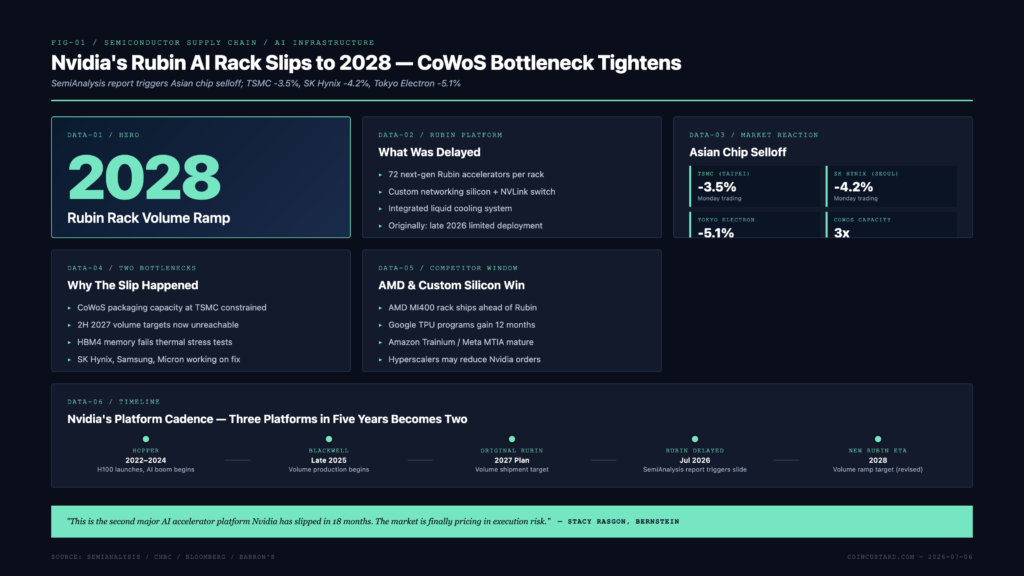
Nvidia’s next-generation AI rack system has been delayed to 2028 due to manufacturing snags and a shortage of advanced packaging capacity, according to a SemiAnalysis report published over the weekend, sending Asian chip stocks sliding and raising fresh questions about whether the AI infrastructure boom can sustain its current pace. The delay affects the company’s flagship Rubin-platform rack, which was originally slated for limited customer deployment in late 2026 and volume shipment in 2027.
The SemiAnalysis note, authored by Dylan Patel and published Saturday, attributes the slip to two specific bottlenecks. First, advanced chip-on-wafer-on-substrate (CoWoS) packaging capacity at TSMC remains constrained and is not expected to scale fast enough to support the volume Nvidia had planned for the second half of 2027. Second, several of the new high-bandwidth memory chips that are critical to the Rubin platform have failed reliability qualification at the planned clock speeds, forcing a board revision that pushes the design freeze into early 2027.
The Rack System Race
The Rubin rack is Nvidia’s most ambitious integrated system to date. Unlike the company’s traditional business of selling individual GPUs, the rack platform bundles 72 next-generation Rubin accelerators with custom networking silicon, liquid cooling, and the company’s new NVLink switch fabric into a single pre-tuned unit. Customers including Microsoft, Meta, Google, and Amazon have reportedly placed orders worth tens of billions of dollars for the system, betting that the integrated approach will let them stand up new AI training clusters faster than assembling components themselves.
The delay to 2028 means that the major hyperscalers will need to bridge the gap with the existing Blackwell generation, which has been in volume production since late 2025. That is unlikely to be a problem in the short term — Blackwell supply remains tight, and the hyperscalers have publicly committed to multi-billion-dollar order books for the platform — but it does mean that the next big leap in integrated AI infrastructure will arrive roughly 12 months later than the company had been telegraphing to investors at its March GTC conference.
The CoWoS Bottleneck
CoWoS, the advanced packaging technology that allows Nvidia to combine multiple silicon dies into a single GPU package, has been the limiting factor for AI accelerator supply since 2024. TSMC is the only foundry with the capacity to produce CoWoS in volume, and the company has been expanding capacity aggressively — adding new fab modules in Tainan and Arizona — but demand from Nvidia, AMD, Broadcom, and a handful of custom silicon programs at the hyperscalers continues to outrun supply. SemiAnalysis estimates that CoWoS capacity will need to roughly triple between now and the end of 2027 to clear the order backlog.
The reliability qualification failure on the high-bandwidth memory chips is a more technical issue. The Rubin platform relies on a new generation of HBM4 memory from SK Hynix, Samsung, and Micron, with significantly higher per-pin bandwidth than the HBM3e used in Blackwell. Sources familiar with the qualification process told SemiAnalysis that several SKUs failed thermal stress tests at the target clock speeds, and that the memory vendors are working on revised timing parameters that should be ready by Q4 2026 — but the slip in the memory timeline cascades into the board design freeze, which in turn pushes the rack ramp.
“This is the second major AI accelerator platform Nvidia has slipped in the past 18 months. The first time it was a footnote in an earnings call. This time it is a SemiAnalysis report that has the entire supply chain repricing. The market is finally pricing in execution risk.” — Stacy Rasgon, senior semiconductor analyst at Bernstein
Market Reaction and Competitive Implications
Asian chip stocks reacted sharply on Monday. TSMC fell roughly 3.5 percent in Taipei trading, SK Hynix dropped 4.2 percent in Seoul, and Tokyo Electron declined 5.1 percent. The moves reflected concern that the delay in Nvidia’s flagship program would ripple through the supply chain, reducing orders for packaging equipment, advanced memory, and substrate materials in the second half of 2027. Several Japanese equipment makers with significant exposure to CoWoS-related tooling saw even larger declines.
Competitors with their own integrated AI rack programs stand to benefit. AMD’s MI400 rack platform, which uses a similar architecture and is being co-developed with hyperscaler customers, is now likely to ship ahead of Nvidia’s Rubin, giving AMD a rare window of competitive advantage. Custom silicon programs at Google, Amazon, and Meta — which had been planning to deploy Nvidia Rubin racks alongside their in-house chips in 2027 — will now have more time to mature their own accelerators before the integrated Nvidia platform arrives.
What This Means for the AI Buildout
For the broader AI infrastructure buildout, the delay is a reminder that the supply chain behind the technology is more fragile than the headline numbers suggest. Hyperscaler capital expenditure guidance for 2027 has assumed that Nvidia would deliver three new platforms in five years — Hopper, Blackwell, and Rubin — a cadence that has been the central pillar of the AI capex narrative. With Rubin now slipping into 2028, the cadence becomes two platforms in roughly five years, and the gap between the major training cluster upgrades grows longer.
That is not necessarily bearish for AI demand — model training continues to consume all available compute, and existing Blackwell systems remain oversold for the next 18 months — but it does suggest that the pace of AI infrastructure improvement will slow slightly in 2027 before re-accelerating in 2028. For Nvidia investors, the question is whether the company can preserve its pricing power through the longer Blackwell window, or whether the delay gives hyperscalers enough breathing room to push their custom silicon programs forward and erode Nvidia’s dominant share.