
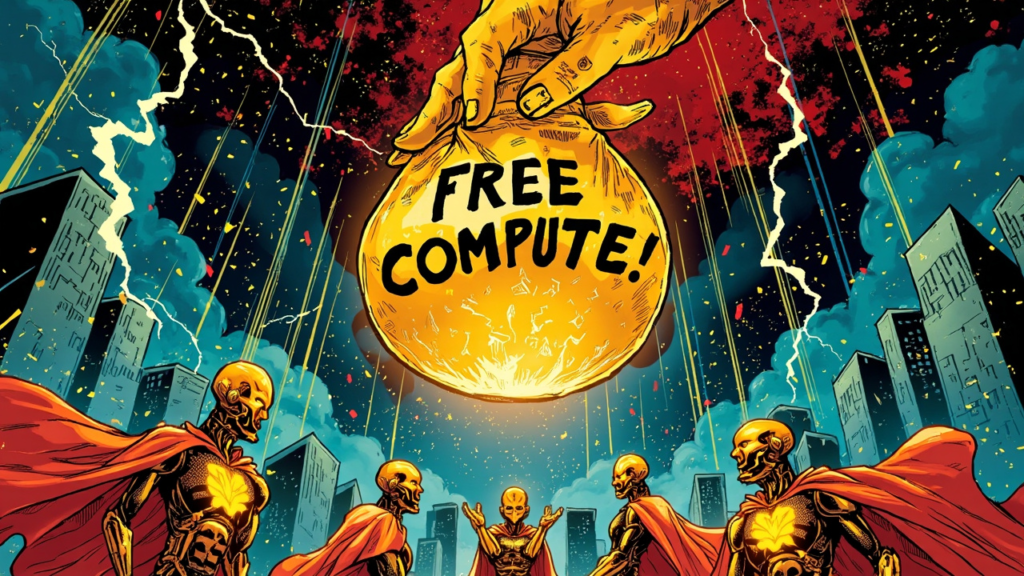
The largest artificial intelligence companies have quietly turned compute into the most generous marketing budget in the technology industry. According to a Wall Street Journal report published this week, OpenAI, Anthropic, Google and a handful of well-funded rivals are handing out tens of millions of dollars worth of free or deeply subsidised cloud capacity to small AI startups, betting that the startups that train their models on those credits will stay locked into the donor’s ecosystem long after the bills come due.
The strategy echoes the customer-acquisition playbooks that defined the early cloud era, when Amazon Web Services offered free credits to lure startups away from on-premise infrastructure. This time, the stakes are larger and the lock-in is deeper, because the compute that trains a foundation model is not a generic input. A startup that trains its models on a particular chip family and software stack inherits the donor’s pricing, hardware roadmap and policy constraints. Switching costs rise with every fine-tuning run.
How the new compute giveaway works
Startups that are accepted into partner programs at OpenAI, Anthropic, or Google Cloud typically receive a six-figure allocation of training and inference capacity that can be drawn down over twelve to twenty-four months. In some cases, the credits stretch into seven figures, particularly for companies working on safety research, robotics, or specialised enterprise agents that the donor wants to seed in its own market. In exchange, the donor receives an early look at the startup’s product roadmap, a seat on an advisory board, and the implicit promise that the startup will adopt the donor’s APIs as its default interface to outside customers.
The economics for the donor are straightforward. Acquiring an enterprise customer through direct sales can cost a large AI lab upwards of half a million dollars by the time the contract is signed. A free compute allocation of similar value produces a customer relationship that is at least as sticky, and that the startup’s own investors have already validated. The marginal cost of an unused GPU hour is essentially zero, and the upside of capturing the next category-defining startup is enormous. OpenAI in particular has been willing to extend credit to competitors in narrow verticals because the alternative, leaving the startup to default to Anthropic or Google, is more expensive in the long run.
What startups give up
- Multi-year pricing tied to the donor’s hardware roadmap, which can shift suddenly when a new accelerator generation arrives.
- Default API exposure to the donor’s distribution channels, which means a meaningful share of revenue flows back to the partner.
- Restrictive use policies on model outputs, particularly for adult content, political speech, and other categories that have drawn regulatory scrutiny.
- Roadmap visibility for the donor’s product team, which can clone successful features before the startup reaches scale.
Investors have grown more sensitive to the resulting concentration. A startup that runs almost entirely on a single donor’s stack is, in practice, a thinly veiled extension of that donor’s strategy, and a board considering a Series B will discount the valuation accordingly. Some founders have begun negotiating for explicit multi-donor commitments, splitting their training runs across two providers so that no single partner can pull the plug without warning.
Why the strategy is accelerating now
The push comes at a moment when the largest labs face a paradox of their own making. Their models are increasingly commoditised, and the real margin now sits in distribution, vertical integrations, and the agentic workflows that customers are layering on top. A startup that builds the leading agent for legal review, or for clinical trial matching, or for autonomous coding inside a regulated industry, is more valuable to OpenAI or Anthropic as a captive customer than as an independent competitor. Free compute is the cheapest way to make that capture happen.
It also reflects the maturation of the inference market. Training a frontier model is a once-or-twice-a-year event for any given lab, and the GPUs sit idle between cycles. Putting that idle capacity to work on third-party startups costs the lab essentially nothing, while generating a pipeline of products whose inference revenue the lab will eventually collect through its APIs. The credits function as a loss-leader on what is, in effect, a futures contract on the startup’s downstream compute bill.
The free-compute era is the clearest sign yet that the AI industry has moved from a research race to a distribution race. Whoever owns the relationship with the next thousand category-defining startups will own the next decade of the consumer and enterprise software markets.
What it means for everyone else
For startups outside the favoured few, the new economics are punishing. Cloud prices for AI workloads have not fallen as fast as raw hardware costs, because demand is outstripping supply at the high end. A team that has to pay list price for its training runs is at a structural disadvantage against a competitor that received a million-dollar allocation, and the gap widens with every iteration. Independent AI labs without a hyperscaler parent are now openly questioning whether the open-weight ecosystem can keep pace with closed models whose developers can subsidise their customers’ bills indefinitely.
For enterprise buyers, the consequences are quieter but real. The startups that emerge from these compute partnerships will arrive in the market with prices and product surfaces shaped by their donor’s strategic priorities. The first wave of AI-native software companies may look more like a set of co-branded reseller relationships than a genuinely open market, and procurement teams that do not notice the dependency will eventually find themselves paying rents to a single supplier that owns the entire stack. The free-compute giveaway is, in the end, the most expensive gift the AI industry has ever handed out, because the bill comes due on whichever side of the table is not paying attention.