
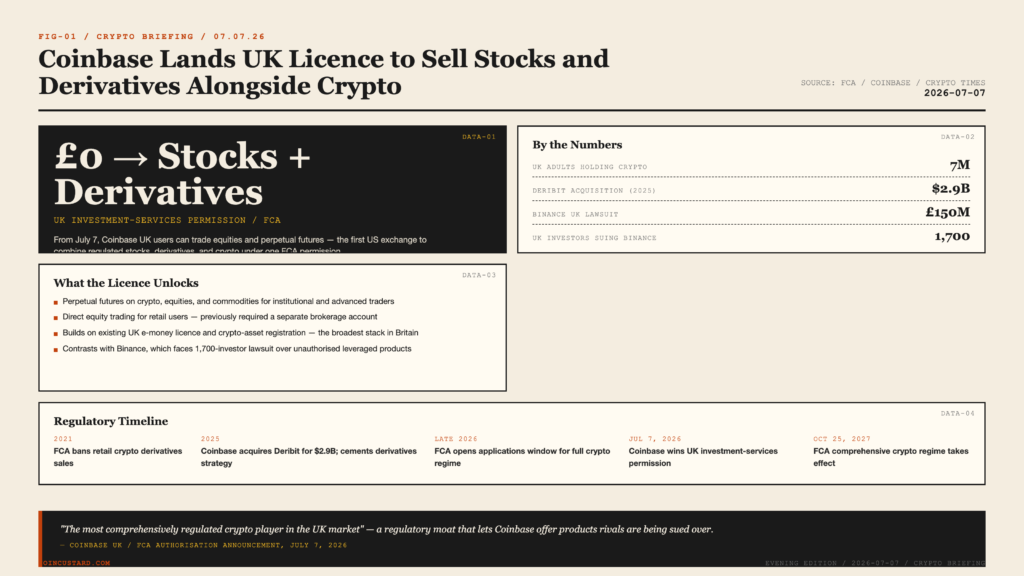
Coinbase has secured a UK investment-services licence that will let the American exchange offer British users access to stocks and derivatives for the first time, a regulatory step that places the company on the same playing field as the country’s incumbent brokerages and accelerates its long-stated ambition to become what chief executive Brian Armstrong calls an “everything exchange.” The authorisation, announced on July 7 by Keith Grose, Coinbase’s UK head, comes from the Financial Conduct Authority and unlocks two new product lines for the company’s roughly seven million UK users: perpetual futures spanning crypto, equities and commodities for institutional and advanced traders, and direct equity trading for retail customers who previously had to open a separate brokerage account to buy shares.
The move lands at a moment when Coinbase’s product surface is finally catching up with the strategic vocabulary the company has used for nearly two years. The exchange has long described its goal as collapsing crypto, equities, derivatives, lending and tokenised real-world assets into a single sign-on experience. The new UK permission is the regulatory key that lets that ambition operate onshore in one of the world’s most important financial centres, and it builds on an unusually broad existing footprint that already includes a UK e-money licence and a crypto-asset registration under the regulator’s anti-money-laundering rules. Coinbase now sits on a stack of permissions that no other crypto-native firm has assembled in Britain.
What the licence actually allows
The new permission is the British post-Brexit equivalent of the European Union’s MiFID framework, administered by the FCA rather than by an EU national regulator. Two product lines are most consequential. The first is perpetual futures, a derivatives instrument that allows sophisticated users to take leveraged positions on crypto, single equities, and commodities. Perpetuals have been the fastest-growing product at offshore crypto venues for the past two years, and bringing them onshore under FCA supervision is a meaningful upgrade in regulatory legitimacy. The second is straight equity trading, which turns the Coinbase app from a crypto venue into a venue for buying ordinary shares, an experience that has until now required a separate login with a bank, a brokerage, or a trading app.
Crypto derivatives are not new in the UK, but they are tightly policed. The FCA banned the sale of crypto derivatives to UK retail consumers in 2021, and around 1,700 UK investors are currently suing Binance for approximately 150 million pounds (roughly 200 million dollars) over allegedly unauthorised leveraged products sold before the ban. Coinbase has been careful to note that its new derivatives offering will be available to advanced and institutional users under the new authorisation, not pushed at unsuspecting retail traders, a distinction that matters both legally and reputationally as the broader industry works through its enforcement backlog.
Coinbase’s UK footprint at a glance
- 7 million UK adults now hold crypto, according to FCA data cited by Coinbase, the addressable market the licence is built to serve.
- 2.9 billion dollars: the price Coinbase paid for options exchange Deribit in 2025, the acquisition that cemented its derivatives strategy.
- 1,700 investors, 200 million dollars: the lawsuit against rival Binance, which Coinbase has been at pains to position itself against.
- October 25, 2027: the date the FCA’s comprehensive crypto regime takes legal effect, with applications opening in late 2026.
Coinbase’s bets in the EU and the UK now read as a single strategy. Across the Channel, the firm anchored its European operations with a Markets in Crypto-Assets licence out of Luxembourg, a regime whose turbulence has seen rivals such as Binance locked out of the bloc for lack of authorisation. In both jurisdictions, the company is treating early and thorough licensing as the foundation for expansion rather than the obstacle to it, and it is executing against a regulatory calendar that gives it a head start over competitors still preparing their applications.
Why the timing matters
The authorisation lands roughly fifteen months before the FCA’s comprehensive crypto framework takes effect, a window in which Coinbase can build product breadth and customer relationships while competitors are still assembling paperwork. The company has positioned itself to offer regulated stocks and derivatives well before the broader regime arrives, which is the kind of regulatory head start that compounds. Each new product line locks in more of the customer’s financial life, raises the cost of switching to a rival, and produces the data that makes the next product recommendation sharper.
The strategy is not without cost or risk. Heavy compliance spending compresses margins, and offering equities and derivatives puts Coinbase into direct competition with established UK brokerages, neobanks, and trading apps that have deep retail relationships and lower reputational baggage from the 2022 crypto downturn. A UK user who could once only buy Bitcoin on Coinbase may soon be able to buy shares, trade futures, and eventually hold tokenised assets in a single app. Whether that breadth converts into the everyday financial relationship that incumbent banks enjoy is the open question, but the licence makes clear the direction the company is heading: not a bigger crypto exchange, but a financial platform that happens to have started in crypto, built deliberately on the permissions that let it play on the same field as the banks.