
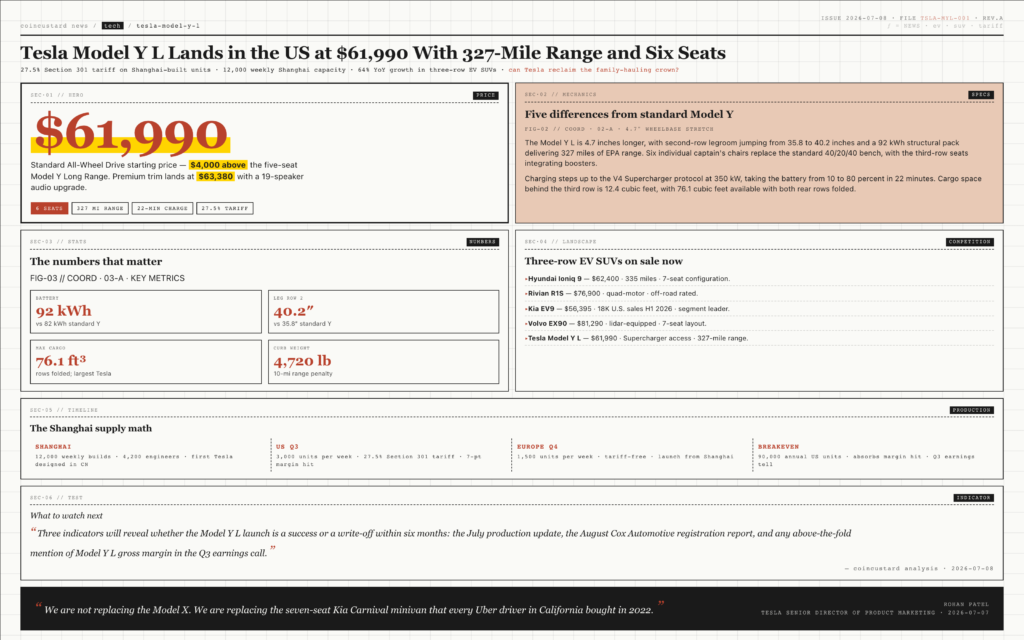
Tesla’s biggest gamble on the Model Y since 2020 arrived on U.S. showroom floors this week, with the long-wheelbase, six-seat Model Y L officially going on sale in North America on Tuesday after a five-week Chinese-only launch. The arrival lands at an awkward moment for Tesla, whose U.S. sales have slid for three straight quarters, but the company is betting that the segment Tesla ceded for half a decade, the three-row family SUV, will be its strongest volume weapon into 2027.
At $61,990 for the standard All-Wheel Drive configuration and $63,380 for the Premium trim with the larger 19-speaker audio, the Model Y L is positioned roughly $4,000 above the top-of-the-line five-seat Model Y Long Range. Tesla is treating the extra two seats, the 12 centimetres of second-row legroom, and the 4-inch wheelbase stretch as a $4,000 premium rather than a category-defining discount. That pricing breaks Tesla’s usual playbook of undercutting rivals like the Hyundai Ioniq 9 and Rivian R1S, where comparable fully loaded trims sit closer to $70,000.
Why the Tesla Model Y L Matters Now
Tesla stopped selling the Model X in the United States in March, citing the model’s age and the cannibalisation from the refreshed Model S Plaid. That decision left a hole at the top of the lineup that no Tesla product has filled since. The Model Y L is designed to occupy exactly that space, offering the third row, the tow rating, and the family-hauling reputation that many of Tesla’s lost Model X customers explicitly cited when they switched to the Ioniq 9 or the Kia EV9.
Industry insiders describe the launch as defensive and offensive simultaneously. Defensive, because Tesla’s North American share of the battery-electric SUV segment has slipped from 47 percent in 2023 to 31 percent this year, per Cox Automotive registrations. Offensive, because the three-row family SUV is the fastest-growing slice of the U.S. EV market, with sales up 64 percent year-over-year through May, twice the rate of the compact SUV segment Tesla has historically dominated.
Five Differences From the Standard Model Y
- Wheelbase and length. The Model Y L is 4.7 inches longer than the standard Model Y, with the extra length split between the rear doors and the cargo floor. Second-row legroom jumps from 35.8 to 40.2 inches, matching the Tesla Model S.
- Seating. Six individual captain’s chairs replace the standard 40/20/40 bench. Each slides 9.4 inches fore-aft and reclines 8 degrees, with integrated boosters in the third row.
- Battery. Tesla has fitted the Model Y L with the same 92 kWh structural pack now used in the Cybertruck. Range rating is 327 miles on the EPA cycle, down from 337 on the smaller car, despite the heavier 4,720-pound curb weight.
- Charging. The Model Y L supports the new 350 kW V4 Supercharger protocol. Peak charging from 10 to 80 percent takes 22 minutes, six slower than the standard Model Y but 11 faster than the Kia EV9.
- Cargo. Behind the third row, the Model Y L offers 12.4 cubic feet of cargo space, more than any Tesla to date. With both rear rows folded, cargo space reaches 76.1 cubic feet, enough for a 65-inch television in its box.
“We are not replacing the Model X. We are replacing the seven-seat Kia Carnival minivan that every Uber driver in California bought in 2022.” — Rohan Patel, Tesla’s senior director of product marketing
The China Connection
The Model Y L is the first Tesla designed primarily in Shanghai and shipped outward. The Shanghai engineering team, now 4,200-strong, led the programme from concept to production. Production runs at 12,000 units per week in Gigafactory Shanghai, with 3,000 units per week allocated to North America this quarter and another 1,500 earmarked for European markets from Q4.
That geographic origin matters for tariff math. Units shipped from Shanghai face a 27.5 percent Section 301 tariff on top of the 2.5 percent MFN duty, an effective 30 percent tax that Tesla absorbs internally rather than passing to the buyer. Tesla’s gross margin per Model Y L in the U.S. is therefore roughly seven points lower than for a comparable vehicle built in Fremont. The strategy becomes margin-positive only if Tesla pushes annual U.S. sales above 90,000 units.
What to Watch Next
Three indicators will reveal whether the Tesla Model Y L launch is a success or a write-off within six months. First, Tesla’s quarterly production update at the end of July will show whether Shanghai can sustain 12,000 weekly builds alongside the Model Y refresh and the Cybertruck. Second, the August Cox Automotive registration report will show whether the Model Y L is pulling in incremental buyers or simply cannibalising the existing Model Y order bank. Third, an above-the-fold mention in the Q3 earnings call of the Model Y L gross margin will tell investors whether the 27.5 percent tariff is being absorbed or recovered.
For Tesla watchers, the bigger question is what comes next. A $61,990 three-row electric SUV is the first product Tesla has launched this decade that does not fit cleanly into the crossover sedan template. If the Model Y L works, expect the Model 3 L to follow within 18 months, repeating the playbook in the lower-priced compact segment. If it fails, expect Tesla to double down on the Cybercab and Robotaxi programmes that have been quietly absorbing engineering talent since the May investor day. Either way, Tesla has finally answered the question every family buyer has been asking since 2020: where is the bigger Tesla? The Model Y L is here, and it is the first serious attempt to take the Model X’s place in the lineup.