
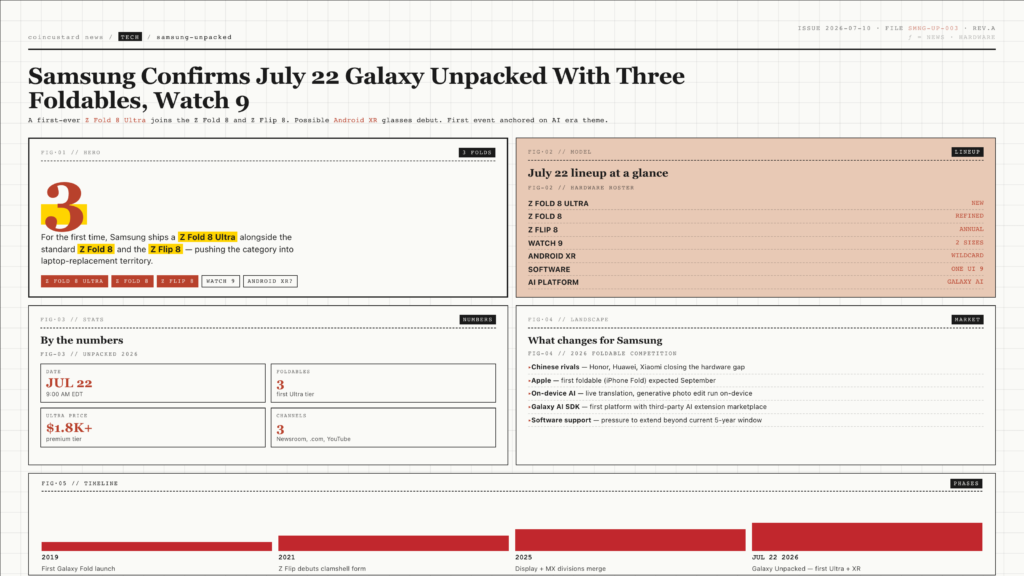
Samsung has officially confirmed that its next Galaxy Unpacked event will take place on July 22, 2026, ending months of speculation about the timing of its annual foldable smartphone refresh and setting the stage for what is expected to be the most aggressive hardware launch in the company’s history. The event, scheduled for 9:00 AM EDT and livestreamed through Samsung Newsroom, Samsung.com, and the company’s official YouTube channel, will be the first Galaxy Unpacked staged around an explicit “AI era” theme, and it is widely expected to deliver three new foldables, a refreshed smartwatch line, and possibly the first commercial debut of Samsung’s long-rumored Android XR glasses.
That scheduling is a deliberate response to a year in which the Korean company has been forced to defend its lead in the global foldable market against credible competition from Chinese vendors, particularly Honor, Huawei, and Xiaomi, each of which has been closing the hardware and software gap. The 2026 lineup is the first one Samsung has developed under the new product-strategy group consolidated after the Display and Mobile Experience divisions were formally merged in late 2025.
Three Foldables, Not Two
The most consequential change in Samsung’s 2026 foldable roadmap is the introduction of a third form factor. For the first time, the company is expected to launch a Z Fold 8 Ultra alongside the standard Z Fold 8 and the Z Flip 8, breaking a long-standing pattern of two flagship foldables per year. According to leaks from Samsung’s component suppliers, the Z Fold 8 Ultra is being positioned as a book-style device that pushes the category’s productivity and display specifications into true laptop-replacement territory, with a larger inner display, a redesigned hinge engineered for higher cycle counts, and the first Samsung foldable to ship with the company’s new ultra-wide camera module.
The Z Fold 8 itself is widely expected to retain the form factor of its predecessor, with refinements focused on weight reduction, a brighter and more efficient inner OLED panel, and the latest Snapdragon application processor optimized for on-device generative AI. The Z Flip 8, the smallest of the three, is expected to ship with a substantially larger cover display than the Z Flip 7, a hinge redesign that Samsung’s component partners have been teasing since early 2026, and a battery capacity increase that addresses one of the most common complaints from existing Z Flip owners. The pricing structure across the three devices is expected to push the Ultra firmly into the premium tier above $1,800, with the standard Fold 8 and Flip 8 holding their existing price points.
The Watch 9 and the Android XR Question
Samsung’s smartwatch refresh, the Galaxy Watch 9 series, will be the secondary headline of the event. Two sizes are expected, with the larger model gaining a slightly bigger battery, a new body-composition sensor, and a refined version of the BioActive health sensor array. AI-driven health insights, processed on-device, are widely expected to be the watch’s main software story. The Watch 9 will also be the first Samsung wearable to ship with the next generation of the company’s Wear OS-based One UI Watch interface.
The wildcard for July 22 is the rumored Android XR glasses. Samsung has been working on an extended-reality product with Google since 2023, and the glasses are widely seen as the company’s first concrete answer to the Ray-Ban Meta line that has dominated the consumer smart-glasses market since 2024. Samsung has not confirmed that the glasses will ship at the event, but the company’s official communications around the Unpacked date have leaned heavily on the phrase “next generation of Galaxy devices,” a wording that leaves room for more than just phones and watches.
The foldable category is no longer an experiment. It is the format where Samsung’s hardware lead is most visible and most defensible, and the July 22 event is the company’s clearest statement yet that it intends to keep it that way.
Why the AI Frame Matters
Samsung’s decision to anchor the entire Unpacked event around an “AI era” narrative is more than a marketing choice. The new foldables are expected to ship with deeper on-device generative AI integration than any previous Samsung phone, with several flagship features, including live translation, generative photo editing, and a system-wide writing assistant, running entirely on the device rather than in the cloud. That shift depends on a new neural processing unit that Samsung’s System LSI division has been developing in parallel with Qualcomm, and the July 22 event is likely to be the public debut of the production-ready version.
For Samsung’s enterprise and developer partners, the more important story is software. The new devices are expected to ship with One UI 9, the company’s next-generation Android skin, and the first version of Samsung’s Galaxy AI platform that is positioned as a true platform rather than bundled features. Galaxy AI on the 2026 foldables will expose a developer SDK, a marketplace for third-party AI extensions, and the first public version of the on-device foundation model that Samsung has been building in partnership with a research team acquired in 2024.
What to Watch for on July 22
The more important signal will be the hardware roadmap Samsung is willing to commit to for the rest of 2026, particularly any indication of an early-2027 Ultra refresh that would challenge the rumored Apple iPhone Ultra launch window. Industry observers will also be watching for any commitment to long-term software support beyond the current five-year window, a competitive pressure that Samsung has so far resisted but that is increasingly being set by the Pixel line at seven years. The July 22 event is the formal opening of a competitive race that will define the second half of 2026, and the lineup Samsung announces will set the pace for the rest of the year.