
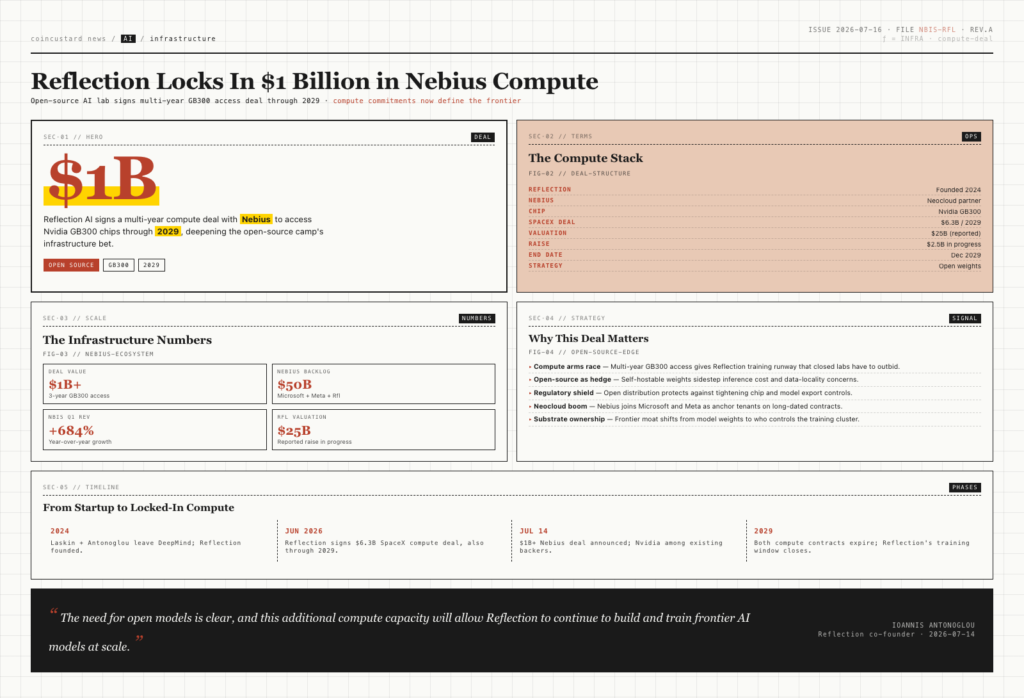
AI startup Reflection has signed a more than $1 billion deal with Nebius to lock in Nvidia GB300 AI chips through 2029, marking one of the largest single-vendor compute commitments by a young model lab and a fresh signal that the infrastructure arms race around frontier training is intensifying rather than easing.
The multi-year agreement, announced Tuesday, gives Reflection access to thousands of Nvidia’s latest-generation accelerators running inside Nebius’s European neocloud footprint. The deal runs to the end of 2029 and mirrors the structure of a separate, larger contract Reflection signed with SpaceX last month for roughly $6.3 billion in compute. Together, the two arrangements effectively pre-commit Reflection to capacity that would have been considered extraordinary for any startup only two years ago.
Open Source as a Compute Strategy
Founded in 2024 by two former Google DeepMind researchers, Misha Laskin and Ioannis Antonoglou, Reflection has staked its identity on open-weight models rather than closed APIs. The strategic logic is twofold. First, open weights allow customers to self-host, which sidesteps the runaway inference costs and data-locality concerns that have emerged around closed frontier models. Second, after recent U.S. export controls on advanced chips and tightening pressure on Anthropic-style deployments, open-source distribution has become a de facto regulatory hedge.
“The need for open models is clear, and this additional compute capacity will allow Reflection to continue to build and train frontier AI models at scale,” Antonoglou said in a statement accompanying the announcement.
Reflection is already backed by Nvidia and is reportedly in the process of raising $2.5 billion at a $25 billion valuation, a figure that would place it among the most valuable private AI labs in the world despite having shipped no consumer product of note. The Nebius contract gives the company something that money alone cannot buy right now: a guaranteed seat in line for the GB300 silicon that hyperscalers, sovereign AI programs, and other well-funded model labs are all trying to secure.
The GB300 Bottleneck
Nvidia’s GB300 generation is the successor to the GB200 chips that powered most of last year’s frontier training runs. Demand has consistently outrun supply, with lead times stretching into quarters rather than weeks. By locking in capacity through 2029, Reflection is making a bet that future model improvements will continue to depend on raw compute density rather than algorithmic efficiency alone.
The Nebius deal also extends a quiet pattern in the AI infrastructure market. Neoclouds, smaller and more specialized than AWS or Azure, have carved out a role by offering multi-year capacity contracts that hyperscalers will not. Nebius itself grew first-quarter revenue 684% year-over-year and holds a contracted backlog that analysts have estimated at $50 billion, anchored by deals with Microsoft, Meta, and now Reflection. The strategy is to lock in long-dated cash flows while hyperscalers concentrate on short-term spot demand.
What It Means for the Frontier Race
For the broader AI ecosystem, the Reflection-Nebius agreement is a marker of how the cost of competing at the frontier has shifted. Two years ago, the bottleneck was talent. Last year, it was data. This year, it is unambiguously hardware, and the labs that secure multi-year capacity first are the ones that will be able to train the next generation of models on schedule.
Compute Commitments Now Define the Frontier
- Reflection’s $1B Nebius deal runs through 2029, mirroring its $6.3B SpaceX agreement.
- The startup is raising $2.5B at a reported $25B valuation, with Nvidia among its backers.
- Nebius’s contracted backlog now exceeds $50B, anchored by Microsoft, Meta, and Reflection.
- Open-source distribution has become both a commercial and a regulatory hedge.
- GB300 lead times remain stretched into quarters, rewarding early capacity lock-ins.
Reflection’s choice to commit more than $7 billion across two long-dated contracts before shipping a flagship public model also suggests that the open-source camp believes the moat in AI will increasingly be defined by who controls the training cluster, not who controls the model weights. If that thesis holds, the next eighteen months of model releases may be decided less by research breakthroughs and more by who got their silicon orders in first.
“The need for open models is clear, and this additional compute capacity will allow Reflection to continue to build and train frontier AI models at scale.” — Ioannis Antonoglou, Reflection co-founder
For enterprise buyers watching the market, the practical takeaway is that open-weight model availability will likely deepen rather than narrow over the next two years, but only for the small handful of labs that have already secured compute. Reflection has just joined that group. Whether that translates into a competitive product, or merely into a more crowded field of well-funded general-purpose models, is the open question for 2027.
It is also a question for regulators, who are watching the consolidation of training capacity into a handful of private contracts. The Reflection-Nebius deal joins a growing list of arrangements in which frontier compute is committed years in advance, often outside public markets and outside the scrutiny that comes with listed infrastructure providers. As the AI sector matures, the next phase of policy debate may focus less on the models themselves and more on who owns the substrate they are trained on.