
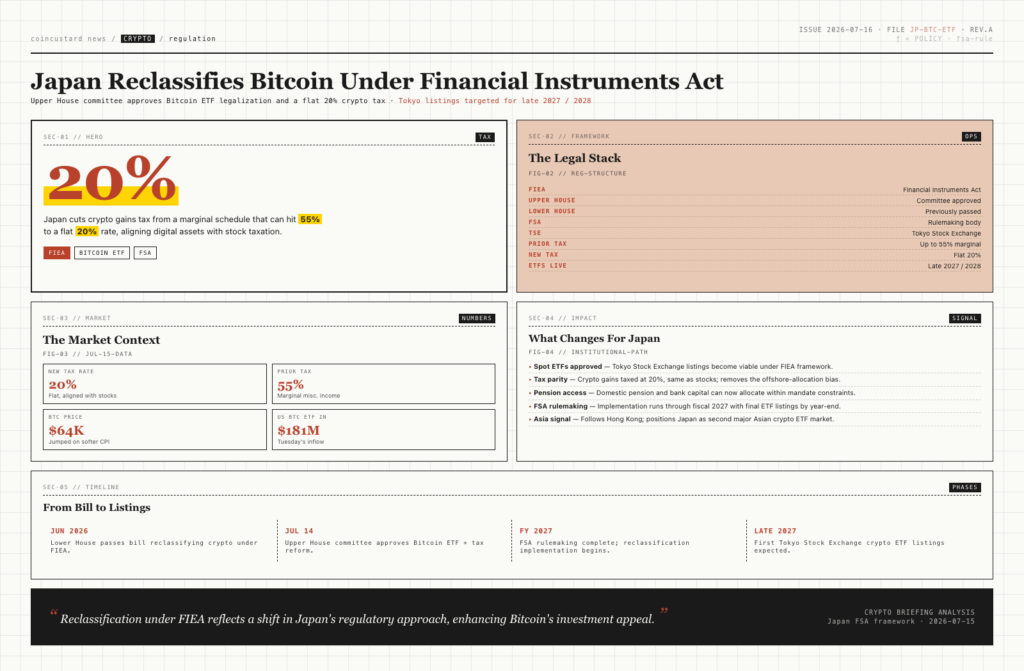
Japan’s Upper House committee has approved a landmark bill that would legalize Bitcoin exchange-traded funds and cut the country’s punishing cryptocurrency tax rate from a variable schedule that can hit 55 percent to a flat 20 percent, reclassifying digital assets as financial instruments under the country’s Financial Instruments and Exchange Act.
The vote advances one of the most consequential pieces of crypto legislation in Asia this year and sets up Japan to become the second major Asian market, after Hong Kong’s spot Bitcoin and Ether ETF launches in 2024, to offer regulated exchange-traded products tied directly to digital assets. Implementation is scheduled for fiscal 2027, with the first Tokyo Stock Exchange crypto ETF listings expected in late 2027 or 2028 once the Financial Services Agency completes rulemaking.
A Tax Regime That Pushed Capital Out
Japan has long been one of the world’s most crypto-active retail markets, but its tax treatment has been a persistent brake on institutional adoption. Under current rules, crypto gains are classified as miscellaneous income and taxed at marginal rates that can climb above 50 percent when combined with national and local levies. By contrast, stock gains are taxed at a flat 20 percent under a separate capital gains framework. The asymmetry has pushed institutional Japanese capital toward foreign crypto products and encouraged retail traders to keep positions offshore.
The new bill aligns crypto with the existing capital gains regime, a long-standing ask from the Japan Virtual and Crypto Assets Exchange Association and from institutional asset managers who have argued that the existing structure is uncompetitive relative to Hong Kong, Singapore, and the United States.
Why ETFs Matter
Spot Bitcoin and Ether ETFs in the United States have absorbed tens of billions of dollars since launch and have become the dominant on-ramp for institutional and retirement capital into digital assets. Japan’s pension funds, banks, and large asset managers have largely been locked out of the asset class because the underlying spot market is not accessible through vehicles that fit their mandate constraints.
Reclassification under the Financial Instruments and Exchange Act changes that. Once ETFs are listed, domestic asset managers will be able to allocate to crypto within the same compliance and reporting framework they already use for stocks and bonds. The Tokyo Stock Exchange listings will also benefit from Japan’s deep domestic brokerage and distribution network, which has historically been one of the most efficient in Asia.
Market Reaction and Price Context
The legislative progress came the same week as a softer-than-expected U.S. consumer price index report, which helped push Bitcoin above $64,000 and Ethereum up sharply on Wednesday. Spot Bitcoin ETFs in the U.S. took in roughly $181 million on Tuesday, a day after shedding about $425 million, suggesting that institutional appetite remains volatile but still flows in during periods of constructive news.
Prediction markets continue to price the chance of Bitcoin reaching $200,000 by the end of 2026 as low, with implied odds around 2 percent, but Japan’s legislative progress is the kind of structural development that institutional desks track rather than retail traders. The cumulative effect of multiple major economies adopting regulated ETF vehicles is to lower the friction for sovereign wealth funds, pension funds, and large family offices to add to their allocations over time.
What Changes Under the New Framework
- Crypto gains taxed at a flat 20 percent, down from a marginal schedule that can hit 55 percent.
- Digital assets reclassified under the Financial Instruments and Exchange Act (FIEA).
- Implementation scheduled for fiscal 2027, with Tokyo Stock Exchange ETF listings by late 2027 or 2028.
- First major Asian market after Hong Kong to offer regulated spot crypto ETFs.
- Domestic pension funds, banks, and large asset managers gain a compliant allocation path.
“This reclassification is expected to be implemented in fiscal 2027, which could pave the way for the first crypto ETF listings on the Tokyo Stock Exchange by late 2027 or 2028.” — Japan FSA implementation framework
For U.S. and European investors, Japan’s shift is less of a direct catalyst than it is a confirmation of a broader trend: the world’s largest capital markets are increasingly integrating crypto into the same regulated wrappers used for traditional assets. The next twelve months will likely see additional G20 jurisdictions move in the same direction, either through spot ETFs, regulated custody frameworks, or both. Japan’s vote is a marker, not the finish line, and the longer-term question is whether the resulting institutional flows will be large enough to absorb the supply from miners, bankrupt estate liquidations, and early-token unlocks that has weighed on prices for the past eighteen months.
For now, the bill still needs final Upper House approval and promulgation, but Japanese legislative committees have historically moved quickly once a measure clears committee. Crypto markets in Tokyo will be watching the next procedural steps closely, with many expecting a final vote before the end of the current parliamentary session.
The Japan Bitcoin ETF vote is the most concrete sign yet that the institutional case for crypto is being settled in legislative chambers rather than trading desks. As more G20 jurisdictions follow Tokyo’s lead, the underlying question is no longer whether Bitcoin belongs in regulated portfolios, but how quickly the regulated wrappers can be built to accommodate it.