
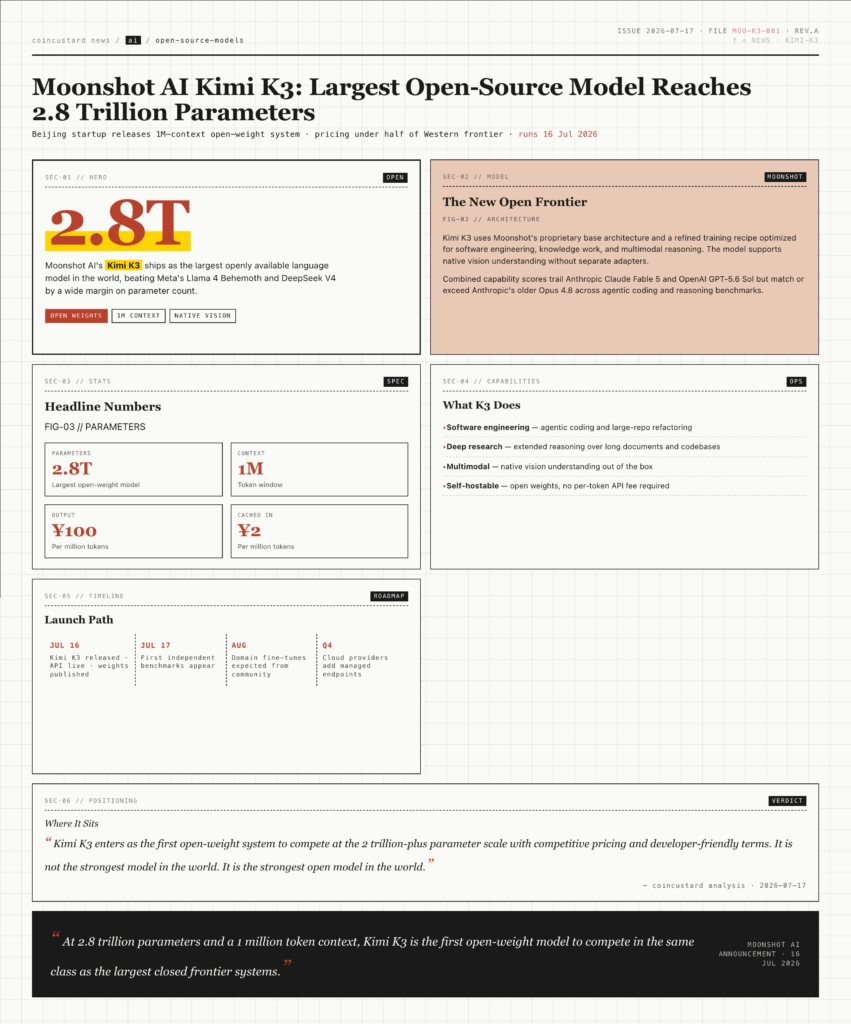
Moonshot AI, the Beijing-based artificial intelligence startup behind the Kimi chatbot, released Kimi K3 on Thursday, a 2.8 trillion parameter open-source language model that immediately becomes the largest openly available AI system in the world. The launch positions China squarely back in the frontier-model conversation and gives developers a heavyweight open-weight alternative to the closed systems sold by Anthropic, OpenAI, and Google DeepMind.
The release lands days before the World Artificial Intelligence Conference in Shanghai, where Chinese President Xi Jinping is expected to outline his country’s AI diplomacy vision. Kimi K3 ships with a 1 million token context window, native vision understanding, and an aggressive pricing structure that undercuts Western frontier models by more than half on inference cost. The model is optimized for software engineering, knowledge work, deep research, and multimodal reasoning tasks, according to Moonshot’s announcement.
The Largest Open Weights Yet
Open-weight models have been closing the gap with closed frontier systems for two years, but Kimi K3 sets a new ceiling on what developers can self-host. At 2.8 trillion parameters, it exceeds Meta’s Llama 4 Behemoth (2 trillion), DeepSeek V4 (1.6 trillion), and Mistral’s largest open release. The 1 million token context window is on par with the longest-context closed models and gives Kimi K3 an edge for tasks that demand extended reasoning over long documents, large codebases, or multi-hour research sessions.
Moonshot also confirmed that Kimi K3 supports native vision understanding out of the box, removing the need for separate vision adapters and bringing the open-source ecosystem closer to the multimodal capability that has been standard on closed systems since 2025. The architecture and training recipe are proprietary, but the weights themselves are freely available, letting enterprises fine-tune the model on their own data without paying per-token API fees or sharing proprietary information with a third party.
Where Kimi K3 Sits Among the Frontier
According to the Financial Times and Chinese technology press, Kimi K3’s combined capability score still trails the two strongest closed models currently in production: Anthropic’s Claude Fable 5 and OpenAI’s GPT-5.6 Sol. However, the model has been independently benchmarked as matching or exceeding Anthropic’s older Opus 4.8 system on a range of agentic coding, instruction-following, and reasoning evaluations, suggesting that the gap between top-tier closed models and the open-source frontier is now measured in months rather than years.
Industry observers note that Kimi K3 enters a market that has rapidly consolidated around a handful of US frontier labs. Moonshot’s release is the first open-weight system that competes in the same parameter class as the largest closed models, and it does so at a price point designed for high-volume production use rather than research experiments.
Pricing and Developer Access
The Kimi K3 API is live immediately, with output priced at 100 yuan per million tokens and standard input at 20 yuan per million tokens, dropping to 2 yuan per million for cached inputs. That translates to roughly $14 per million output tokens and $2.80 per million input tokens at current exchange rates, well under half the price Anthropic charges for Claude Opus 4.8 in most regions and a fraction of OpenAI’s GPT-5.6 Sol list price.
For startups and enterprise teams running high-volume inference, the pricing structure could reshape build-versus-buy calculations. A team processing 10 billion tokens of output per month could spend less on Kimi K3 than on a single mid-tier closed model subscription, while retaining the option to fine-tune or self-host the weights for latency-sensitive or compliance-heavy workloads.
What Developers and Enterprises Should Watch
- Inference infrastructure: Running a 2.8 trillion parameter model requires substantial GPU memory. Expect cloud providers and inference platforms to add Kimi K3 endpoints over the coming weeks, similar to how Llama 4 Behemoth deployments rolled out in early 2026.
- Fine-tuning ecosystem: Open weights mean community fine-tunes for coding, math, medical, and legal domains will appear rapidly. The first wave of domain-specialized K3 variants typically arrives within 30 to 60 days of a major open release.
- Geopolitical context: The release lands alongside broader Chinese AI diplomacy efforts, including the upcoming Shanghai conference. Expect continued discussion of export controls and compute access for Chinese AI labs.
- Competitive response: Anthropic, OpenAI, and Google DeepMind are likely to respond with pricing adjustments or new tier launches aimed at the open-weight competitive threat.
Implications for the Open-Source AI Race
Kimi K3 is not the first open-source model to push the frontier, but it is the first to do so at the 2 trillion-plus parameter scale with competitive pricing and a developer-friendly license. If early benchmarks hold, the model gives enterprises a credible path to independence from closed API providers for high-volume workloads while keeping multimodal capability intact.
For Moonshot AI, the launch validates a strategy the company has pursued since its founding: build frontier-class models, release them openly, and monetize through API access and enterprise partnerships. The bet is that open weights plus aggressive pricing will capture enough of the developer mindshare to build a sustainable business even as closed frontier labs continue to set the upper bound on raw capability. With Kimi K3, that bet just got significantly more credible.