
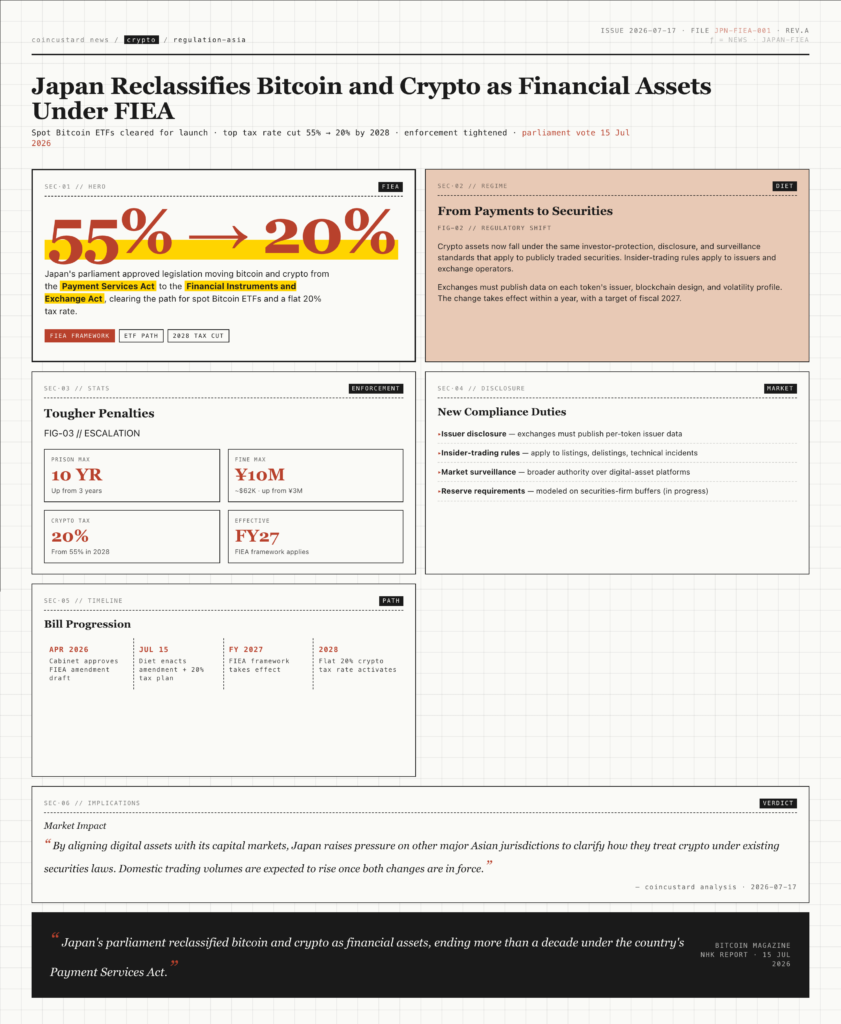
Japan’s parliament approved legislation on Wednesday that reclassifies bitcoin and other cryptocurrencies as financial assets, ending more than a decade of treating digital assets under the country’s payment services framework. The vote marks the most consequential regulatory shift for crypto in Japan since the Mt. Gox era and clears the path for spot bitcoin exchange-traded funds and a flat 20 percent tax on crypto gains by 2028.
The amendment pulls cryptocurrency out of the Payment Services Act and folds it into the Financial Instruments and Exchange Act (FIEA), the same statute that governs stocks, bonds, and investment trusts. According to public broadcaster NHK, the change takes effect within a year with a target of fiscal 2027, formally aligning digital assets with the country’s traditional capital markets regime.
What the Reclassification Actually Changes
Until this week, Japanese regulators treated bitcoin primarily as a means of settlement, placing it under consumer protection rules designed for payment providers rather than investment products. Moving crypto under FIEA replaces that framework with the same investor-protection, disclosure, and surveillance standards that apply to publicly traded securities.
The practical effects reach across compliance, enforcement, and market structure. Crypto issuers and exchange operators now fall under insider-trading rules that bar parties with access to non-public information from trading ahead of token listings, delistings, or major technical incidents. Exchanges face new disclosure obligations: platforms must publish data on each token’s issuer, blockchain design, and volatility profile, a standard that mirrors the reporting demands placed on securities firms. Regulators gain broader market-surveillance authority, with powers closer to those held by financial watchdogs in major Western markets.
Enforcement Tightens Across the Board
Penalties climb sharply under the new law. The maximum prison term for unregistered crypto operators rises from three years to ten, while the top fine increases from 3 million yen to 10 million yen, roughly $62,000 at current exchange rates. The tougher enforcement signals a move to treat crypto misconduct with the same severity as securities fraud, a notable departure from the lighter-touch approach that has defined Japanese crypto oversight since the collapse of Mt. Gox in 2014.
The Path to Spot Bitcoin ETFs
For asset managers and institutional investors, the most immediate consequence is the structural removal of barriers to spot bitcoin ETFs in Japan. Because FIEA governs the products that regulated funds can hold, moving crypto under its umbrella eliminates the legal obstacle that has kept Japanese asset managers from launching domestic spot bitcoin ETF products. Major Japanese brokerages and asset managers are widely expected to begin filing for ETF approvals once the new framework takes effect.
The reclassification also positions Japan to align with the United States, Canada, and several European markets where spot bitcoin ETFs have already attracted tens of billions of dollars in cumulative inflows. Japanese institutional investors have been largely locked out of direct crypto exposure, relying instead on foreign-listed products or domestic exchange-traded instruments backed by crypto-related equities. The new framework changes that calculus and could unlock significant pent-up demand.
The Tax Cut
Alongside the reclassification, lawmakers formally approved a separate plan to cut the top tax rate on crypto gains from 55 percent to a flat 20 percent starting in 2028. The current 55 percent rate, which classifies crypto gains as miscellaneous income, is among the steepest in any major market and has historically pushed Japanese retail traders toward foreign exchanges. The new rate matches the tax on stock gains and is tied to the 2026 Tax Reform Outline.
The combined effect of FIEA reclassification and the 20 percent flat tax could substantially reshape Japan’s crypto market structure. Lower tax rates reduce the incentive to use offshore platforms, while the ETF pathway gives retail and institutional investors a regulated, custody-friendly way to gain exposure. Industry analysts project that domestic crypto trading volumes could increase substantially once both changes are in force.
Industry and Regulatory Implications
- Exchange disclosure standards rise: Platforms must publish data on each token’s issuer, blockchain design, and volatility profile under FIEA disclosure rules.
- Insider-trading enforcement begins: Issuers, exchange operators, and other parties with material non-public information are now barred from trading ahead of listings or delistings.
- Institutional capital access expands: Domestic spot bitcoin ETFs become possible under FIEA, opening regulated entry points for pensions, insurers, and asset managers.
- Retail migration slows: A 20 percent flat tax removes the punitive-rate incentive to trade on offshore exchanges.
- Broader Web3 push: The reforms arrive alongside a wider Japanese government effort to position Tokyo as a Web3 hub, including reserve requirements modeled on securities firm buffers.
Regional and Global Impact
Japan’s regulatory turn carries weight beyond its borders. The country served as an early template for crypto regulation after Mt. Gox, and its cautious posture influenced supervisory approaches in Singapore, South Korea, and across Southeast Asia. By aligning digital assets with its capital markets framework, Japan raises the pressure on other major Asian jurisdictions to clarify how they treat crypto under existing securities laws.
For an industry that has long viewed Japan as an early and cautious mover, this week’s vote marks a decisive turn toward legitimacy. The country that once served as a template for crypto regulation is now aligning digital assets with its capital markets, a decision that could pressure other jurisdictions to follow.