
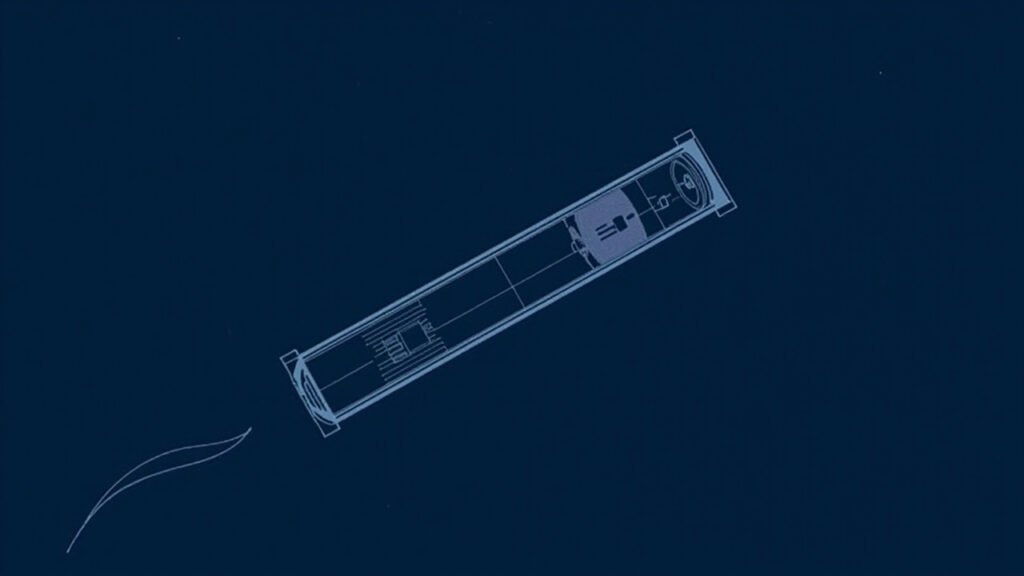
Besxar Fabship SpaceX Falcon 9 semiconductor space is the focus of this story. Besxar Space Industries completed the first flight test of its Fabship hardware on July 5, 2026, riding a SpaceX Falcon 9 first-stage booster for the Starlink 10-50 launch from SLC-40 at Cape Canaveral. Liftoff occurred at roughly 6:50 a.m. EDT, with two Besxar pods attached to the booster rather than to the upper stage carrying the 29 Starlink v2 Mini satellites. The canisters stayed with the first stage for about 8 minutes and 19 seconds before the booster flipped and landed on a drone ship, exposing the hardware to vacuum without ever reaching orbit.
Besxar Fabship SpaceX Falcon 9 semiconductor space: What the hardware actually does
The Fabship design is a microwave-sized canister that holds semiconductor wafers through launch, vacuum exposure, and booster recovery. Founder and CEO Ashley Pilipiszyn, an early OpenAI hire who started Besxar in 2023, framed the July test as an “ultimate egg drop challenge” in a prior CNBC Manifest Space interview. The first mission was not attempting active deposition. Pilipiszyn told Payload Space: “If we can’t keep it clean and protect the wafers, nothing else matters.” Returning the substrates intact, then inspecting them on the ground, is the baseline for every later experiment.
Coverage of the test resurfaced on September 9, 2026 across space and tech outlets after weeks of secondary reporting. SpaceNews, Payload Space, and Spaceflight Now all carried sourced material on the program.
Why ride the booster instead of orbit
Besxar is betting on short, frequent vacuum exposures rather than long-duration orbital processing. The booster coasted to roughly 115 km altitude, well above the Kármán line equivalent for atmospheric vacuum but far below orbital velocity. That gives the payloads several minutes of residual vacuum without the cost or thermal swings of free flight. The model contrasts with Varda Space Industries, which processes materials in orbit for days or weeks before reentry. Besxar’s pitch is volume and cadence: many Falcon 9 boosters fly each year, and reusability means cheap rides.
The commercial thesis runs through power, cooling, and silicon scaling. Pilipiszyn said in pre-flight remarks: “We’re reaching the limits of what can be built on Earth. AI data centers are straining against power and cooling limits, silicon is nearing its physical edge, and fabrication plants can’t achieve the vacuum or yields that next-generation materials demand.” Vacuum above 100 km is essentially free, the company argues, and ultra-high-vacuum exposure can produce higher-quality substrates and precursor materials than terrestrial fabs can match.
The SpaceX manifest and the investor stack
Besxar announced a SpaceX agreement in October 2025 covering 12 Falcon 9 missions under a campaign called Clipper-class. Two pods fly per mission, for 24 total payload rides. The company describes the arrangement as “the first reusable payload program on a SpaceX rocket,” since the hardware is designed to survive booster recovery and fly again. SpaceX is also listed among Besxar’s investors.
The seed round raised $9.35 million, led by Dauntless Ventures with co-lead Overture VC. Participating investors include 645 Ventures, Singh Capital Partners, Koru Capital, and Plum Alley Ventures. Besxar is also part of NVIDIA’s Inception startup program, which provides hardware access and technical support rather than direct funding.
What comes next
The July flight was the first of the 12 contracted suborbital missions. A second flight is expected before the end of 2026, with the cadence determined by SpaceX’s booster turnaround and Starlink launch tempo. Longer manufacturing runs will require upgrading from passive exposure to active deposition inside the canisters, then verifying substrate quality against terrestrial benchmarks.
Later, the Fabship canisters are designed to integrate with Starship for launch, on-orbit processing, and return, letting the launch provider handle reentry rather than Besxar developing its own vehicle. If active deposition succeeds and wafer quality holds up to inspection, Besxar joins a small group of companies, including Varda, attempting to extend parts of the semiconductor supply chain into space. The near-term milestones are simpler: keep the wafers from cracking, repeat the profile on the next booster, and start running recipes. The Besxar Fabship SpaceX Falcon 9 semiconductor space program is now a measured cadence problem, not a one-off demonstration.
Source: https://news.ssbcrack.com/besxar-tests-semiconductor-manufacturing-spacex-falcon-9-boosters
The engineering work between Flight 1 and Flight 2 is largely a thermal-mechanical story rather than a chemistry story. Each Fabship canister has to survive the Falcon 9 throttle-down profile, the max-Q acoustic environment, and the propellant slosh on the booster during reentry and landing burn. Vibration and shock loads during recovery on the droneship are also a recurring failure mode, so Besxar has been working with vibration isolators originally designed for CubeSat deployers and adapting them to the heavier wafer stack. Internal contamination control is the other quiet priority: terrestrial fabs spend enormous sums on cleanroom ISO classifications, and any equivalent aboard a Falcon 9 booster has to fit inside a payload fairing that was never designed for cleanroom duty.
Industry observers note that the Fabship program’s economics rest on a peculiarity of the Falcon 9 manifest. Starlink launches now fly so frequently that some boosters carry paying customers essentially for free, since the marginal cost of adding a small secondary payload is small compared with the booster’s overall amortization. That pricing dynamic is what allows Besxar to underwrite a cadence-driven experiment campaign rather than a single high-cost orbital mission, and it is also why Pilipiszyn has publicly framed the Clipper-class agreement as a reusable payload program in its own right.
Competing approaches in the in-space semiconductor and materials segment remain narrow but increasingly visible. Varda’s orbital processing of pharmaceuticals and exotic materials is the closest analogue, though Varda’s vehicles stay in orbit for days and return via a dedicated reentry capsule. Other startups such as Space Forge, Outpost, and Axiom Space-adjacent research efforts have explored similar markets, but none have yet combined a SpaceX-style booster manifest, suborbital profiles, and a terrestrial wafer inspection loop on the timeline Besxar is targeting. The narrower competitive set is actually helpful for funding conversations: investors can benchmark against Varda’s recent funding rounds and public milestones. That conclusion shapes how the Besxar Fabship SpaceX Falcon 9 semiconductor space program is likely to be read over the next twelve months.
Source: https://news.ssbcrack.com/besxar-tests-semiconductor-manufacturing-spacex-falcon-9-boosters