
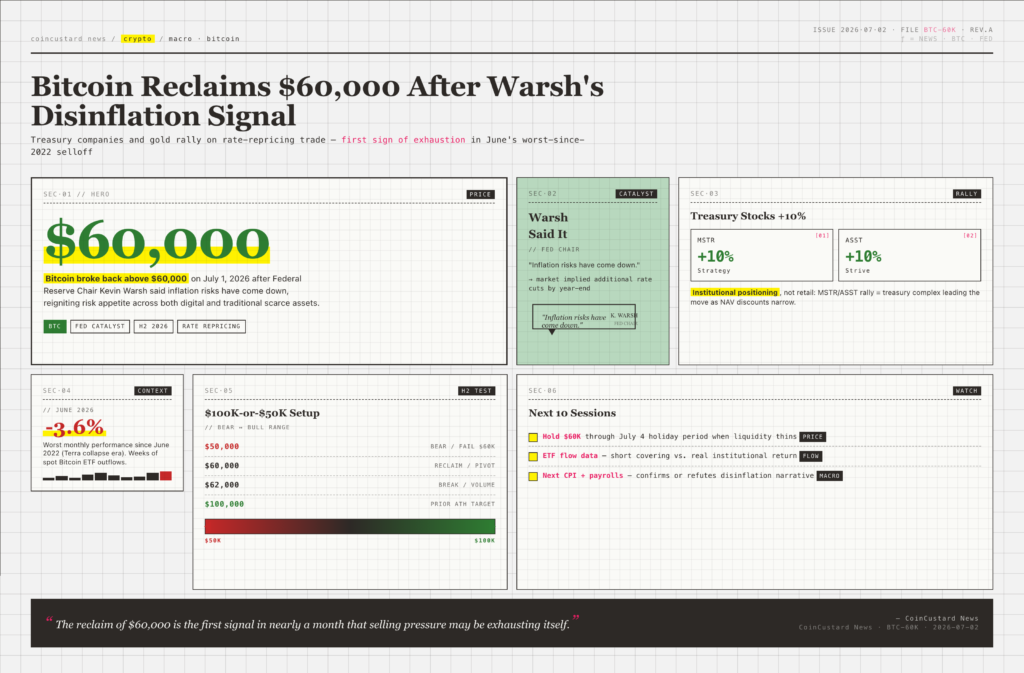
Bitcoin reclaimed the $60,000 level on July 1, 2026, after Federal Reserve Chair Kevin Warsh said inflation risks had come down, comments that reignited risk appetite across both digital and traditional assets. The price action was accompanied by a sharp rally in Strategy, the MicroStrategy rebranded bitcoin treasury vehicle, and in Strive, the asset manager founded by Vivek Ramaswamy, both of which jumped more than 10 percent on the day. Gold also surged on the same comments, highlighting the broader rotation back into scarce assets as traders repriced the path of U.S. interest rates for the second half of 2026.
The move is a notable turn after Bitcoin’s worst monthly performance since June 2022, when the asset was crushed by aggressive Fed tightening and the collapse of the Terra stablecoin. In the month leading up to Warsh’s comments, Bitcoin had drifted below $60,000 multiple times on heavy spot-ETF outflows, weak institutional demand, and a broader risk-off tone across crypto markets. The reclaim of $60,000 is the first signal in nearly a month that the selling pressure may be exhausting itself, although the level remains a critical technical and psychological pivot for the rest of the year.
Why the Warsh Comments Mattered
Warsh’s remarks on inflation risks being on a downward trajectory shifted market expectations for the timing and pace of additional Fed rate cuts. Lower real yields reduce the opportunity cost of holding non-yielding assets like Bitcoin and gold, and the market read into the comments a higher probability of a second or third cut before year-end. Crypto and metals responded almost in lockstep, which is a useful signal that the move is being driven by the rate channel rather than by crypto-specific catalysts.
Bitcoin Magazine reported the rally was concentrated in the treasury and yield vehicles, not in spot buying from retail, with Strategy and Strive leading the move. Both companies have been under pressure in 2026 as the discount of their net asset value to their underlying Bitcoin holdings has widened, and a Bitcoin recovery directly closes that gap. The fact that the rally is being led by the treasury complex suggests that institutional positioning, not retail enthusiasm, is the dominant force behind the current price action.
Market Context for the Reclaim
- Bitcoin reclaimed $60,000 after drifting below the level multiple times in June
- Strategy (MSTR) and Strive (ASST) both jumped more than 10 percent intraday
- Gold also surged on the same Fed-driven repricing
- Spot Bitcoin ETFs had seen weeks of net outflows leading up to the move
- June was Bitcoin’s worst monthly performance since June 2022
The $100K-or-$50K Test for the Rest of 2026
Bitcoin’s reclaim of $60,000 sets up a two-sided market for the second half of the year, with bulls pointing to a path back toward the prior all-time high near $100,000 and bears arguing that the $50,000 zone remains a real possibility if ETF outflows resume and the Fed turns more hawkish. Cryptonews framed the setup as a $100K-or-$50K test, and that framing captures the asymmetric distribution of outcomes that traders are pricing into year-end.
The bear case is anchored in the persistence of ETF outflows and the absence of a fresh demand catalyst. The bull case is anchored in the supply tightening from the latest halving, the continued accumulation by treasury vehicles, and a Fed that is now visibly leaning toward easier policy. The Warsh comments are an important data point in the bull case, but they are not yet enough to change the broader trend on their own.
“The reclaim of $60,000 is the first signal in nearly a month that the selling pressure may be exhausting itself, although the level remains a critical technical and psychological pivot for the rest of the year.”
What to Watch Next
Three things matter over the next two weeks. First, whether Bitcoin can hold above $60,000 on a closing basis through the July 4 U.S. holiday period, when liquidity tends to thin and sharp moves can be amplified. Second, the daily ETF flow data, which will tell us whether the institutional buyers are returning in size or whether the move is being driven by short covering and treasury-company flows. Third, the next round of U.S. economic data, particularly CPI and payrolls, which will either confirm or refute the disinflation narrative that drove the Warsh rally.
For investors with existing Bitcoin exposure, the reclaim of $60,000 is a useful reminder that the asset remains highly sensitive to the rate channel and to treasury-vehicle flows, and that the round-number levels continue to act as both resistance and support. For investors who have been waiting for a better entry, the next few sessions will determine whether the current move is the start of a durable recovery or another bear-market rally that fades into August. The next CPI print, due later this month, will be the most important macro data point for the direction of the market, and the Warsh rally may be the first signal that institutional money is starting to position for that print to come in soft. A clean break and hold above $62,000 on rising volume would meaningfully shift the probability distribution toward the $100,000 scenario for year-end, while a failure to hold $60,000 in the next ten trading sessions would likely re-open the path toward the $50,000 zone and a more cautious positioning regime for the rest of the summer.