
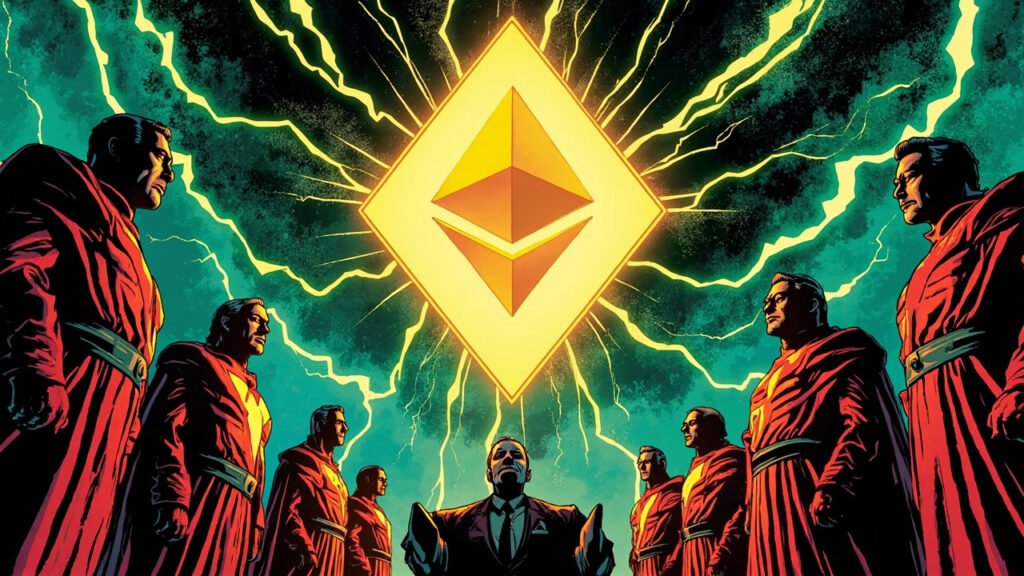
A leadership shakeup at the Ethereum Foundation is producing a strange effect across the cryptocurrency industry. Several of the most prominent voices in the space are publicly declaring renewed confidence in the network’s long-term prospects, even as ether’s price continues to trade near multi-month lows. The contrast between institutional skepticism and on-chain optimism has become one of the defining tensions of the current market cycle, and the events inside the Foundation are now widely viewed as a catalyst for a possible reset of how the protocol evolves.
The Ethereum Foundation, the Switzerland-based nonprofit that funds core protocol research and coordinates upgrades to the network, has undergone significant turnover in its executive ranks over the past several weeks. Multiple long-serving directors have stepped aside, and a new generation of researchers and protocol engineers has taken on responsibility for steering the network through its next major technical transition. The reorganization has prompted a wave of commentary from venture capitalists, exchange founders, and protocol developers, many of whom have framed the changes as the most consequential governance shift since the original Ethereum yellow paper era.
Why the Bull Case Is Back
The renewed bullish sentiment is being driven less by price action and more by a perception that the Foundation’s new leadership is willing to make decisions that previous boards were reluctant to pursue. Several high-profile protocol changes, including adjustments to the validator economics and a long-anticipated scaling roadmap, are reportedly being prioritized. For institutional observers who have watched the network lose ground to faster and cheaper alternatives over the past two years, the prospect of decisive action has changed the calculation.
Joe Lubin, the founder of Consensys and one of the original Ethereum co-founders, has been among the most vocal advocates for the network’s renewed direction. Lubin argued in a recent public appearance that the current leadership understands what previous boards did not, namely that the protocol’s long-term competitiveness depends on prioritizing scalability and developer experience over a commitment to maximalist decentralization that has historically slowed decision-making.
The Layer-2 Question Returns
Central to the discussion is the future of Layer-2 scaling networks, which handle the bulk of Ethereum’s transaction volume today but generate relatively little revenue for the underlying chain. Critics have argued that the proliferation of Layer-2 networks has diluted Ethereum’s economic value, while defenders counter that scaling must happen somewhere and that the base layer’s role is increasingly to provide security and settlement rather than to process every transaction directly.
The Foundation’s new leadership is reportedly preparing a formal position on Layer-2 economics that could include shared sequencing, native rollup incentives, and a more explicit division of labor between the base layer and its scaling companions. Such a position would represent the most significant institutional statement on Layer-2 architecture since the original rollup-centric roadmap was articulated in 2020.
- Shared sequencing could reduce the trust assumptions users must accept on individual rollups
- Native rollup incentives would align Layer-2 operators with base-layer value accrual
- Explicit role clarification would resolve years of ambiguity about where the boundary between L1 and L2 should sit
The Skeptics Still Have a Case
Not everyone in the industry is convinced. Several prominent traders and analysts have pointed out that governance enthusiasm rarely translates into price performance over short time horizons, and that ether remains structurally tied to broader risk-asset sentiment regardless of who is running the Foundation. The network’s recent price action has reflected this reality, with the token continuing to trade in a narrow range even as positive governance news accumulates.
Critics also note that the Foundation’s influence over the protocol’s direction is more limited than its critics suggest. Core protocol upgrades still require consensus among a large and globally distributed community of client developers, validator operators, and application teams, and the Foundation’s role is primarily to coordinate research funding rather than to dictate outcomes. A leadership change at the Foundation cannot by itself produce a faster scaling roadmap if the broader developer community is not aligned.
Even so, several of crypto’s most respected voices are betting that the new Foundation leadership will be willing to push harder than its predecessors on the decisions that have stalled progress.
What the Market Is Watching
Three concrete developments will determine whether the bullish thesis holds up. First, the Foundation’s formal statement on Layer-2 economics, expected before the end of the current quarter, will reveal whether the new leadership is willing to make the structural commitments that institutional observers have been requesting. Second, the pace at which the protocol’s next hard fork is scheduled and executed will indicate whether the new team can move with the speed that critics have long demanded. Third, the level of cooperation between the Foundation and major Layer-2 operators will demonstrate whether the relationship between the base layer and its scaling companions can be stabilized.
For long-term holders of ether, the current moment is best understood as a governance inflection point rather than a price catalyst. The market has been waiting for evidence that the protocol can adapt to a competitive landscape that looks very different from the one Ethereum was designed to dominate. The new Foundation leadership now has an opportunity to deliver that evidence, but the work of proving the thesis will take quarters, not weeks.