
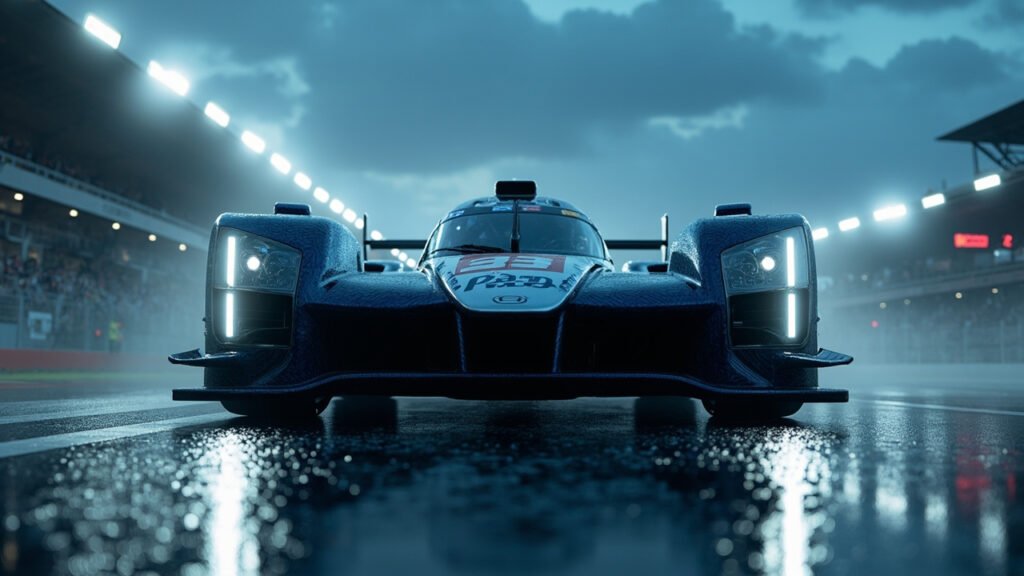
Sixty years ago, following two failed attempts, Ford won the 24 Hours of Le Mans with its GT40 race car. Now the Blue Oval is seeking another overall victory, unveiling the GT41 during the Detroit Lions-Chicago Bears football game as Ford prepared for a demanding World Endurance Championship campaign. The new car represents another attempt to recapture the defining achievement of Ford’s endurance racing history.
Ford returned to France numerous times after its GT40 victory, although its subsequent results at Le Mans varied. The manufacturer could not reproduce the GT40’s success in taking the overall win, but Ford marked the car’s 40th anniversary with a class victory. The GT41 carries that ambition forward as part of Ford Racing’s Hypercar program, with the stated objective of competing for the major endurance trophy once again.
Dan Sayers, manager of Ford Racing’s Hypercar program, called the unveiling a significant moment for everyone involved. He said the GT41 was the result of extensive work by Ford’s engineering, design and development teams, as well as an important milestone on the program’s journey towards 2027.
“Revealing the Ford GT41 is a significant moment for everyone involved in this program,” Sayers said. “It’s the result of an enormous amount of work across our engineering, design, and development teams and an important milestone on our journey towards 2027. We know the scale of the challenge ahead, the level of competition in Hypercar is incredibly high, and there are no shortcuts to success. Our focus has been on building the right foundations, bringing together the right people and making sure we learn as much as possible from every stage of development.”
The launch presentation was accompanied by a video directed by Zack Snyder and featuring Matt Damon’s voice-over. That cinematic introduction gave the GT41 a dramatic public debut while presenting it as the latest stage in Ford’s long-running effort to build an endurance race car capable of challenging for overall honors at Le Mans.
Technical choices will shape how seriously Ford can pursue that objective. Like many other entrants in the World Endurance Championship’s Hypercar class, Ford selected the rear-wheel-drive LMDh technical approach rather than designing its car entirely from scratch. Ferrari and Aston Martin took the latter route for their respective Hypercar entries, but Ford’s decision places its program within a group of manufacturers using a common technical structure to develop their race cars.
Under the LMDh approach, cars begin with one of four approved carbon fiber chassis. Ford is working with Oreca, which has also partnered with Genesis and Acura. The relationship brings an established constructor into Ford’s Hypercar effort while retaining the manufacturer’s own engineering, design and development work across the GT41 program.
Ford’s history makes the unveiling more than a routine race-car launch. The GT40 delivered an overall Le Mans victory after two preceding failures, establishing the Blue Oval as a major force in endurance racing. Later Le Mans appearances brought varying degrees of success, including a class win on the GT40’s 40th anniversary, but the manufacturer says it is now aiming at the central prize rather than settling for another category result.
The GT41 must overcome what Sayers described as incredibly intense Hypercar competition. His comments emphasized foundations, personnel and continuous learning at each stage of development, suggesting Ford sees the road to 2027 as a process rather than a single step. The car’s debut marks an important milestone on that journey, but Ford has not presented the unveiling as evidence that its overall ambition has already been achieved.
That distinction matters because the program combines a famous target with a rapidly evolving technical format. Ford has chosen a shared chassis foundation and rear-wheel-drive LMDh route, while Ferrari and Aston Martin have developed their cars from scratch. The GT41’s competitiveness will therefore depend on how effectively Ford and Oreca turn that foundation into a durable and quick car against established and new Hypercar rivals.
The unveiling has also placed the GT41 within a broader cultural moment. Sayers presented the project as a collective achievement involving Ford’s engineering, design and development teams, while the launch video brought in Zack Snyder as director and Matt Damon as the voice. Ford used those elements to frame the car as a significant new chapter in a racing story that began with the GT40’s breakthrough 60 years ago.
With the car now public and the program moving towards 2027, attention turns to the evidence that matters on the circuit. Development will continue, lessons will be drawn from every stage, and competition will intensify across the Hypercar class. Ford’s claim is clear, but the ultimate answer will come at the race where the GT40 became a legend and where the GT41 hopes to write a new chapter.
Can Ford turn the GT41’s promising debut into another overall victory at the 24 Hours of Le Mans?