
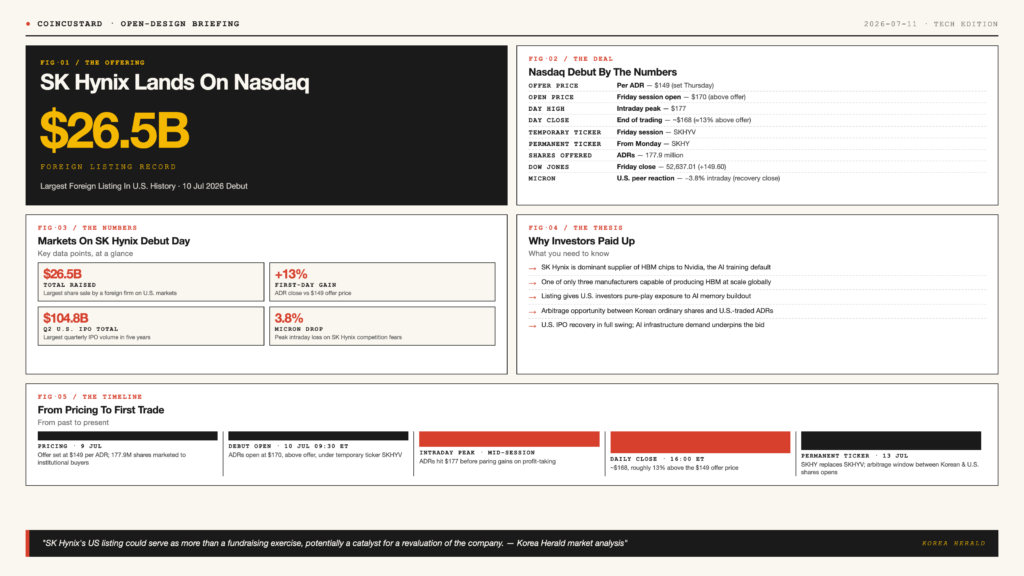
SK Hynix closed its first day of trading on the Nasdaq with a roughly 13 percent gain, capping the largest share sale ever conducted by a foreign company on a U.S. exchange and cementing the South Korean chipmaker’s position at the centre of the global artificial intelligence hardware supply chain. The Korean memory giant raised $26.5 billion by offering 177.9 million American depositary receipts at $149 each, eclipsing every previous foreign listing on U.S. markets and underscoring investor appetite for pure-play exposure to high-bandwidth memory, the chip category powering the world’s most advanced AI accelerators.
The ADRs, trading Friday under the temporary ticker symbol “SKHYV,” opened at $170, climbed as high as $177 during the session, and closed around $168, roughly 13 percent above the offering price. The permanent ticker “SKHY” takes effect Monday. The strong debut arrived as all three major U.S. indexes edged higher, with the Dow Jones Industrial Average rising 149.60 points to close at 52,637.01, the S&P 500 gaining 31.75 points to finish at 7,575.39, and the Nasdaq Composite adding 74.72 points to end at 26,281.61.
AI Memory as the Listing Thesis
The investment case for SK Hynix rests on a single structural fact: the company is one of only three manufacturers in the world capable of producing high-bandwidth memory chips at scale, and it is the dominant supplier to Nvidia, whose graphics processing units are the default training and inference engines for the largest AI models. Rapidly growing demand for HBM and high-performance DRAM, driven by sustained investment in AI data centres, has transformed SK Hynix from a cyclical memory commodity play into a strategic AI infrastructure supplier.
The listing also reflects a broader recovery in the U.S. IPO market. U.S. IPO fundraising reached $104.8 billion in the second quarter of 2026, the largest quarterly total in five years, as companies across sectors seek to capitalise on AI-related demand. SK Hynix’s Nasdaq debut landed squarely within that wave, and its premium pricing suggests that public investors are willing to pay up for direct exposure to the AI hardware buildout that has, until now, been largely intermediated through Nvidia and a handful of contract chipmakers.
The Largest Foreign Listing in U.S. History
SK Hynix’s $26.5 billion raise surpasses every previous foreign listing on U.S. exchanges, a record that highlights both the scale of the AI capital cycle and the willingness of U.S. investors to underwrite strategic infrastructure suppliers regardless of geography. The offering also drew attention for the speed at which it was executed: priced Thursday, trading Friday, and with the permanent ticker in place by Monday, a timeline that reflects intense institutional demand.
The size of the listing is also a function of structural design. SK Hynix ADRs are securities backed by a portion of the company’s ordinary shares listed on the Korean stock market, designed to allow U.S. investors to trade the stock easily in their home market. That structure introduces arbitrage opportunities between the domestic Korean shares and the U.S.-traded ADRs, and observers will be watching how the premium formed on Friday carries over to the underlying share price in Seoul.
“SK Hynix’s US listing could serve as more than a fundraising exercise, potentially a catalyst for a revaluation of the company.” — Korea Herald market analysis
The Micron Effect
SK Hynix’s debut had a differentiated impact within the U.S. memory chip sector. Micron, the only major U.S.-based memory manufacturer, fell as much as 3.8 percent during Friday’s trading before recovering some of its losses, weighed down in part by concerns that the new listing could draw investment away from the stock. The dynamic illustrates a recurring pattern in semiconductor markets: when a competitor goes public, existing peers often face selling pressure as investors rotate into the new vehicle.
The relative valuation gap between SK Hynix and Micron is now the central question for memory-chip investors. SK Hynix trades at a premium that reflects its commanding position in HBM, while Micron is seen as a challenger with stronger long-term optionality. How that gap narrows, or fails to, will determine how the two stocks perform in the back half of 2026.
Nvidia, Meta, and the Customer Stack
Nvidia, one of SK Hynix’s largest customers, advanced on Friday on expectations for continued AI chip demand, a reminder that the AI semiconductor trade remains broadly intact even as individual stocks consolidate. Meta also gained on anticipation surrounding its in-house AI chip development and a new family of AI models, demonstrating that the appetite for vertically integrated AI infrastructure extends beyond pure-play memory suppliers.
Geopolitical tensions remained a backdrop. While U.S.-Iran frictions continued through the week, the prospect of further negotiations led markets to lean toward a resumption of dialogue rather than a sharp escalation. Oil prices edged down, with Brent crude for September delivery settling at $76.01 a barrel and West Texas Intermediate for August at $71.41, easing one source of inflation pressure that has complicated the Federal Reserve’s rate path.
For SK Hynix, the U.S. listing is more than a fundraising milestone. It is a strategic repositioning that places the company on the same trading floor as the customers and competitors that will define its next decade. The 13 percent first-day gain reflects investor enthusiasm, but the real test will be whether the premium holds as the AI infrastructure cycle matures and as the company begins to be valued not as a Korean exporter but as a global AI hardware incumbent.