
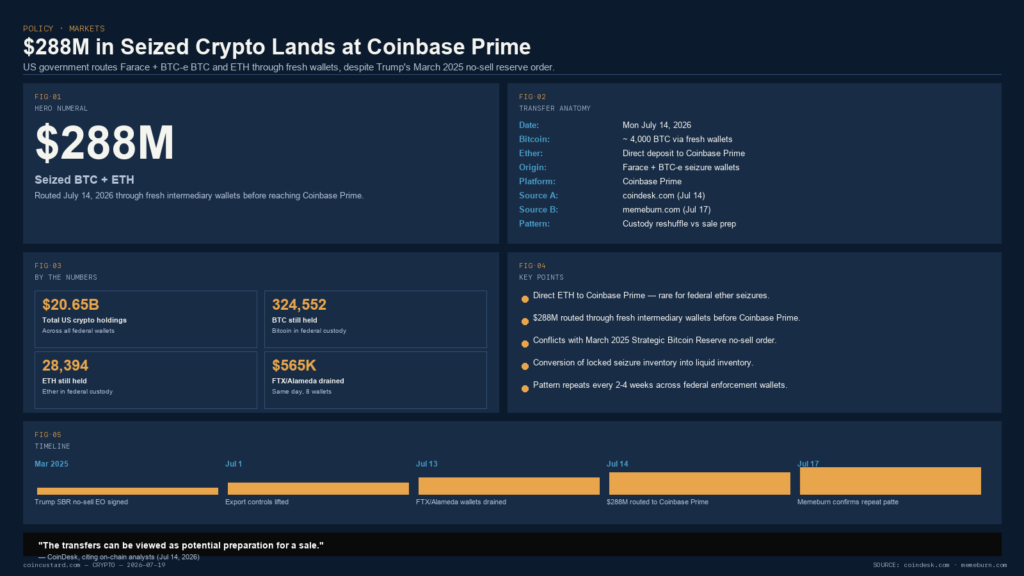
United States government wallets moved roughly $288 million in seized bitcoin and ether to Coinbase Prime on Monday July 14, routing the funds through fresh intermediary wallets before depositing them on the institutional platform. The transfers, which involve coins originally seized from the Farace and BTC-e enforcement actions, appear to conflict with a March 2025 executive order signed by President Donald Trump that directed seized bitcoin into a Strategic Bitcoin Reserve and explicitly barred its sale. Blockchain analysts now say the deposits could be read as a preparation for sale, even though they represent only a small fraction of the government’s roughly $20.65 billion crypto holdings.
The transfer emerged on a single day alongside a separate sweep from a wallet linked to the seized FTX and Alameda Research estate. That smaller transaction emptied $565,400 in eight tokens across eight fresh addresses, according to memeburn.com’s reporting. The combination of the two moves, a $288 million institutional deposit and a $565,400 retail-equivalent sweep, frames the United States government as the most predictable seller of seized crypto in the market. Each blockchain observer now watches the same Coinbase Prime wallet cluster as the signal for whether seized assets are about to be liquidated.
- $288M: Total seized BTC and ETH moved to Coinbase Prime on July 14.
- ~$20.65B: Current crypto holdings across all US government-controlled wallets.
- 324,552 BTC: Bitcoin still held by US government wallets post-transfer.
- 28,394 ETH: Ether held by US government wallets post-transfer.
- 145.5M USDT: Tether held by US government wallets post-transfer.
- $565,400: FTX and Alameda estate wallet drained the same day across eight tokens and eight addresses.
Why the seizure-routing pattern matters for the Strategic Bitcoin Reserve
The March 2025 executive order established the Strategic Bitcoin Reserve as the destination for any bitcoin seized by federal enforcement actions and explicitly directed the Treasury not to sell those holdings. The order was widely read at the time as a no-sell commitment that locked in a floor under the government’s BTC exposure. The July 14 transfer, however, routes assets through fresh wallets before they reach Coinbase Prime, which means the seizure trail does not connect cleanly to the Strategic Bitcoin Reserve ledger and which leaves the custody-versus-sale interpretation open.
The ether portion went directly to Coinbase Prime without an intermediate wallet, an unusual pattern that analysts described in the coindesk.com coverage as the more concerning move. Direct institutional deposits of ether by federal wallets typically accompany a custody reshuffle for non-sale reasons, but a direct deposit of ether tied to a criminal seizure is rare enough to warrant its own explanation. Bitcoin, by contrast, was routed through what blockchain researchers called fresh intermediary wallets, a pattern that historically precedes sales and which has prompted analysts to ask whether the transfer is a prelude to liquidation rather than a routine custody move.
Theory one is that the Coinbase Prime deposit is a custody reshuffle. Government-controlled crypto has historically been held across multiple wallets and exchanges as enforcement actions wind down. The Treasury may have consolidated the seized Farace and BTC-e coins at Coinbase Prime because the platform provides institutional custody with audit trails that other venues cannot match, and a custody move is the most innocuous reading of the transaction. Theory two, which the public-data timing supports, is that the move is preparation for sale, and that the March 2025 no-sell order is being tested one transfer at a time. Theory three is more pragmatic: the transfer combines the two motives, with custody built up first and sales executed later, which would explain why the assets landed on a venue with deep liquidity rather than on a cold-storage custodian.
The Strategic Bitcoin Reserve sits inside a $20.65 billion overall crypto position that includes 324,552 BTC, 28,394 ETH, and 145.5 million USDT. The ratio across those three assets is roughly 92 percent bitcoin, 5 percent ether, and 3 percent USDT by dollar value, a portfolio that mirrors the typical seized-asset mix from multi-year federal enforcement actions. The July 14 transfer does not move that ratio, because the bitcoin and ether portions moved together. What it does move is the sale optionality: assets at Coinbase Prime can be sold within minutes, while assets at cold-storage addresses cannot, so the transfer converts locked seizure inventory into liquid inventory.
The dual-track pattern across the Farace, BTC-e, and FTX seizures shows that the United States government has settled into a regular selling rhythm that now activates roughly every two to four weeks. Each enforcement-action wallet is processed in turn, and the seized bitcoin and ether that the Strategic Bitcoin Reserve was supposed to lock in are quietly rotated through fresh intermediary wallets and into Coinbase Prime. The Treasury has not announced a sale, but each transfer tightens the practical no-sell posture that the March 2025 executive order was meant to enshrine, and the seized bitcoin and ether that lands on Coinbase Prime is one wallet-hop closer to liquidation.