
Wells Fargo has emerged as one of the most aggressive traditional finance players in crypto, revealing exposure to Bitcoin, Ethereum, Solana, and the two largest corporate treasury vehicles Strategy (MSTR) and BitMine (BMNR) in its latest quarterly filing. The disclosure covers spot Bitcoin ETFs, a new options position, and direct stock holdings across the crypto economy, and it lands at a moment when Wall Street’s largest banks are quietly positioning for the next leg of institutional adoption.
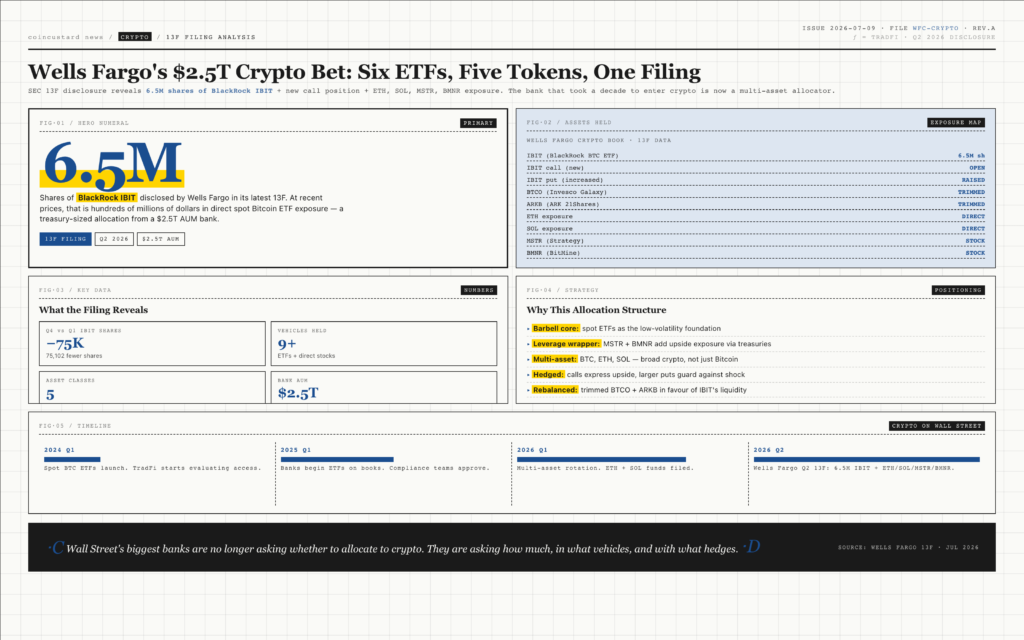
The $2.5 trillion asset manager disclosed 6.5 million shares in BlackRock’s spot Bitcoin ETF, IBIT, alongside a new call position and an increased put position. The bank also trimmed its exposure to the Invesco Galaxy Bitcoin ETF (BTCO) and the ARK 21Shares Bitcoin ETF (ARKB), suggesting a deliberate rebalancing toward the deepest-liquidity product in the spot category. Beyond Bitcoin, the filing revealed direct or indirect exposure to Ethereum, Solana, Strategy, and BitMine, signalling that Wells Fargo’s crypto book is now a multi-asset, multi-vehicle portfolio rather than a single trade.
The Largest TradFi Bet Yet
For an industry that spent a decade debating whether banks would ever touch Bitcoin at all, the scale of Wells Fargo’s position is striking. Six and a half million shares of IBIT is not a toe-dip. It is a treasury-sized allocation that, at recent prices, represents hundreds of millions of dollars in direct Bitcoin exposure. Holding both Strategy and BitMine alongside the ETFs signals that Wells Fargo is not just buying Bitcoin, it is buying the trade.
The shift reflects a broader change in how the largest US banks are approaching crypto. After years of compliance-first caution, the post-ETF era has given compliance teams a regulated, well-understood vehicle to allocate to. The result is a quiet land grab: every major Wall Street firm is now sizing up its crypto book, and the firms that moved first are already extending into Ethereum, Solana, and the corporate treasury companies that have become the most successful capital-markets plays of the cycle.
From Bitcoin ETFs to Corporate Crypto Treasuries
The decision to hold both spot ETFs and direct stock in Strategy and BitMine tells a more sophisticated story. Spot ETFs give a clean, regulated, redeemable exposure to the underlying asset. Strategy and BitMine add leverage, governance, and yield on top, in a structure that traditional finance has historically favoured. By holding both, Wells Fargo is building a barbell: a low-volatility core (the ETFs) wrapped around higher-octane exposure to the companies most exposed to the underlying crypto rally.
The same logic appears to be driving the bank’s call-and-put options book. The new call position expresses continued upside conviction, while the larger put position hedges against a sudden macro shock. The combination is the kind of structure a sophisticated institutional desk would build if it expected crypto to keep appreciating but wanted protection against a sudden geopolitical or liquidity event. Recent market stress, including the flare-up of US-Iran tensions, has made that kind of insurance more attractive than it was a quarter ago.
What It Means for Crypto Markets
The disclosure is bullish for the largest crypto names and bullish for the ETF complex. When the second-largest US retail bank by deposits signals that Bitcoin, Ethereum, and Solana are allocatable, smaller institutions read the memo. RIAs, family offices, and pension consultants have spent the last year waiting for a major bank to take the lead, and Wells Fargo’s filing is the closest thing to permission they are likely to get.
The filing also suggests the institutional flows that have dominated Bitcoin’s price action since the launch of spot ETFs are broadening. Bitcoin captured the first wave. Ethereum is now catching up, with a string of ETF launches and a fresh wave of staking-yield products beginning to attract serious capital. Solana is the next candidate, with a spot SOL ETF decision still pending at the Securities and Exchange Commission. Wells Fargo’s exposure to all three suggests the bank expects that broadening to continue.
Wall Street’s biggest banks are no longer asking whether to allocate to crypto. They are asking how much, in what vehicles, and with what hedges.
Strategy and BitMine as the New Core Holdings
The exposure to Strategy and BitMine is the most underrated part of the disclosure. Both companies have built themselves into de facto crypto treasury proxies, with balance sheets anchored in Bitcoin and Ethereum respectively. They are also the two largest non-ETF vehicles for traditional investors to access the underlying assets with leverage and a corporate governance wrapper.
For Wells Fargo to hold both, alongside the underlying ETFs, is a clear statement that the corporate-treasury trade is now considered a permanent part of the crypto capital structure rather than a temporary anomaly. It is also a strong endorsement of the management teams at both companies, who have raised billions of dollars of equity and convertible debt to scale their crypto positions since the start of the cycle.
The Bigger Picture
Crypto is now a routine line item in the 13F filings of the largest US banks, and Wells Fargo’s latest disclosure is the clearest sign yet that the trade is moving from optional to core. The bank is positioning for a multi-year cycle in which digital assets, ETFs, and corporate crypto treasuries all coexist as legitimate portfolio building blocks, and it is doing so with the kind of structured exposure (long ETFs, long treasuries, calls, puts) that defines how the most sophisticated desks in the world approach any new asset class.
For the rest of Wall Street, the message is hard to misread. Wells Fargo has now gone on the record as a multi-asset crypto allocator, and the next round of 13Fs from JPMorgan, Bank of America, and Citi is likely to show similar patterns. The institutional cycle that started with the spot Bitcoin ETF launch has now reached the balance sheets of the banks themselves, and the next phase of the rally will be shaped as much by the desks of Wells Fargo as by the trading flows on Coinbase.