
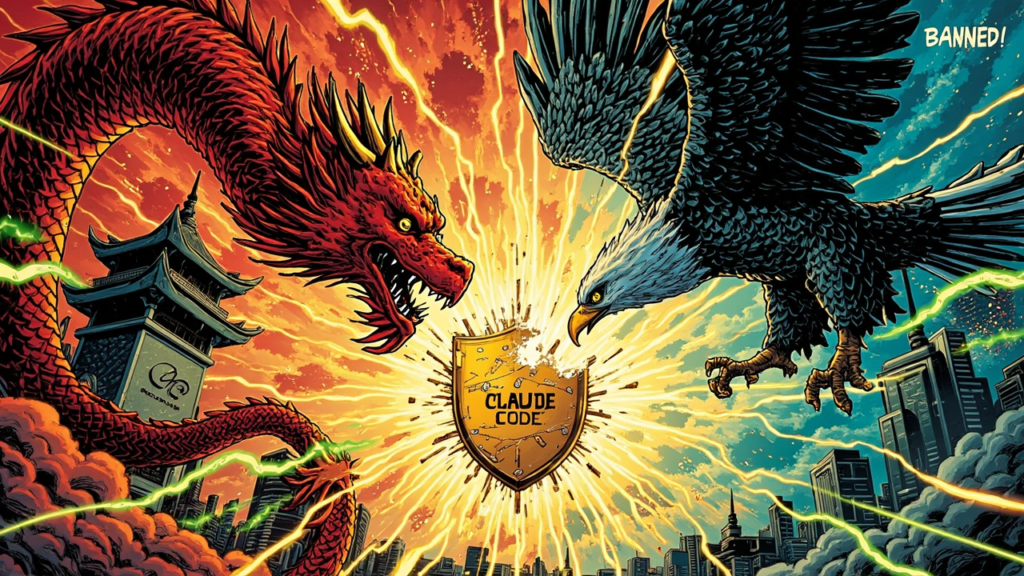
Alibaba has banned its employees from using Anthropic’s Claude Code, accusing the American AI lab of running a covert “distillation attack” against Chinese developers. The accusation, first reported by CNBC on July 6, 2026, marks the moment the US-China AI cold war stopped being a policy debate and started showing up in corporate IT policies. Anthropic has rejected the framing, but the dispute is now reshaping how the world’s two largest AI ecosystems treat each other’s tools.
The trigger was a claim by Alibaba that Anthropic’s coding assistant contained a hidden mechanism for detecting users in China and feeding their prompts back into Claude’s training pipeline. The allegation, which Anthropic denies, is the most explicit accusation yet that US AI labs are running what the industry calls “distillation” against Chinese models: using another model’s outputs to train your own at a fraction of the compute cost. If the accusation holds, it would be a quiet but aggressive form of intellectual property theft carried out at the prompt level rather than the model-weight level.
What Alibaba Actually Banned
The ban covers Claude Code, Anthropic’s agentic coding tool, which the company markets to enterprise engineering teams. According to a Reuters report from July 4, Alibaba informed staff that the tool would be removed from approved software lists by the end of the month. The decision was framed internally as a security precaution, but the public language from Alibaba’s leadership has been sharper, describing Anthropic’s behavior as an “attack” rather than a competitive practice.
Alibaba is not the only Chinese tech giant tightening access. The July 6 CNBC report indicates that other major Chinese cloud and AI platforms have begun auditing their own developers’ use of Western coding tools. The fear is not just about distillation: it is about the data exfiltration pathway that a foreign-hosted agentic tool can create. Every line of code, every prompt, every secret an Alibaba engineer types into Claude Code is a piece of Alibaba’s internal IP, and Anthropic’s terms of service give the US lab broad rights to use submitted content for model improvement.
Distillation Goes From Industry Trick to Geopolitical Flashpoint
Distillation has been a quiet corner of machine learning for years. The technique trains a smaller, cheaper “student” model to mimic the outputs of a larger, more capable “teacher” model. OpenAI, Google, Meta, and Anthropic have all used variants of it to ship faster, cheaper products. Until now, the practice has been discussed in papers and conference talks, not in corporate memos and government briefings.
Two things have changed. First, the capability gap between frontier US models and Chinese open-weight models has narrowed dramatically, making distillation both more tempting and more consequential. A successful distillation run can compress months of frontier training into days of student training, erasing a competitor’s lead in a single cycle. Second, the Trump administration’s expanded export controls on advanced AI chips have made it harder for Chinese labs to train at frontier scale, increasing the appeal of any shortcut that does not require the most advanced Nvidia silicon.
The New York Times framed the moment on July 6 with a piece titled “Why A.I. Distillation Has Become a Hot Topic in the Race with China.” The article points out that distillation accusations now fly in both directions: US labs accuse Chinese groups of scraping their API outputs, and Chinese groups accuse US labs of doing the same. Alibaba’s ban is the first time a major Chinese platform has made the accusation part of an official corporate action.
What Anthropic Says
Anthropic has rejected the framing of Alibaba’s complaint. The company’s position is that its products do not contain hidden detection mechanisms and that all training on user data is disclosed in its terms. Anthropic has long argued that its safety work, including the responsible scaling policy and the constitutional AI methodology, sets it apart from competitors, and the Alibaba accusation cuts directly against that brand. The company has not announced any specific response to Alibaba’s ban, but the dispute will almost certainly come up in upcoming US-China trade and technology talks.
Why This Matters for the AI Industry
The practical consequence of the Alibaba ban is that Chinese developers now have one fewer Western tool in their stack. That is bad news for Anthropic’s enterprise ambitions in Asia and good news for domestic alternatives such as Alibaba’s own Qwen, DeepSeek, and the growing open-weight ecosystem that has emerged from Chinese labs over the past two years.
The deeper consequence is corporate IT teams everywhere are about to spend a lot more time on AI vendor reviews. Until now, the question was “which model gives us the best code completion.” After Alibaba’s ban, the question becomes “which model’s terms of service can we accept, and which model is going to weaponize our prompts against us.” Expect every major bank, pharma company, and government contractor to add a distillation risk assessment to their AI procurement checklist by the end of 2026.
The New Front in the AI Cold War
For the past two years, the US-China AI rivalry has been fought over chips, with export controls on Nvidia hardware the primary weapon. The Alibaba-Anthropic dispute opens a second front, fought over data, prompts, and the terms under which an AI lab is allowed to learn from its users. Distillation has gone from a backroom engineering trick to a public flashpoint in less than a quarter, and the next move will likely come from Anthropic, OpenAI, or Google as they all try to reassure enterprise customers that their tools are not, in the words of one Alibaba executive, “an attack surface disguised as a productivity tool.”
Alibaba’s ban is unlikely to be the last. With the AI cold war now showing up in IT policy memos in Hangzhou and Shenzhen, expect a wave of similar restrictions across China’s tech sector in the coming months, and a corresponding tightening of US restrictions on Chinese AI products deployed inside American enterprises.