
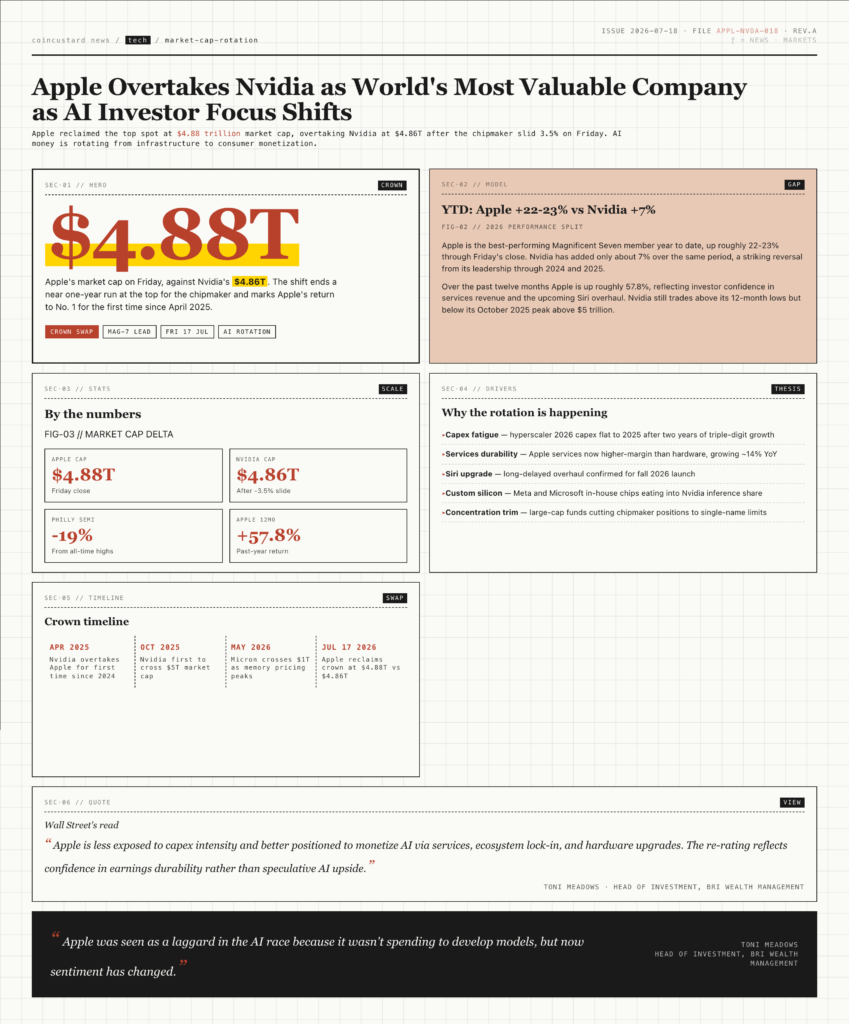
Apple reclaimed its position as the world’s most valuable publicly traded company on Friday, overtaking Nvidia as the chipmaker’s stock fell 3.5 percent and Apple’s market capitalization climbed to roughly $4.88 trillion against Nvidia’s $4.86 trillion. The shift ends a near one-year run at the top for Nvidia, which became the first company to cross $5 trillion in market value in October 2025, and marks Apple’s return to the No. 1 spot for the first time since April of last year.
What happened on Friday
Apple shares held steady to slightly higher through the trading session, while Nvidia slid throughout the day on a broader selloff in chip and semiconductor stocks. The Philadelphia SE Semiconductor Index is down nearly 19 percent from its all-time highs as of Friday’s close, reflecting growing investor anxiety about the durability of the AI infrastructure spending cycle that drove Nvidia to its $5 trillion valuation in the fall. SK Hynix, the high-bandwidth-memory leader whose chips feed Nvidia’s accelerators, fell more than 13 percent on Friday alone, dragging the broader chip complex with it.
The market-cap swap is the latest signal that Wall Street is rotating away from the most concentrated AI trades and toward companies seen as better positioned to monetize AI through consumer products and services rather than through capital-intensive chip sales. Nvidia’s slide coincides with weakness across memory and AI infrastructure names. Micron Technology, which crossed $1 trillion in market value in May, has pulled back sharply over the past two weeks as memory pricing has come off its peak. The rotation also reflects a flight from concentration risk, with several large-cap funds trimming their chipmaker positions to comply with single-name exposure limits.
The 2026 trajectories
Apple is up roughly 22 to 23 percent year to date through Friday’s close, the best performance among the Magnificent Seven. Nvidia has added only around 7 percent over the same period, a striking reversal given that Nvidia led the cohort through most of 2024 and 2025. Over the past twelve months, Apple’s stock has risen roughly 57.8 percent, reflecting investor confidence that the company’s installed base and services revenue can carry it through the AI transition even as it has lagged peers on model development. Apple also got a boost earlier this week when the company received government approval to roll out Apple Intelligence enhancements across its full device lineup.
Why the rotation is happening
“Apple was seen as a laggard in the AI race because it wasn’t spending to develop models, but now sentiment has changed,” said Toni Meadows, head of investment at BRI Wealth Management. “Apple is less exposed to capex intensity and better positioned to monetize AI via services, ecosystem lock-in, and hardware upgrades. The re-rating reflects confidence in earnings durability rather than speculative AI upside.”
Apple’s relative valuation advantage comes from its services business, which now generates higher-margin recurring revenue than its hardware division, and from the upgrade cycle expected to follow the long-delayed overhaul of Siri that Apple confirmed for release this fall. Analysts at several major banks have raised their price targets on Apple over the past month on the view that even a modest AI upgrade to Siri will drive a multi-quarter iPhone replacement cycle. The services segment grew at roughly 14 percent year over year in the most recent quarter, and management has guided to a similar pace through fiscal 2027.
“The re-rating reflects confidence in earnings durability rather than speculative AI upside,” Meadows said.
What Nvidia is up against
Nvidia’s near-term challenge is the digestion of the enormous AI infrastructure buildout that has powered its rise. Hyperscaler customers, including Microsoft, Google, Meta, and Amazon, have signaled that 2026 capital expenditure will be roughly flat to 2025 levels after two years of triple-digit growth, a deceleration that has weighed on Nvidia’s forward earnings multiples even as data-center revenue continues to set records. The flattening capex profile is healthy for the cloud providers’ free cash flow but removes the source of Nvidia’s most aggressive upside surprises.
The company is also facing renewed competition in the inference market from custom AI silicon being developed internally at Meta and Microsoft and externally by Broadcom, AMD, and a handful of well-funded startups. Custom chips are unlikely to displace Nvidia in training workloads for the next 18 months, but they are increasingly taking share in inference deployments where total cost of ownership matters more than peak performance. Nvidia has responded with its own networking and rack-scale systems that bundle chips, switches, and software into a more defensible package, but the era of Nvidia holding 90-plus percent share of every accelerator market is starting to look like the exception rather than the rule.
Why it matters
Apple’s return to the top of the market-cap rankings is more than a symbolic event. It marks the moment when the market stopped treating AI exposure as a uniform trade and began to differentiate between companies that sell the picks and shovels of the AI buildout and those that collect the end-user economics. If Apple’s lead holds into the September iPhone launch, it would be the first time since 2024 that the Magnificent Seven’s top spot has rotated away from a chip or model vendor, a development that would reset sector positioning across the index for the back half of 2026 and would likely pull capital toward consumer-facing AI plays, services platforms, and durable cash-flow names with limited capex exposure.