
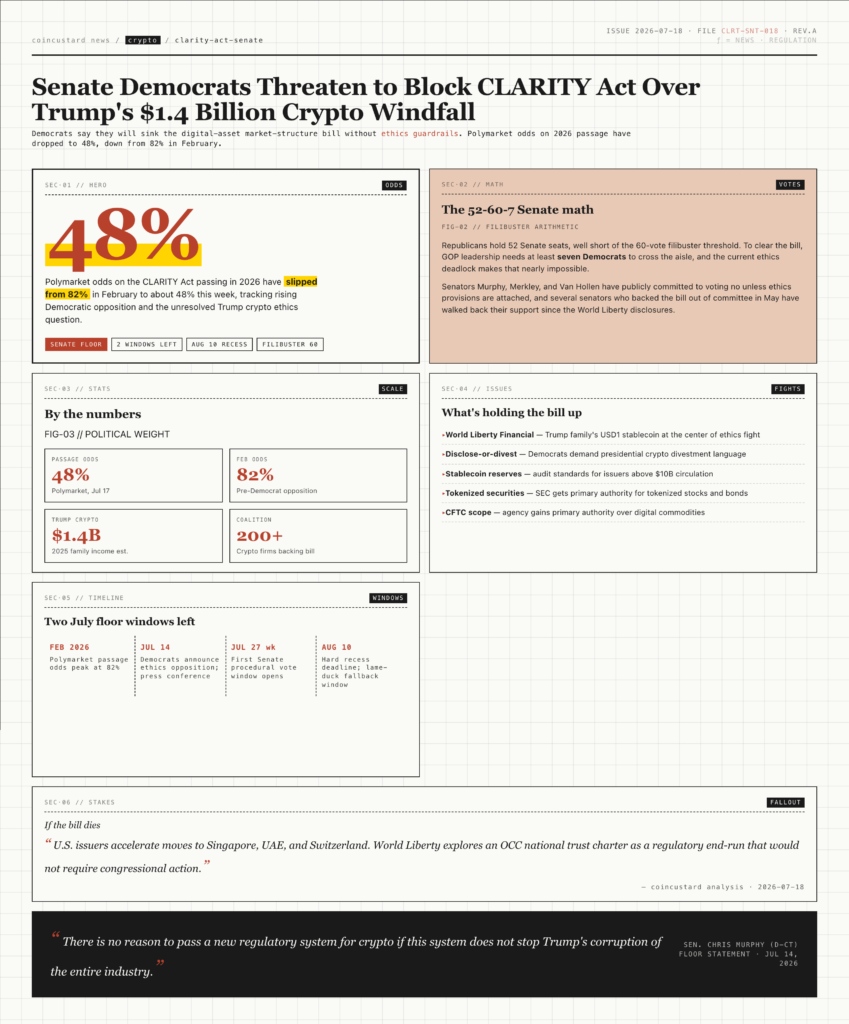
Senate Democrats moved this week to block the Digital Asset Market Clarity Act, the long-stalled market-structure bill that would set the first federal framework for digital assets, unless it addresses what they describe as ongoing conflicts of interest tied to President Donald Trump’s personal crypto ventures. The threat, delivered at a Tuesday press conference by Senators Chris Murphy, Jeff Merkley, and Chris Van Hollen, complicates a floor vote that Senate Majority Leader John Thune has pledged to hold before the August 10 recess.
Why Democrats are threatening to sink the bill
At issue is the roughly $1.4 billion in 2025 crypto income the Trump family is estimated to have earned through World Liberty Financial and related ventures, a figure that has become a rallying point for ethics groups and a faction of Senate Democrats who argue that any market-structure framework passed without disclosure or divestment guardrails would legitimize rather than regulate the president’s crypto business. World Liberty’s USD1 stablecoin has become the central flashpoint, with Democrats pointing to its rapid growth and the relatively light regulatory touch the administration has applied to similar products.
“There is no reason to pass a new regulatory system for crypto if this system does not stop Trump’s corruption of the entire industry,” Murphy said at the press conference, held alongside Americans for Financial Reform, Indivisible, and actor Ben McKenzie. Merkley and Van Hollen echoed the position, framing the bill as unfinished business that should not move until it carries ethics provisions comparable to those that traditionally accompany financial-services legislation. The group is also pushing for an explicit ban on presidential and senior-executive involvement in digital-asset ventures that could benefit from federal regulatory decisions.
The math in the Senate
Republicans hold 52 seats, well short of the 60 votes needed to clear a filibuster. To pass the CLARITY Act, the GOP needs at least seven Democrats to cross the aisle. The current ethics deadlock makes that math nearly impossible to clear on the merits, and Senate leadership is now weighing whether to attach ethics provisions as an amendment or strip the bill back to its narrowest market-structure core to lure reluctant Democrats. Several senators who voted for the bill out of committee in May have since publicly walked back their support in light of the World Liberty disclosures.
Polymarket and the slipping odds
The political pressure is showing up in prediction markets. Polymarket odds on CLARITY Act passage in 2026 have fallen to about 48 percent, down from roughly 82 percent in February, a slide that tracks the rising Democratic opposition and the unresolved Trump crypto ethics question. Two Senate floor windows remain before the August recess, in late July and the first week of August, and crypto industry groups are pressing for a vote on the narrower bill before the window closes. Some Hill staffers have privately conceded that even a successful floor vote this month would likely be followed by a House-Senate conference that reopens the ethics fight in September.
More than 200 crypto firms have publicly backed the Clarity Act, including Coinbase, Ripple, and Circle, a coalition that has so far been unable to break the impasse. The CLARITY Act would assign primary market-structure authority to the Commodity Futures Trading Commission for digital commodities and to the Securities and Exchange Commission for tokenized securities, ending years of regulatory ambiguity that has pushed many issuers offshore. The bill also creates a formal pathway for tokenized real-world assets and lays out disclosure standards for stablecoin issuers above $10 billion in circulation.
What is at stake
If the CLARITY Act dies in the Senate, the U.S. digital-asset industry would enter 2027 under the same fragmented patchwork of enforcement actions and guidance documents that has governed the sector since 2023. Industry groups warn that the lack of a clear federal regime is already driving token issuers to jurisdictions such as Singapore, the UAE, and Switzerland, where the licensing pathways are predictable and the political risk is lower. Stablecoin issuers, in particular, have signaled that they will accelerate overseas incorporation if the U.S. framework fails to clarify reserve and audit standards.
For Trump, the bill’s collapse would remove one of the few remaining legislative vehicles for codifying the president’s own crypto ventures into the federal regulatory architecture, an outcome that ethics advocates on both sides of the aisle have described as the better outcome but that administration allies have privately lobbied to avoid. World Liberty has separately explored the possibility of seeking a national trust charter from the Office of the Comptroller of the Currency, a route that would not require congressional action but would leave the company’s primary regulator fragmented between federal banking and state money-transmission authorities.
“This bill is worthless if it protects the corruption rather than the consumer,” Murphy said.
What happens next
Thune’s office has signaled that the August 10 recess remains the hard deadline and that a procedural vote on the narrower market-structure package could come as early as the week of July 27. Whether that timing holds will depend on whether Senate leadership can assemble the seven Democratic votes needed, and whether the White House is willing to accept ethics provisions that Democrats have demanded as a condition of any crossover support. The next ten days will determine whether the bill lands before recess or slips into a fall window that itself looks crowded with must-pass appropriations work. If the bill slips past August, the most realistic remaining path would be a lame-duck push in December, when political incentives for both sides tend to align on bipartisan deals.