
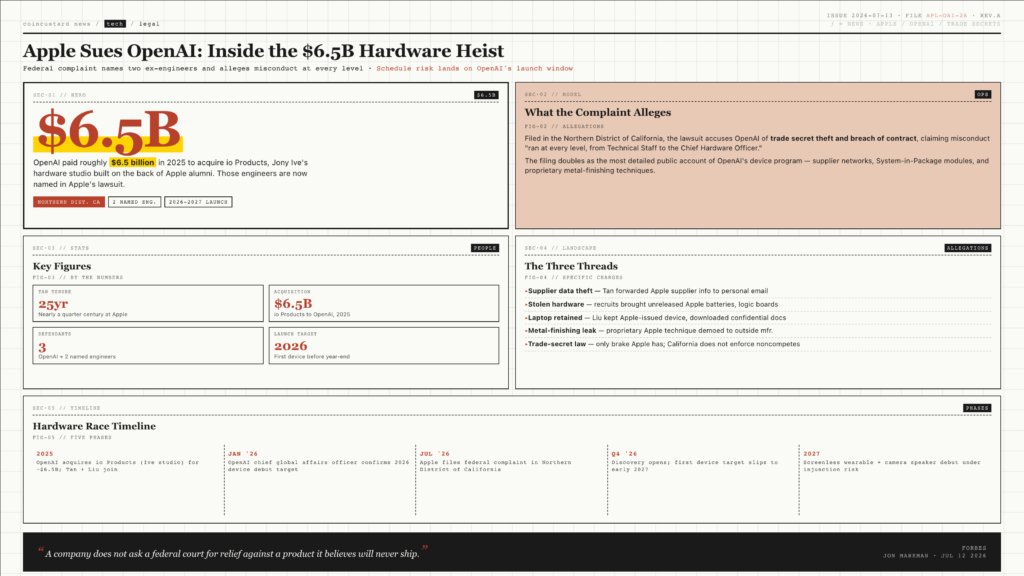
Apple filed a federal lawsuit against OpenAI in the Northern District of California on Friday, accusing the artificial intelligence company of orchestrating a coordinated campaign to steal trade secrets tied to its next-generation hardware program. The complaint, the most detailed public account of OpenAI’s secretive device effort to date, names two former Apple engineers and alleges that misconduct “ran at every level, from members of its Technical Staff to its Chief Hardware Officer.”
The lawsuit lands at an awkward moment for one of the strangest partnerships in consumer technology. Two years ago, Apple gave OpenAI the most valuable real estate in the industry: native ChatGPT integration inside the iPhone operating system. On Friday, the same company asked a federal court to treat OpenAI as a thief. The complaint doubles as a warning shot across the bow of OpenAI’s consumer hardware program, which is racing toward a launch window at the end of this year and into early 2027.
What the Complaint Alleges
The central figure is Tang Yew Tan, a veteran Apple product designer who spent nearly a quarter century overseeing hardware for the iPhone and Apple Watch. Tan co-founded io Products, the design studio built with former Apple design chief Jony Ive, before OpenAI acquired the company for roughly $6.5 billion in 2025. According to the filing, Tan forwarded Apple supplier information to his personal email before leaving the company, coached incoming recruits on how to navigate Apple’s departure procedures, and directed candidates interviewing at OpenAI to bring hardware from unreleased Apple products to their interviews as show-and-tell.
The complaint also names Chang Liu, a senior systems electrical engineer who allegedly kept an Apple-issued laptop after joining OpenAI this year and used it to download confidential technical documents. A third thread claims that OpenAI demonstrated a proprietary Apple metal-finishing technique to a manufacturing partner while leading the partner to believe Apple had approved the disclosure.
OpenAI has rejected the allegations. “We have no interest in other companies’ trade secrets,” the company said in a statement. Apple is asking the court to bar OpenAI from keeping or using the materials and to order their return.
Apple’s complaint alleges misconduct “ran at every level, from members of its Technical Staff to its Chief Hardware Officer.”
The Device Program in Apple’s Filing
Every item Apple chose to highlight sketches a piece of the device OpenAI has never publicly announced. System-in-Package modules are how engineers fit a computer into something the size of a hearing aid. Supplier relationships are what a company needs when a prototype becomes a production line. A metal-finishing technique matters to a team deciding how mass-manufactured hardware feels in a customer’s hand.
By protecting these secrets, Apple has confirmed which secrets a consumer AI device actually requires. The public record fills in the rest of the picture. OpenAI’s chief global affairs officer told Axios in January that the company aims to debut its first device before the end of this year, and subsequent reporting describes a screenless wearable and a smart speaker with a camera, with parts of the lineup slipping toward early 2027. Whatever the final form factor, Apple’s filing treats the program as far along. A company does not ask a federal court for relief against a product it believes will never ship.
The Battle Over Next-Generation Hardware
That is also what makes the suit a schedule risk for OpenAI. Discovery reaches into its hardware lab at the exact moment the lab is racing a launch window, and an early injunction, if Apple wins one, lands on the program’s critical path. The lawsuit effectively forces OpenAI to defend its device business in open court while it tries to ship that business to consumers.
The filing also highlights the deep entanglement between the two companies. Apple has integrated OpenAI’s ChatGPT into the iPhone’s Siri and writing tools, while announcing a parallel multi-year partnership with Google to bring Gemini models into Apple Intelligence features. That two-track strategy reflects Apple’s stated desire to keep its AI options open while OpenAI builds a hardware platform that, if successful, would compete directly with the iPhone for the next generation of consumer attention.
The California Hiring Question
OpenAI has shown it can buy nearly every input it needs. Compute arrives through multi-year cloud commitments, capital through the largest private fundraises on record, distribution through a chatbot used by hundreds of millions of people. Consumer hardware runs on a scarcer input: engineers who have shipped miniaturized electronics at hundred-million-unit scale, and the overwhelming majority of them trained at one company in Cupertino.
Hiring those people is legal. California famously does not enforce noncompete agreements, which is why trade-secret law is the only brake Apple has on the movement of its own alumni. The conflict surfaces in a courtroom rather than in an offer letter. Apple’s bet is that the courtroom is enough.
What Comes Next
The Northern District of California is one of the fastest venues for complex commercial litigation, and Judge Beth Freeman, who has not yet been assigned the case, will set the discovery schedule and trial calendar in the coming weeks. OpenAI’s lawyers will almost certainly move to narrow the complaint, while Apple’s team will press for expedited discovery into Tan’s and Liu’s devices and communications.
For investors in OpenAI’s private rounds, the suit introduces a new kind of risk. Hardware programs already burn cash at unusual rates. Adding a federal trade-secrets case to the timeline, and the possibility of an injunction that could delay a launch, is the kind of disclosure that complicated the most recent funding round. For Apple, the calculus is simpler. The company has spent two decades building a hardware advantage, and it has decided, in a 50-page federal complaint, that the legal system is worth the fight.