
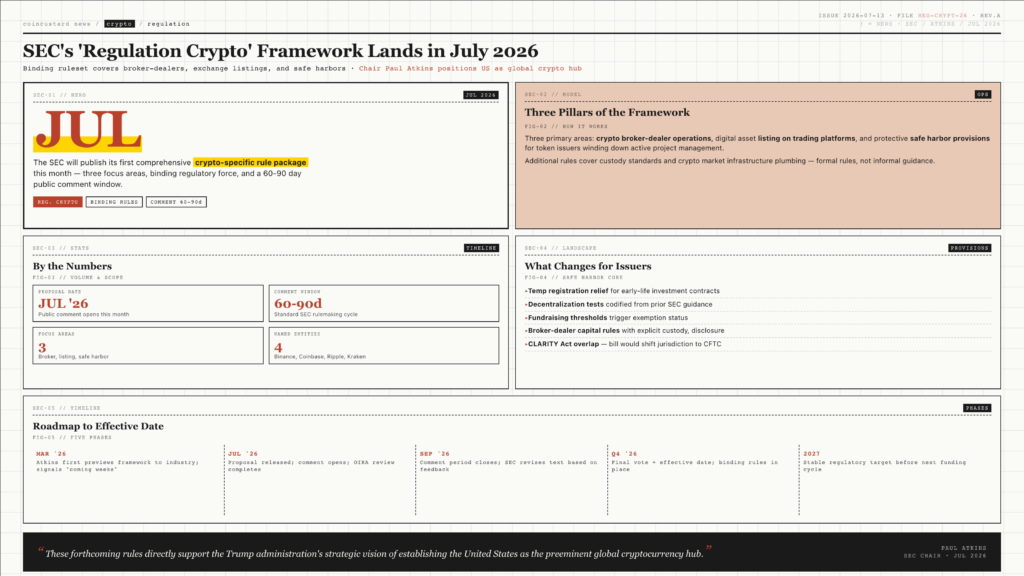
The U.S. Securities and Exchange Commission is on track to release its first comprehensive cryptocurrency regulatory framework this month, a package that will introduce conditional exemptions from securities registration rules for token issuers, brokers, and trading platforms. The proposal, branded “Regulation Crypto,” represents the most consequential digital-asset rulemaking effort in the agency’s history and the clearest signal yet that Washington intends to put the United States at the center of the global crypto industry.
SEC Chair Paul Atkins unveiled the updated regulatory roadmap on Tuesday, framing the framework as direct support for the Trump administration’s stated goal of making America “the preeminent global cryptocurrency hub.” Atkins first previewed the approach in March 2026, projecting implementation “in the coming weeks.” The July timeline now appears on the agency’s official calendar, although the proposal still sits with the White House Office of Information and Regulatory Affairs for final review.
Three Pillars of the Framework
The Regulation Crypto package covers three primary areas. First, the framework sets new rules for cryptocurrency broker-dealer operations, bringing a class of intermediaries that has long operated in regulatory limbo under formal oversight. Second, it addresses digital asset listings on trading platforms and national securities exchanges, codifying how tokens move from private markets to public venues. Third, and most closely watched by founders, it establishes protective safe harbor provisions for token issuers who are deliberately winding down active project management.
Additional provisions address digital asset custody standards and the plumbing of crypto market infrastructure. Unlike the no-action letters and informal guidance the agency has leaned on for the past decade, these measures are binding regulations with substantial legal weight, which makes them much harder for a future commission to reverse.
What Changes for Token Issuers
Under the proposal, developers launching cryptocurrency investment contracts would receive temporary registration relief during the early life of a project. The framework also sets prescribed fundraising thresholds and offers legal protections for issuers who are actively reducing operational control over their digital assets, a structure that mirrors the “sufficient decentralization” tests that have been debated in token circles since the 2018 ICO boom.
The package builds on the SEC’s inaugural digital-asset taxonomy released earlier this year, which set classification standards for various token types and their corresponding regulatory treatment. Parallel efforts are underway to develop specific rules for tokenized securities, the rapidly growing class of traditional assets such as stocks, bonds, and money-market fund shares that are being represented on blockchains.
“These forthcoming rules directly support the Trump administration’s strategic vision of establishing the United States as the preeminent global cryptocurrency hub.” — Paul Atkins, SEC Chair
Congressional Friction and the CLARITY Act
The push has not been without resistance. Democratic legislators have criticized the commission for what they describe as reduced enforcement intensity against entities connected to the Trump administration, including Binance, Coinbase, Ripple Labs, and Kraken. In January, three Democratic House members sent a letter to Atkins warning that the SEC’s withdrawal from enforcement proceedings has created investor protection gaps, particularly given that federal courts have already classified certain tokens as securities.
The broader contest is playing out alongside the proposed CLARITY Act, a market-structure bill that would transfer substantial SEC crypto oversight to the Commodity Futures Trading Commission. That legislation is currently stalled in Congress. Atkins has signaled the agency will continue moving forward on its own track but is prepared to defer to Congressional authority if a comprehensive framework passes.
From Trump Skepticism to Strategic Politics
The crypto turn in Washington marks a striking reversal for the political coalition now in power. Donald Trump publicly admitted on Monday that his engagement with cryptocurrency was “a little bit for politics,” a candid acknowledgment that contrasts sharply with his first-term posture, when he characterized Bitcoin as fraudulent before repositioning himself ahead of the 2024 election.
That shift has reshaped the commission’s priorities. Atkins, sworn in as chair in April 2025, has dropped several high-profile cases against crypto companies and signaled that the agency’s posture toward enforcement is changing. The pace of new rulemaking, by the commission’s own count, is unprecedented for the sector.
Why July Matters
If the proposal is published on schedule, the SEC will open a public comment period that typically runs sixty to ninety days. After the comment window closes, the agency will revise the text, hold a final vote, and set effective dates. A July release means the final rule could be in place before the end of 2026, which would give platforms and issuers a stable regulatory target before the next major fundraising cycle begins.
For startups, the safe harbor is the most consequential piece. Founders who have spent the past several years structuring token launches to dodge enforcement actions will, for the first time, have a federally defined path that protects them from securities claims if they hit specific decentralization milestones. For brokers and exchanges, the new rules will clarify capital, custody, and disclosure obligations that have been inconsistently enforced across the industry.
The central question facing the sector is whether formal SEC rules will arrive before Congressional action on the CLARITY Act. The agency’s preferred path is a unilateral rule that establishes a federal floor. Lawmakers prefer a negotiated division of labor between the SEC and the CFTC. For the moment, Atkins holds the pen, and the calendar shows July.