
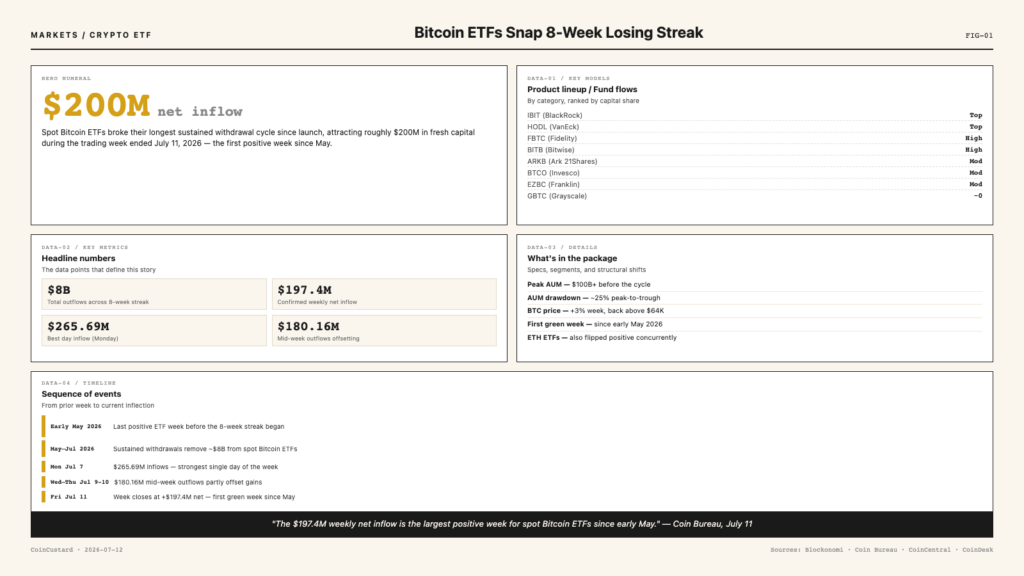
Spot Bitcoin exchange-traded funds snapped an eight-week losing streak during the trading week that ended July 11, 2026, attracting approximately $200 million in net inflows and posting their first positive week since May. The reversal breaks one of the longest sustained withdrawal cycles these investment vehicles have ever recorded, and it is being read across the industry as a tentative signal that institutional appetite for Bitcoin exposure may be returning after months of capitulation.
Across the previous eight weeks, market participants withdrew more than $8 billion from the spot Bitcoin ETF complex, a sustained withdrawal that dragged prices below the $60,000 level and put pressure on miners, treasury companies, and the broader crypto market. The new inflows, while modest by historical standards, mark the first concrete break in that pattern and coincide with a roughly 3% recovery in Bitcoin’s market value above $64,000.
The Week’s Flow Pattern
The recovery was not uniform. The week’s strongest session came on Monday, when approximately $265.69 million entered the eleven spot Bitcoin funds. That single day accounted for the bulk of the weekly net inflow figure. Mid-week sessions told a more cautious story: combined withdrawals on Wednesday and Thursday totaled roughly $180.16 million, partially offsetting Monday’s surge before the market stabilized on Friday.
The intraweek volatility mirrors what analysts have called the current fragile state of institutional sentiment. Large allocators are clearly willing to add exposure on dislocations, but they are equally quick to take profits when prices recover. That pattern of buy-the-dip and sell-the-rip flow is consistent with a market that has not yet committed to a directional view.
Who Led the Inflows
BlackRock’s IBIT and VanEck’s HODL captured the largest share of the new money, according to fund flow trackers, with Fidelity’s FBTC and Bitwise’s BITB rounding out the top four. Smaller funds including Ark 21Shares’ ARKB, Invesco’s BTCO, and Franklin Templeton’s EZBC saw more modest but still positive flows. Grayscale’s GBTC, which has been a persistent drag on net flows since its conversion from a trust, posted near-zero flows during the week.
The BlackRock and Fidelity concentration is consistent with the broader trend of institutional consolidation around a small number of brand-name issuers. Asset allocators building strategic Bitcoin exposure are increasingly routing their dollars through the funds with the deepest liquidity, the most favorable fee structures, and the most reliable creation-and-redemption mechanics.
Fund flow analysts at Coin Bureau noted on social media that the $197.4 million weekly net inflow figure is the largest positive week for spot Bitcoin ETFs since early May, when the current outflow streak began.
What the Streak Reveals About the Market
The eight-week withdrawal cycle that preceded this week’s reversal removed more capital from the spot Bitcoin ETF complex than any comparable stretch since the funds launched in January 2024. The total of approximately $8 billion in outflows over two months is a striking number in absolute terms, but it is even more striking relative to the funds’ total assets. At the peak of the previous cycle, the eleven spot Bitcoin ETFs held more than $100 billion in combined assets. By the time the outflow streak bottomed, that figure had fallen roughly 25%.
The mechanical impact of that flow reversal is significant. ETF share redemptions force authorized participants to sell underlying Bitcoin on the open market, creating persistent selling pressure that compounds during withdrawal cycles. The break in the pattern means that selling pressure from ETF redemptions has paused, even if it has not yet flipped decisively into buying pressure at scale.
Macro Context Matters
The reversal in flows also reflects broader shifts in the macro backdrop. The Federal Reserve’s communication around its next rate decision has become less hawkish in recent weeks, with several FOMC members signaling openness to a cut later this year if disinflation continues. Treasury yields have eased from their peaks. Risk assets broadly have responded, with equities and credit both grinding higher.
For Bitcoin specifically, the macro tailwind is amplified by the asset’s increasing correlation with rate-sensitive growth trades. When the market prices in easier policy, Bitcoin tends to benefit disproportionately because its duration characteristics make it behave more like a long-duration risk asset than a pure inflation hedge. The current ETF flow reversal is consistent with that dynamic.
The Ethereum Picture
Spot Ethereum ETFs, which launched later and have a smaller asset base, also saw their first positive week in roughly the same timeframe. Combined net inflows into the nine spot Ether funds totaled tens of millions of dollars, breaking a comparable streak of weekly outflows. The simultaneous reversal in both Bitcoin and Ethereum ETF flows is a constructive signal for the broader digital asset complex, suggesting that the institutional demand reset is not Bitcoin-specific.
Whether the recovery sticks is the question that will define the next several weeks of price action. A single positive week, after eight negative ones, is a tentative signal at best. Bulls need to see this week’s inflows compounded by another positive week, ideally with broader participation across fund issuers and a more stable intraday flow pattern that suggests genuine accumulation rather than tactical rebalancing. Bears will point to the $180 million mid-week outflow as evidence that the selling pressure remains just below the surface. For now, the data has shifted from one-sided bearish to genuinely two-sided, and that alone is a meaningful change in the market’s character.