
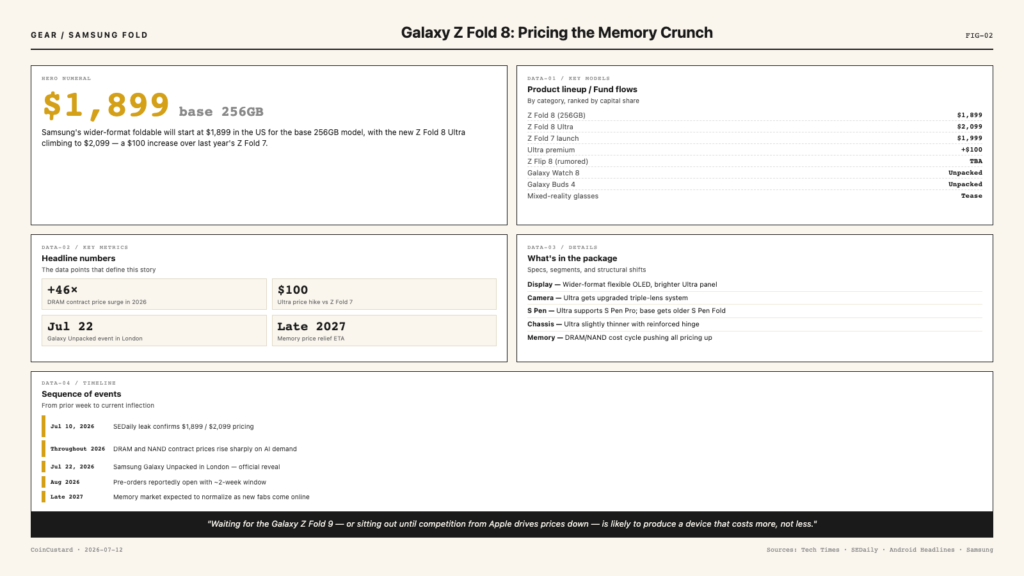
Samsung will unveil the Galaxy Z Fold 8 lineup at its Galaxy Unpacked event in London on July 22, and a pricing leak from Korean publication SEDaily has already given buyers their clearest look yet at what the next generation of foldables will cost. The base Galaxy Z Fold 8 will reportedly start at $1,899 in the United States for the 256GB configuration, while the new Galaxy Z Fold 8 Ultra will begin at $2,099. The Ultra pricing represents a $100 increase over the Z Fold 7’s launch price, and it lands at a moment when memory component costs are climbing sharply across the industry.
Samsung has not officially confirmed any pricing and will not do so before the Unpacked stage presentation. The leaked figures, however, are consistent with the broader trend toward premium pricing for foldable form factors and align with what industry analysts have been projecting since the spring.
Two Phones, Two Different Audiences
The 2026 foldable lineup breaks from Samsung’s recent naming convention in a meaningful way. The standard Z Fold 8 is positioned as Samsung’s wider-format productivity device, aimed squarely at users who treat the inner display as a primary workspace for multitasking, document review, and creative work. The Z Fold 8 Ultra, by contrast, is the direct successor to last year’s Z Fold 7 and inherits the Ultra badge to signal its positioning as the premium tier of the foldable family.
The two devices are not simply size variants. According to the SEDaily leak and corroborating reports, the Ultra introduces a more advanced camera system, a brighter display panel, and a slightly thinner chassis. Samsung is also rumored to be reserving its S Pen Pro support for the Ultra, leaving the standard Z Fold 8 compatible with the older S Pen Fold Edition. That product segmentation is consistent with how Samsung has historically structured its Galaxy S flagship line, where Ultra models command a meaningful premium for camera and display upgrades.
Why Prices Are Climbing
The $100 price increase on the Ultra is the most visible symptom of a deeper structural shift in the memory market. DRAM and NAND Flash contract prices have risen sharply through 2026, driven by surging demand from AI data centers, hyperscalers building out inference capacity, and the broader electrification of the consumer electronics supply chain. Industry analysts project that memory prices will continue rising through the remainder of 2026 and will not see meaningful relief until late 2027.
For Samsung, this creates a difficult pricing environment. The foldable category is already a high-cost manufacturing proposition, with yields on flexible OLED panels, hinge mechanisms, and ultra-thin glass all running below the equivalent components in conventional smartphones. Add a memory component inflation cycle on top of those structural costs, and the company has very little room to absorb the increase while preserving margins.
Memory analysts warn that DRAM contract prices are set to continue their 46-fold surge trajectory through 2026, with relief not expected before late 2027 as new fab capacity comes online.
The Buy-Now Argument
The conventional wisdom for years has been that consumer electronics prices fall over time as manufacturing scales and components commoditize. That wisdom does not apply to foldables in 2026. Buyers who wait for the Galaxy Z Fold 9 in 2027, or who sit out this cycle entirely in the hope that Apple entering the foldable category with its rumored 2028 device will drive prices down, are likely to find themselves paying more, not less.
This represents a notable inversion of the usual buy-versus-wait calculation. Historically, the wait-and-see approach rewards patient buyers with feature improvements and price reductions. In the current memory pricing environment, the wait-and-see approach may reward patient buyers with the privilege of paying a higher price for the same category of device. Samsung’s pricing reflects that dynamic.
What to Expect at Unpacked
Beyond the two foldables, Samsung is widely expected to use the July 22 London event to introduce additional products. The Galaxy Z Flip 8 is virtually certain to make an appearance, likely as the more accessible entry point into Samsung’s foldable ecosystem. Persistent leaks also point to new Galaxy Watch models, refreshed Galaxy Buds, and potentially a first look at Samsung’s long-rumored mixed-reality glasses.
The London venue itself is significant. Samsung has rotated its major Unpacked events between San Francisco, New York, Seoul, and Barcelona in recent years, but the choice of London for the 2026 summer event suggests the company is positioning this launch for a European audience that has historically been more receptive to premium-tier devices. London also offers a symbolically neutral venue at a moment when US-Asia trade tensions continue to complicate technology supply chains.
How Samsung Stacks Up Against Competition
The foldable category remains Samsung’s strongest differentiator in a smartphone market where Chinese competitors have largely closed the gap on conventional flagship hardware. Honor, Vivo, Oppo, and Xiaomi have all released competitive book-style and clamshell foldables in 2026, but Samsung’s vertical integration, software maturity, and carrier relationships continue to give it a structural advantage in Western markets. The pricing announcement on July 22 will set the tone for how aggressive Samsung intends to be in defending that position through the back half of 2026 and into 2027.