
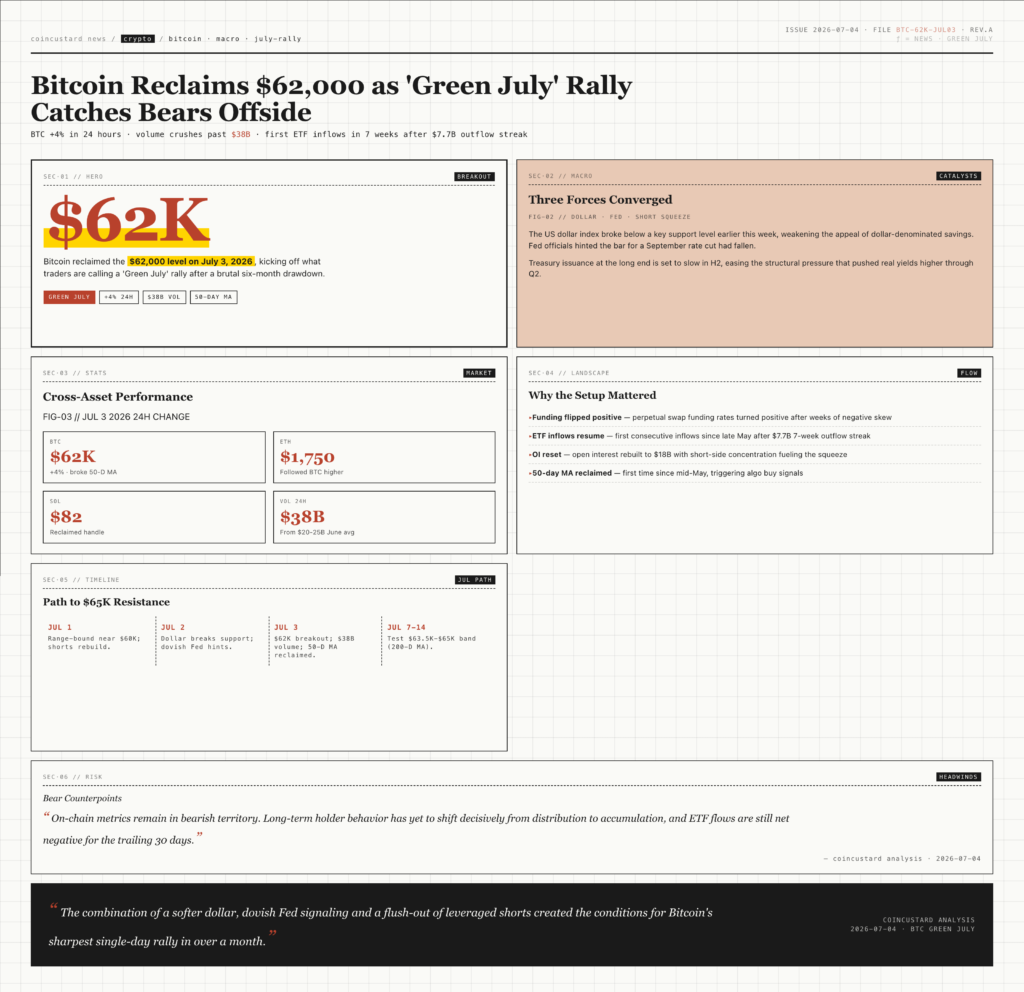
Bitcoin reclaimed the $62,000 level on July 3, 2026, kicking off what traders are calling a “Green July” for digital assets after a bruising six-month stretch that saw the leading cryptocurrency fall more than 25 percent from its early-year highs. The rally came on the back of improving macroeconomic signals, a softer US dollar and a wave of short covering that caught leveraged bears offside.
The move lifted BTC roughly 4 percent in 24 hours and pushed 24-hour trading volume above $38 billion across major exchanges, a meaningful jump from the depressed $20-to-25 billion range that dominated June. The bounce coincided with a broader risk-on rotation across asset classes following fresh commentary from Federal Reserve officials hinting that the next rate move could be a cut rather than a hold. Ethereum followed suit, climbing back toward the $1,750 mark and dragging the rest of the altcoin complex higher, with Solana reclaiming the $82 handle and BNB adding 3 percent on the day.
Why July 3 Mattered
July has historically been one of Bitcoin’s strongest months, with the asset posting positive returns in eight of the last ten Julys and an average gain north of 7 percent. The setup heading into Q3 2026 had several ingredients working in the bulls’ favor. Open interest in Bitcoin futures had reset to a more neutral footing after the June deleveraging, funding rates on perpetual swaps flipped back into positive territory, and spot Bitcoin ETFs in the United States — after a brutal 7-week stretch of net outflows totaling roughly $7.7 billion — posted their first consecutive days of net inflows since late May.
The technical picture also improved. Bitcoin broke above its 50-day moving average for the first time since mid-May, a level that had acted as stiff resistance for nearly seven weeks. With that line reclaimed, algorithmic systems that buy on moving-average crossovers were triggered into adding exposure, layering incremental demand on top of the fundamental shift in macro sentiment.
The Macro Backdrop
Behind the price action, three macro factors are doing the heavy lifting. First, the US dollar index broke below a key support level earlier this week, weakening the appeal of dollar-denominated savings relative to scarce digital assets. Second, several Fed officials — including regional bank presidents known for hawkish leanings — used recent speaking engagements to acknowledge progress on inflation and hint that the bar for a September rate cut had fallen. Third, treasury issuance at the long end of the curve is set to slow in the back half of the year, easing one of the structural pressures that had pushed real yields higher and weighed on risk assets through Q2.
Risks to the “Green July” Thesis
Not everyone is convinced the rally has legs. Several on-chain metrics remain in bearish territory — the percentage of Bitcoin supply in profit just climbed back above 70 percent but is still well below the 90 percent-plus readings that typically mark cycle tops, and long-term holder behavior has yet to shift decisively from distribution to accumulation. Meanwhile, exchange-traded fund flows, though positive this week, are still net negative for the trailing 30 days, meaning institutional demand remains fragile.
Geopolitics could also throw a wrench into the setup. Escalation in the Middle East, a sudden tightening of crypto regulations in a major economy, or a high-profile exchange hack would all be enough to derail the nascent risk-on rotation. For now, though, the tape is cooperating, and a successful test of the $65,000 level in the next two weeks would go a long way toward confirming that “Green July” is more than just a meme.
The combination of a softer dollar, dovish Fed signaling and a flush-out of leveraged shorts created the conditions for Bitcoin’s sharpest single-day rally in over a month.
What the Short Squeeze Tells Us
The single-day move had more than just fundamental fuel behind it. Leverage data shows that open interest on Bitcoin perpetual swaps had rebuilt to roughly $18 billion by mid-June, with a meaningful skew toward short positions. When price broke above the $60,800 area that had marked the top of the recent range, those shorts were forced to cover, creating a self-reinforcing bid that pushed BTC into the $62,000s within hours. That kind of mechanical squeeze is typically a feature of early-stage trend changes rather than the late stages of a bull move, which is one reason several analysts are pointing to it as evidence that the worst of the H1 2026 drawdown may be behind the market.
Historical July Tendency
Seasonality also supports the bull case. Bitcoin has posted positive returns in eight of the last ten Julys, with an average gain above 7 percent and a median gain closer to 5 percent. The pattern has been attributed to a combination of mid-year portfolio rebalancing, tax-driven selling pressure from Q1 having rolled off the books, and renewed risk appetite among institutional allocators who tend to set fresh budgets at the start of the third quarter. None of those factors is a guarantee, but together they form a backdrop that historically has rewarded bulls willing to lean into summer strength.
The Path Back to $65,000
For the “Green July” thesis to hold, Bitcoin needs to clear the next cluster of resistance around $63,500 to $65,000 — a band that aligns with the 200-day moving average and a series of lower highs from May and early June. A clean break above that zone on rising volume would almost certainly trigger another wave of short covering and probably pull sidelined capital off the sidelines. Failure to break it, on the other hand, would invite another round of range-bound chop and likely drag the broader altcoin complex back down with it. The next week of price action will go a long way toward determining which of those two paths the market takes.